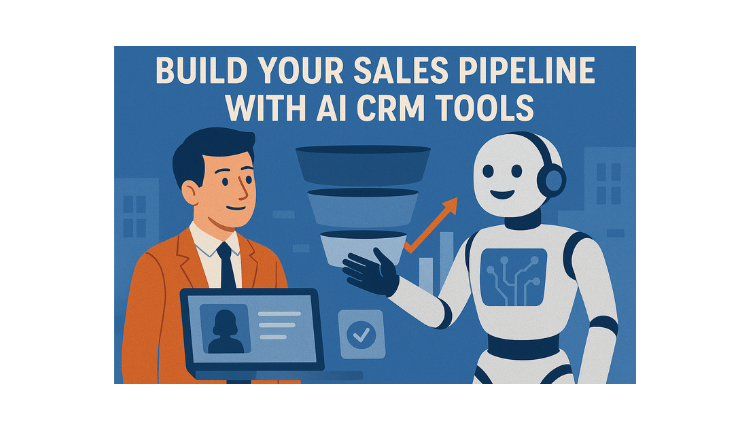
Build Your Sales Pipeline with AI CRM Tools
Introduction: The Evolution of Sales Pipelines in the AI Era
In today’s fast-paced business environment, maintaining a robust sales pipeline is more critical—and more challenging—than ever. Traditional CRM systems have long been the backbone of sales operations, but the integration of artificial intelligence has revolutionized how businesses build, manage, and optimize their sales pipelines. AI-powered CRM tools are not just automating routine tasks; they’re providing unprecedented insights, predicting customer behavior, and enabling personalized engagement at scale.
According to recent industry research, companies that embrace AI in their sales processes see an average 50% increase in leads and appointments, 60% reduction in call time, and 40-60% cost reductions. With these compelling statistics, it’s no wonder that 85% of sales professionals plan to increase their use of AI tools in the coming year.
This comprehensive guide explores how your business can leverage AI CRM tools to build a more efficient, data-driven sales pipeline that converts more prospects into loyal customers.“While AI tools make sales tracking easier, pairing them with Digital Marketing Services ensures that leads actually keep flowing into your pipeline.”
Understanding AI-Enhanced Sales Pipelines
What Makes AI CRMs Different from Traditional Systems
Traditional CRM systems excel at data storage and basic reporting, but AI CRMs take capability to an entirely new level. The fundamental difference lies in how these systems approach data:
- Traditional CRMs are retrospective, showing what has already happened
- AI CRMs are predictive and prescriptive, forecasting what will happen and suggesting optimal actions
AI-powered systems continuously learn from interactions, transactions, and outcomes to improve their recommendations and automate increasingly complex processes. This shift from passive data repositories to active sales assistants marks a paradigm shift in pipeline management.
Key AI Capabilities Transforming Sales Pipelines
The integration of artificial intelligence into CRM platforms provides several game-changing capabilities:
- Predictive lead scoring: Automatically ranking prospects based on their likelihood to convert
- Sales forecasting: Delivering more accurate revenue predictions based on pipeline analysis
- Conversation intelligence: Analyzing sales calls to identify successful patterns
- Buying signal detection: Flagging prospects demonstrating purchase intent
- Automated engagement: Initiating timely, personalized communications at scale
These capabilities address the most persistent challenges in pipeline management: identifying quality leads, prioritizing opportunities, and maintaining consistent follow-up.
Top AI CRM Tools for Modern Sales Pipelines
Enterprise-Level Solutions
For large organizations with complex sales processes:
- Salesforce Einstein: Salesforce’s AI layer provides predictive lead scoring, opportunity insights, and automated activity capture. Its strength lies in seamless integration with the broader Salesforce ecosystem.
- Microsoft Dynamics 365 Sales Insights: Leveraging Microsoft’s AI capabilities, this solution offers relationship health scoring, conversation intelligence, and advanced forecasting tools.
- Oracle Sales: Combines AI-powered opportunity scoring with next-best-action recommendations and automated administrative tasks.
Mid-Market Solutions
For growing companies seeking powerful yet manageable systems:
- HubSpot Sales Hub: Offers AI-powered lead prioritization, email sequence automation, and conversation intelligence in an intuitive platform.
- Zoho CRM Plus: Features Zia, an AI assistant that provides anomaly detection, prediction capabilities, and automated workflow recommendations.
- Freshsales: Delivers AI-based lead scoring, predictive contact scoring, and activity capture in a user-friendly interface.
Solutions for Small Businesses and Startups
For organizations with limited resources but ambitious growth goals:
- Pipedrive with AI Sales Assistant: Provides deal progress tracking, activity suggestions, and performance insights with a focus on simplicity.
- Keap (formerly Infusionsoft): Combines CRM, marketing automation, and e-commerce with AI-powered contact scoring and follow-up recommendations.
- Zendesk Sell: Offers AI-driven lead scoring, activity capture, and email engagement tracking in an easy-to-implement solution.
Implementing AI CRM for Pipeline Optimization
Assessment and Planning
Before implementing an AI-powered CRM solution, conduct a thorough assessment of your current sales process:
- Document your existing sales pipeline stages from lead generation to close
- Identify bottlenecks and inefficiencies where AI could make the biggest impact
- Determine key performance indicators (KPIs) that matter most to your business
- Audit your current data quality and quantity, as AI systems require clean, comprehensive data
- Evaluate team readiness for adopting new technology and processes
This preparation phase is crucial for selecting the right solution and ensuring successful implementation.
Integration and Data Migration Strategies
A successful AI CRM implementation requires careful attention to data integration:
- Start with a data cleanup to remove duplicates and standardize formats
- Develop a phased migration plan rather than attempting a complete cutover
- Integrate with existing marketing tools and customer service platforms
- Establish data governance policies to maintain quality as new information enters the system
- Create automated data enrichment workflows to continuously improve contact information
Remember that AI systems are only as good as the data they’re trained on—prioritize data quality from day one.
Training and Adoption Best Practices
Even the most powerful AI CRM will fail without proper user adoption:
- Provide role-specific training focused on daily workflows rather than features
- Identify and empower internal champions who can support their peers
- Create clear standard operating procedures for critical pipeline activities
- Establish metrics for system usage and tie them to performance evaluations
- Collect and implement user feedback to continuously improve the system
Successful adoption requires both initial training and ongoing reinforcement of best practices.
Leveraging AI for Each Pipeline Stage
Lead Generation and Qualification
AI transforms the traditionally labor-intensive process of finding and qualifying leads:
- Automated web visitor identification turns anonymous traffic into named prospects
- Predictive lead scoring helps sales teams focus on high-potential opportunities
- Behavioral analytics identify patterns that indicate purchase intent
- Automated enrichment adds valuable context to basic contact information
- Account-based insights reveal organizational relationships and influence patterns
These capabilities ensure that only qualified prospects enter your pipeline, improving efficiency throughout the sales process.
Nurturing and Relationship Building
AI excels at maintaining engagement with prospects throughout longer sales cycles:
- Personalized content recommendations based on prospect interests and behavior
- Optimal timing suggestions for follow-up communications
- Sentiment analysis to gauge prospect receptiveness
- Automated, personalized email sequences that adjust based on recipient engagement
- Buying team identification to ensure all decision-makers are engaged
These tools help maintain momentum with prospects who aren’t ready to buy immediately, preventing opportunities from stalling out.
Opportunity Management and Closing
As deals progress toward closing, AI provides critical insights and support:
- Win probability predictions updated in real-time as deals progress
- Competitive intelligence suggestions based on deal characteristics
- Pricing optimization recommendations to maximize deal value
- Risk alerts when deals show signs of stalling or competitor influence
- Digital sales rooms with AI-powered content recommendations for buyers
These capabilities help sales teams prioritize their closing efforts and take the most effective actions to secure revenue.
Measuring Success and Continuous Improvement
Key Metrics for AI-Enhanced Pipelines
Evaluate the impact of your AI CRM implementation with these critical metrics:
- Lead-to-opportunity conversion rate: Are you identifying better prospects?
- Sales cycle length: Is AI helping accelerate deals through the pipeline?
- Average deal size: Are predictive insights helping maximize opportunity value?
- Forecast accuracy: Has AI improved your ability to predict results?
- Pipeline velocity: How quickly are opportunities moving through each stage?
- Rep productivity: Are salespeople spending more time selling and less on administration?
Track these metrics before and after implementation to quantify your ROI.
Using AI for Sales Coaching and Team Development
Beyond pipeline management, AI CRMs offer powerful tools for developing sales talent:
- Conversation intelligence identifies successful talk patterns and coaching opportunities
- Deal guidance helps newer reps navigate complex sales processes
- Best practice identification from top performers’ activities
- Personalized coaching recommendations based on individual performance data
- Automated skills gap analysis to focus training efforts
These capabilities help sales leaders scale their coaching efforts across distributed teams.
Future-Proofing Your Sales Pipeline
The AI CRM landscape continues to evolve rapidly. Stay ahead with these strategies:
- Allocate resources for regular system updates and new feature adoption
- Participate in user communities to learn emerging best practices
- Develop an AI ethics framework to ensure responsible technology use
- Create a regular cadence for reassessing processes as capabilities advance
- Invest in ongoing data science skills within your sales operations team
Organizations that view AI CRM as a journey rather than a destination will continue to gain competitive advantage as technology evolves.AI CRM tools give you the system, but real growth needs strategy. Explore our IT & Digital Services to build a sales pipeline that never runs dry.”