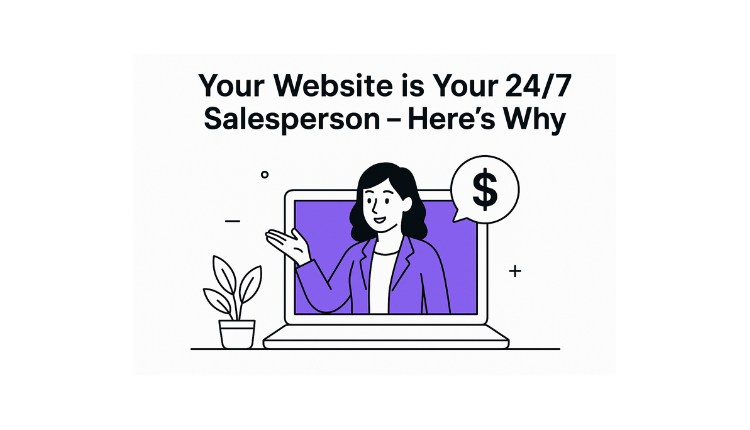
“Your Website is Your 24/7 Salesperson – Here’s Why”
In today’s digital age, your website is more than just an online presence—it’s a tireless salesperson working around the clock to attract, engage, and convert visitors into customers. Unlike a human salesperson, your website never sleeps, never takes a break, and can reach a global audience instantly. In this guide, we’ll explore why your website is your most valuable sales asset, how to optimize it to reflect your brand, and actionable steps to make it a conversion powerhouse. Plus, we’ve included a free checklist to ensure your website is sales-ready!
Why Your Website is Your 24/7 Salesperson
A well-designed website does the heavy lifting of a traditional salesperson by guiding visitors through the buyer’s journey, from awareness to purchase. Here’s why it’s indispensable:
- Always Available: Operates 24/7, reaching customers across time zones without downtime.
- Scalable Reach: Connects with thousands (or millions) of visitors simultaneously.
- Brand Ambassador: Communicates your brand’s values, personality, and unique selling points.
- Data-Driven: Collects insights on visitor behavior to refine sales strategies.
- Cost-Effective: Delivers consistent results without the recurring costs of a sales team.
Step-by-Step Guide to Make Your Website a Top-Performing Salesperson
Follow these steps to transform your website into a dynamic sales tool that works tirelessly to grow your business.
Step 1: Define Your Website’s Sales Goals
Your website’s purpose should align with your business objectives. Common sales goals include:
- Generating leads (e.g., form submissions, email sign-ups)
- Driving direct sales (e.g., e-commerce purchases)
- Building trust and credibility (e.g., showcasing testimonials)
- Educating prospects (e.g., through blogs or resources)
Pro Tip: Use the SMART framework (Specific, Measurable, Achievable, Relevant, Time-bound) to set clear goals. For example, “Increase lead form submissions by 15% in Q2 2026.”
Step 2: Know Your Audience
A great salesperson understands their customer, and your website should too. Research your target audience to tailor your content and design:
- Demographics: Age, location, gender, or profession.
- Pain Points: What problems are they trying to solve?
- Preferences: What motivates their purchasing decisions?
- Behavior: How do they interact with websites (e.g., mobile vs. desktop)?
Example: If you’re selling fitness gear to millennials, highlight vibrant visuals, customer reviews, and mobile-friendly navigation to match their preferences.
Step 3: Craft a Compelling Brand Aesthetic
Your website’s design is its “first impression.” A cohesive brand aesthetic builds trust and makes your site memorable. Here’s how to align it with your brand:
- Color Palette: Use 2-3 primary colors that reflect your brand identity (e.g., blue for trust, red for energy).
- Typography: Choose clean, readable fonts that match your brand’s tone (e.g., modern sans-serif for tech, elegant serif for luxury).
- Imagery: Use high-quality images or custom graphics that resonate with your audience.
- Consistency: Ensure your logo, colors, and fonts are uniform across all pages.
Tip: Create a style guide to maintain consistency. Tools like Canva or Adobe Express can help design visuals that align with your brand.
Step 4: Optimize for User Experience (UX)
A seamless user experience keeps visitors engaged and guides them toward conversion. Focus on:
- Navigation: Use a clear menu structure with intuitive categories (e.g., Home, About, Shop, Contact).
- Mobile Optimization: Ensure your site is responsive, as over 50% of web traffic comes from mobile devices.
- Page Speed: Aim for load times under 3 seconds using tools like Google PageSpeed Insights.
- Clear CTAs: Include prominent calls-to-action (e.g., “Shop Now,” “Get a Quote”) on every page.
Example: Place a “Buy Now” button above the fold on product pages to drive immediate action.
Step 5: Create High-Converting Content
Your website’s content is its sales pitch. Craft messaging that persuades and converts:
- Homepage: Highlight your value proposition (e.g., “Premium Skincare, Delivered Fast”).
- Product/Service Pages: Use clear descriptions, benefits-focused copy, and high-quality visuals.
- Testimonials: Showcase customer reviews or case studies to build credibility.
- Blog/Resources: Offer valuable content to educate and nurture leads.
- SEO Optimization: Use relevant keywords to attract organic traffic.
Pro Tip: Write headlines that grab attention, like “Transform Your Skin in 30 Days” instead of “Our Products.”
Step 6: Implement Conversion Tools
Equip your website with tools to capture leads and drive sales:
- Lead Magnets: Offer free resources (e.g., eBooks, checklists) in exchange for email addresses.
- Pop-Ups: Use exit-intent pop-ups to retain visitors with special offers.
- Live Chat: Add tools like Intercom to answer questions in real-time.
- Analytics: Use Google Analytics or Hotjar to track visitor behavior and optimize performance.
Example: A “Download Our Free Website Checklist” pop-up can capture leads while providing value.
Step 7: Test and Refine
A great salesperson adapts, and so should your website. Continuously test and improve:
- A/B Testing: Experiment with different headlines, CTAs, or layouts to see what converts best.
- Analytics Review: Monitor metrics like bounce rate, time on page, and conversion rate.
- Feedback: Collect user feedback via surveys or heatmaps to identify pain points.
Tip: Tools like Optimizely or Google Optimize make A/B testing easy and data-driven.
Step 8: Download Our Free Website Optimization Checklist
To help you turn your website into a 24/7 salesperson, we’ve created a free checklist. This downloadable resource includes:
- Key elements for a sales-driven website
- UX and design best practices
- SEO and content optimization tips
- Tools to track and improve performance
Download the Free Website Optimization Checklist Here (Note: Replace with actual link to downloadable checklist.)
Best Practices for a Sales-Driven Website
- Stay Consistent: Align your website’s design and messaging with your brand across all channels.
- Prioritize Speed: Compress images and minimize code to ensure fast load times.
- Build Trust: Include trust signals like SSL certificates, customer reviews, and secure payment options.
- Update Regularly: Refresh content and visuals to keep your site relevant and engaging.
- Track Performance: Use analytics to measure success and identify areas for improvement.
Common Challenges and Solutions
- Challenge: High bounce rates.
- Solution: Improve page speed, simplify navigation