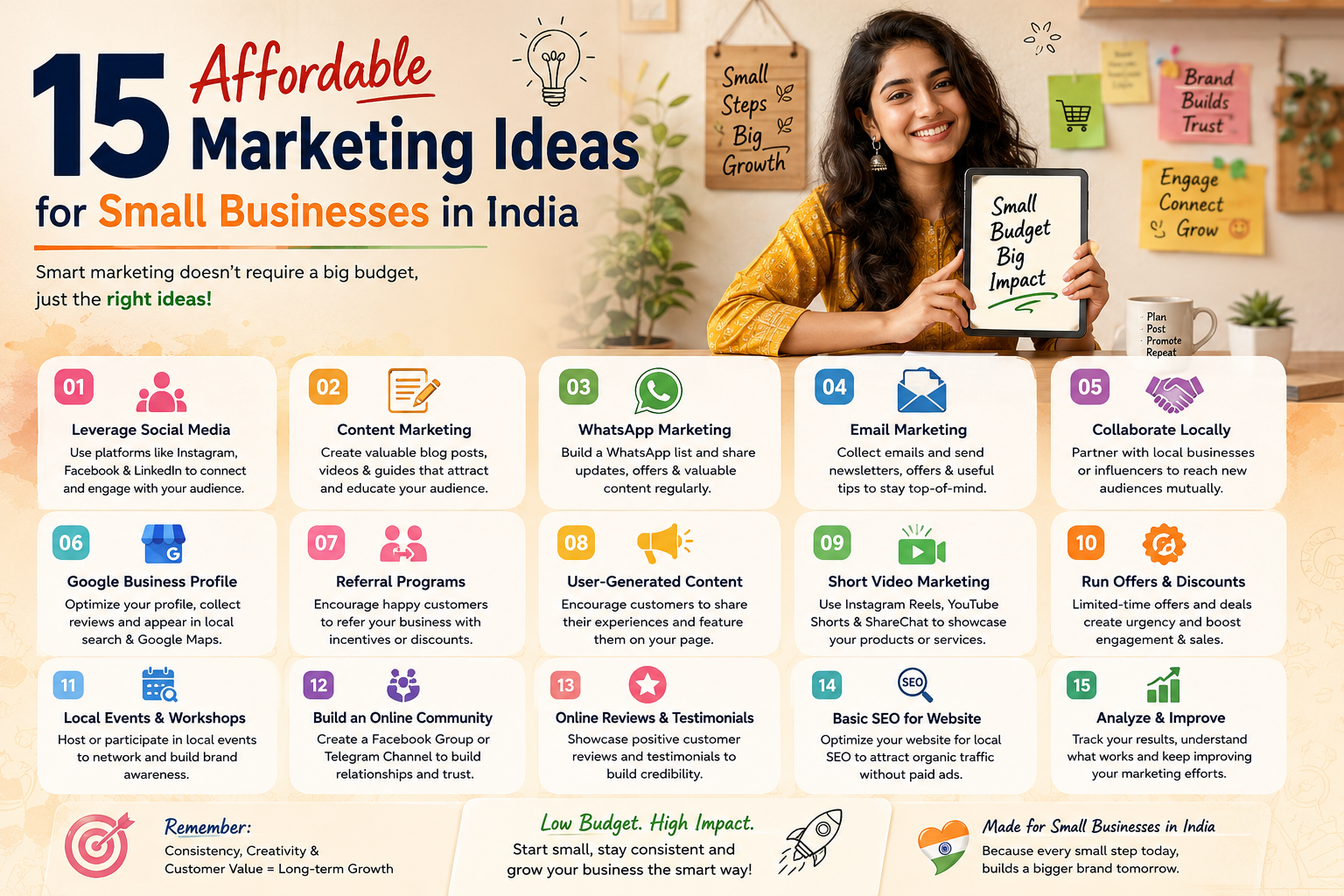
15 Affordable Marketing Ideas for Small Businesses in India (2026 Guide)
Written by a digital marketing consultant with 10+ years of experience working with small and medium businesses across Gujarat and India.
Bhaveshbhai has been running the same hardware shop in Nikol, Ahmedabad for nineteen years. His father opened it. He took it over. Now his teenage son helps on Saturday afternoons. Every wall is lined with fasteners, fittings, and tools — the kind of institutional knowledge that only comes from two generations of serving the same neighbourhood.
Two years ago, a national home improvement chain opened a large-format outlet three kilometres down the road. Air conditioning. Big parking lot. Weekend discounts on FM radio. Within four months, Bhaveshbhai's daily footfall had dropped by nearly a third.
When I met him, he was calculating the cost of newspaper ads. He had a number in his head — around ₹40,000 — and he was ready to spend it.
"Roko," I told him. Wait.
Six months later, spending roughly ₹3,000 a month, his footfall was higher than it had been before the chain arrived. Not because he outspent them — he couldn't. Because he out-connected them, using tools that cost almost nothing and required only consistency to work.
This article documents exactly what he did — and fourteen more ideas like it, drawn from a decade of working with businesses across Gujarat and India. Every idea here is either free or nearly free. All of them work. None of them work without consistency.
What Google's Own Research Says About Small Business Marketing
Before the list, a piece of context that shapes everything on it.
Google's Think With Google research has consistently found that the majority of purchase decisions — even for physical products bought in physical shops — begin with an online search. For local service businesses in India, this number is growing every year. A customer who needs a plumber in Paldi, a tailor in Rajkot, or a CA in Gandhinagar is increasingly likely to search Google before asking a neighbour.
This matters because it means that even the most "offline" marketing strategies — referral programs, community sponsorships, loyalty cards — now work best when combined with a visible online presence that makes it easy for referred customers to find, verify, and contact you.
The fifteen ideas below are organised with that in mind: they build visibility, trust, and referral pathways simultaneously, across both online and offline touchpoints.
One principle before anything else: The failure I see most often in small business marketing is not choosing the wrong platform — it is choosing every platform at once and doing all of them badly. A garment trader in Surat, a physiotherapist in Vadodara, a catering business in Gandhinagar — I have watched each of them launch Instagram, Facebook, YouTube, JustDial, and Google Ads in the same month, burn out after six weeks, abandon everything, and conclude that "digital marketing doesn't work." It works. The approach was wrong. Pick three of these fifteen ideas. Commit seriously for six months. Then add more.
Organic Social Media: Free, But Only If Done With Intention
1. Post content that earns attention, not just space in a feed
Walk through Instagram for ten minutes and count how many small business accounts are posting generic "Good Morning" graphics and festival greetings that could have been created by any business in any city. These posts do not build customers. They fill a feed.
The test to apply before posting anything: "Would a customer share this? Would it make someone think of my business the next time they need what I offer?"
Content that consistently earns attention for Indian small businesses:
Before-and-after posts work across almost every category. A tailor in Rajkot showing a dated blouse reconstructed into a contemporary design. A painting contractor in Ahmedabad showing a crumbling exterior wall versus a freshly finished one. A dentist in Surat (with appropriate privacy measures) showing a smile transformation. The visual contrast is compelling, the proof is immediate, and no caption is needed to convey competence.
Process videos are the format most small businesses underestimate. Thirty to sixty seconds of real work being done — a farsan maker in Maninagar frying fresh ganthia at six in the morning, a furniture carpenter in Anand assembling a teak dining table, a mehendi artist in Surat filling in a bridal design — cost nothing to make and earn genuine attention because people find skilled work genuinely interesting to watch. These videos regularly outperform professionally produced promotional content.
Expertise-based tips build trust faster than promotional posts. A CA posting "three things that trigger a GST scrutiny notice and how to avoid them" earns more credibility in one week than six months of "contact us for your tax needs" posts. The logic is simple: if you teach people something useful, they associate you with that knowledge — and when they need help with that problem, you are the obvious person to call.
Expert insight: Social media researcher and author Gary Vaynerchuk has documented extensively that small, local businesses consistently outperform large brands in local social media engagement when they focus on community-specific, genuine content rather than polished promotional material. His specific observation — backed by platform data — is that authenticity creates engagement that advertising budgets cannot replicate, and that small businesses have a structural advantage in authenticity because they are run by real people who know their customers personally.
What the data shows: Sprout Social's research consistently finds that video content generates 48% more engagement than static image posts across major platforms. On Instagram Reels specifically, short-form videos from small local businesses regularly outperform boosted posts from competitors with significantly larger budgets.
Practical implementation: Set a weekly content plan with three slots — one educational tip, one process or behind-the-scenes video, one customer outcome or testimonial (with permission). Batch-create content on Sunday for the coming week. This takes about 90 minutes weekly and eliminates the daily scramble that leads most business owners to post generic content or stop posting entirely.
2. WhatsApp Status as a daily business broadcast
This comes up in almost every marketing conversation I have with a small business owner, and the reaction is nearly always the same: they knew WhatsApp Status existed. They had just never thought of it as a marketing channel.
The reality is straightforward. Your WhatsApp contact list is your most valuable existing audience — people who have already bought from you, already have your number, and have already decided they trust you enough to keep you saved. Every time they open WhatsApp (which, for most Indian smartphone users, is dozens of times a day), your Status is there, free to view.
Post one Status every morning. A photo of today's fresh stock. A short clip of a completed job. A tip for the week. A customer's message with their permission. The content does not need to be polished — authentic and consistent is what works.
It costs nothing. It takes three minutes. And it keeps your name visible to the people who are most likely to buy from you again — or mention your name when a friend needs what you offer.
Practical implementation: Save a note on your phone with your "Status content calendar" — Monday: new stock or product highlight. Tuesday: tip or advice from your expertise. Wednesday: completed work or customer outcome. Thursday: behind-the-scenes or process. Friday: offer or reminder. Rotate and adapt as needed. The consistency of posting is more important than the variety of content.
Local SEO: Being Found Before Anyone Even Knows You Exist
3. Google Business Profile — the single highest-return free tool in local marketing
When someone searches "electrician near Paldi" or "saree shop Surat" or "tiffin service Vadodara" on Google, the first results they see are not websites. They see a map and three business listings — names, ratings, hours, photos, phone numbers — sitting at the very top of the page before any website result appears.
That map pack is where local purchase decisions are increasingly being made. Research from BrightLocal's Local Consumer Review Survey found that 93% of consumers used Google to find a local business in the past year, and that listings in the top three map positions receive the substantial majority of clicks and calls.
If you are not in those three for your key search terms, most customers searching for what you offer will never know you exist.
Getting into the map pack is achievable for almost any business — and free. Claim your Google Business Profile at business.google.com, complete every field including festival hours and product listings, upload a minimum of 20 photos, collect reviews consistently, and post at least once a week. We documented the complete process in our Google Business Profile Optimization article, but the core point is this: this single free tool, managed properly and consistently, is the highest-return marketing action available to any local business in India — bar none.
Expert insight: Darren Shaw, founder of Whitespark and one of the most widely cited researchers on local search ranking, has found in his annual Local Search Ranking Factors survey that Google Business Profile signals — specifically profile completeness, review recency, and posting activity — are among the top three factors determining which businesses appear in the local map pack. His research, conducted across thousands of businesses, consistently shows that complete, active profiles outrank inactive ones regardless of how long the inactive business has been operating.
Practical implementation: Block two hours this week to claim and complete your GBP if you have not already. If you have a listing, spend an hour auditing it against our full GBP checklist. Then set a calendar reminder for every Monday to post one update — an offer, a tip, a new photo, anything that signals to Google that your listing is active.
4. Free directory listings that strengthen your Google ranking
Google builds its assessment of your business's legitimacy and local authority by aggregating data from multiple sources across the internet. When your business appears consistently and accurately on multiple credible directories, it reinforces Google's confidence that your business is real, established, and trustworthy — which improves your local ranking.
For Indian businesses, the most valuable free listings:
- JustDial — one of the most actively searched local directories in India, with particularly strong usage for service categories
- Sulekha — strong for home services, beauty, education, tutoring, and coaching
- IndiaMart — essential for any business selling to other businesses; one of the most visited B2B platforms in India
- TradeIndia — particularly relevant for exporters and industrial manufacturers
- Yellow Pages India — smaller but consistently indexed by Google
- GCCI Directory — for Ahmedabad-area businesses, the Gujarat Chamber of Commerce directory is a locally credible citation
The non-negotiable rule: your business name, address, and phone number must be letter-perfect identical on every platform. Not approximately the same — identical. "Shop 4, Iscon Mall" on one platform and "S-4, Iscon Mega Mall" on another look like the same business to a human but create conflicting data signals for Google's algorithm, reducing the ranking benefit these listings provide.
Practical implementation: Spend two hours creating or updating your listings on each of the above platforms. Use a single "master format" for your business name, address, and phone — copy it exactly from platform to platform. Set a reminder to audit these listings every six months for accuracy.
5. Branded search — the tiny habit with a measurable ranking impact
When a customer completes a purchase, say: "Whenever you need us again or want to send someone our way, just search [your business name] on Google — we come up at the top."
This five-second habit trains customers to search specifically for your business name rather than a generic term. When enough people search your business name, Google interprets it as a popularity and recognition signal — which contributes, over time, to improved local ranking.
It also has a practical benefit: a customer who has searched your name and found your Google listing has now seen your reviews, your photos, and your contact details. They are more likely to contact you again than a customer who only has your number saved.
WhatsApp Marketing: The Channel India Was Built For
6. Broadcast lists that feel personal, not promotional
There is a distinction in WhatsApp Business that fundamentally changes how customers experience your messages. In a Group, everyone sees each other. In a Broadcast List, each person receives your message as a private, one-to-one message from your business — they see only your name, not a group header.
That difference matters. A message arriving as a personal message from a trusted business gets read. A message arriving in a group of 200 people gets muted.
WhatsApp Business (the free app) allows broadcast lists of up to 256 contacts. Use them for new stock arrivals, seasonal offers, service reminders, and tips that your customers will genuinely find useful. The non-negotiable rule: only add customers who have voluntarily given you their number and who know your business. Unsolicited messages get numbers reported, and a reported business number can be permanently blocked by WhatsApp — destroying a communication channel you have spent years building.
Practical implementation: Create three broadcast lists — "Regular customers," "Occasional customers," and "Prospects who enquired but haven't bought." Tailor your message frequency and content to each group. Regular customers can receive updates 2 to 3 times a month. Prospects should receive something valuable (a tip, a case study, a limited offer) rather than a direct sales message.
7. The WhatsApp Catalogue feature almost nobody uses
WhatsApp Business includes a Catalogue feature that the majority of small business owners in India have never opened. It allows you to upload product photos with prices, descriptions, and SKU codes, and share individual items or your entire catalogue with a customer in a single tap during any conversation.
For a kirana store in Vatva, a clothing boutique in Vadodara's Alkapuri, a home-based catering business in Paldi, or a stationery shop in Rajkot's Karanpara — this is a free, frictionless digital product display that lives inside the app your customers already use dozens of times daily.
Practical implementation: Open WhatsApp Business, tap the three-dot menu, go to Business Tools, then Catalogue. Add your top 20 products or services with clear photos and accurate prices. Share the catalogue link in your broadcast messages and on your WhatsApp Status once a week. Customers can browse, select, and share directly — reducing the friction between enquiry and purchase.
8. The follow-up message that systematically generates reviews and referrals
Send this message 48 hours after every purchase or completed service:
"Namaste! Hope everything went well with the [product/service]. If you are happy, a Google review from you genuinely helps us — most of our new customers find us that way. Here is the link: [review short link from your GBP dashboard]. And if you know anyone who could use [what you do], we would be glad to help them too."
This single message, sent consistently, does three things simultaneously: it resolves any dissatisfaction before it becomes a complaint or a negative review, it generates reviews while the experience is still fresh, and it opens a natural door to referrals.
A home painting contractor in Satellite, Ahmedabad, that I have worked with sends this message to every client after completing a job. He now has 67 Google reviews — all genuine, all from real clients. He estimates that 35 to 40 percent of his new clients come through referrals generated by this one WhatsApp habit. His total marketing spend is approximately ₹0 per month.
Practical implementation: Save this message as a template in your WhatsApp saved messages. Copy and personalise it for each client. Create a simple checklist or habit tracker — a note on your phone, a column in a spreadsheet — so no completed job goes without a follow-up.
Referral Programs: Making Word of Mouth Systematic
9. The structured bring-a-friend offer
Word of mouth is already happening for your business. Customers who are happy with you mention you to friends and family. The question is whether you are making it easy, frequent, and rewarding — or leaving it to chance.
A referral programme turns an occasional, organic behaviour into a predictable, systematic one. It does not require software, apps, or complexity. The simplest version:
Tell your best customers directly: "If you refer someone to us and they make a purchase, we will give you [a discount/a free item/priority booking] on your next order." Give the new customer a small first-visit incentive as well, so they arrive feeling welcomed rather than just transactional.
Track it with a simple WhatsApp message ("I was referred by Rameshbhai") or a physical card. That is enough infrastructure to start.
A mithai shop near Vasna in Ahmedabad introduced a straightforward referral offer — a free box of four ladoos (roughly ₹75 at cost) to any customer who referred someone who spent ₹500 or more. Within three months, nearly a quarter of their new customers were arriving through referrals. Their cost of acquiring each new customer: one box of sweets and a WhatsApp message. Their equivalent Google Ads cost to acquire the same customer, based on their category benchmarks, would have been roughly ₹300 to ₹500 per lead.
Expert insight: Marketing professor Philip Kotler, widely considered the father of modern marketing, has documented across decades of research that referred customers have a higher lifetime value, lower acquisition cost, and higher satisfaction rate than customers acquired through any paid channel. His research specifically notes that personal recommendations carry trust weight that no advertisement can replicate — and that small businesses are uniquely positioned to activate this channel because their relationships with customers are personal in a way that large chains cannot match.
10. The stamp card that protects repeat business
A printed loyalty card — ten boxes, one stamp per visit, tenth visit earns a meaningful reward — costs under ₹5 to print and dramatically improves repeat visit frequency.
The psychology behind this is well-documented. Once a customer has received three or four stamps, the card itself becomes a reason to return — they have already invested in the relationship and want to see it through. It works for chai tapris, salons, laundry services, farsan shops, bakeries, juice bars, opticians, and any business where customers make the same purchase repeatedly.
Practical implementation: Design a simple card at Canva (free) with your logo, ten boxes, and your offer ("10th visit free" or "10% off your 10th purchase"). Print 100 cards at a local print shop — approximately ₹400 to ₹500 for the batch. Hand one to every customer at the billing counter for the first two weeks, then offer to anyone who does not already have one.
11. Informal referral partnerships with complementary businesses
Look at your customer base and ask: what other businesses serve these same people without competing with me?
Your customers are likely using multiple businesses at roughly the same life stage or moment of need. A wedding photographer's clients are simultaneously booking mandap decorators, caterers, bridal boutiques, florists, mehendi artists, and photographers for mehendi night. None of these businesses compete. All of them are serving the same family during the same four-month planning window.
Referral partnerships in Gujarat that I have seen work consistently:
A CA firm in Rajkot formed informal referral arrangements with a company registration consultant and a GST software provider. Each business serves the same type of client — a new or growing business — at a different stage of that business's journey. Within a year, roughly 30 percent of the CA firm's new clients were coming through these two referral partners, at zero acquisition cost.
A gym in Ahmedabad partnered with a sports nutrition shop, a physiotherapist, and a sportswear retailer. Each one displays the others' cards at their counter. Each refers clients with specific needs to the appropriate partner.
The arrangement requires only a conversation, a mutual understanding of what each business offers, and a genuine commitment to only referring clients you believe will be well-served.
Community Marketing: The Oldest Strategy That Consistently Outperforms Most Digital Ads
12. Sponsor small, gain big
Local society garba events, school sports days, neighbourhood clean-up drives, and GIDC business association dinners all need sponsors. Costs typically range from ₹1,000 to ₹5,000 for banner placement, a name mention from the stage, and the kind of community goodwill that digital advertising cannot manufacture.
For a business serving a specific locality — a clinic, a tuition centre, a salon, a grocery delivery service — physical presence at local events builds recognition that compounds over time. When Dhruvilbhai from the society committee knows you personally, he mentions your business every time someone in his building asks for a recommendation. That recommendation carries a conversion rate that no Facebook ad can approach.
Practical implementation: Identify three community events in your area over the next three months. Contact the organiser directly — societies, school PTAs, and GIDC associations are typically easy to reach and genuinely appreciate local business support. Ask what the sponsorship includes, and make sure your banner includes your phone number and Google search term clearly.
13. Teach something genuinely useful and become the obvious expert
This is the highest-leverage free marketing strategy on the entire list — and by far the most underused.
Every business owner has specialised knowledge that their ideal customers would find valuable. The instinct is to protect that knowledge, to treat it as the reason customers need you. The reality, demonstrated consistently by businesses that have tried this approach, is the opposite: sharing expertise freely creates trust that advertising cannot buy, and that trust converts into paying clients at a rate that direct promotion cannot match.
Three Gujarat examples from the past 18 months:
A CA firm in Rajkot hosted a free 90-minute session at their GIDC business association on "three GST changes in the 2025 budget that directly affect manufacturers." They promoted it only through their existing network and a WhatsApp message. Forty-two business owners attended. The firm added eleven new clients in the following six weeks — every one of them an attendee who had already seen the team present, already assessed their competence, and needed no further sales process.
A home decor shop in Ahmedabad's Satellite area ran a free Saturday workshop: "how to style your living room for under ₹10,000." They taught genuinely useful content — colour psychology, furniture placement, lighting principles. At the end, they walked attendees through the products in their showroom that made each principle achievable. Eight of the twelve attendees made a purchase before leaving.
A nutritionist in Vadodara began hosting free monthly online sessions — what to eat during Navratri fasting that still maintains energy levels; how to adjust diet for Gujarat's summer heat. Her paid consultation waiting list is now three weeks long, filled entirely by people who attended a free session, experienced her knowledge directly, and decided they wanted more.
The principle is consistent: when you teach well and generously, you earn a level of trust that no promotional budget can replicate. And when attendees eventually need the paid version of what you shared, you are not just one option — you are the obvious one.
Practical implementation: Identify one question your ideal customer asks more than any other. Build a 60 to 90 minute session around answering it thoroughly and practically. Partner with a local business association, society committee, or community group to host it. Promote it two weeks in advance via WhatsApp Status and broadcast. Follow up with every attendee by WhatsApp within 48 hours.
14. Build genuine community presence before you promote in it
Every residential society in Ahmedabad has a WhatsApp group. Every GIDC estate has a traders' group. Every professional community has multiple groups. Being actively helpful in these spaces — answering questions, sharing relevant information, offering genuine advice in your area of expertise — builds a reputation that no advertisement can create.
The distinction that determines whether you benefit from community groups or get quietly muted is straightforward: help first, promote rarely.
If someone asks in the Nikol traders' group "does anyone know a reliable electrician for a commercial premises?" and you are that electrician, a direct reply with your number and a brief, specific description of your relevant experience is appropriate and helpful. Posting "BEST ELECTRICAL SERVICES — ALL WORK GUARANTEED — CALL NOW" twice a week is not.
Practical implementation: Join the three to five WhatsApp or Facebook groups most relevant to your business area and customer type. Set a rule: answer at least two genuine questions per week before posting anything promotional. Over three months, this builds a recognisable, trusted presence that generates enquiries organically.
15. Email — the channel with the highest ROI that Indian businesses almost never use
Campaign Monitor's research on email marketing ROI has been replicated across multiple studies and geographies: for every ₹1 invested in email marketing, the average return across industries is approximately ₹3,600. That is not a misprint. It is consistently the highest ROI of any digital marketing channel, and it holds across small businesses, large businesses, B2B, and B2C contexts.
The reason email outperforms every other channel is structural: you own the list. Instagram can change its algorithm tomorrow and your organic reach drops to 3%. Google can update its ranking system and your website traffic falls. But your email list belongs to you — no platform change, no algorithm update, no advertising cost increase can take it away.
For a small Indian business, getting started requires only a free MailChimp account (up to 500 contacts, 1,000 emails per month at no cost) and a commitment to sending one email per month. The content does not need to be elaborate: a feature product or service, a useful seasonal tip, a customer story, a festival offer, and your contact details. That is a complete email that serves your audience.
Practical implementation: Start collecting email addresses today. Ask at the billing counter: "Can I add you to our monthly updates? We share useful tips and occasional offers." Ask when someone WhatsApps for the first time. Add them to a spreadsheet with their name and the date added. When you reach 50 addresses, open a MailChimp account and send your first email — introduce yourself, share one useful tip, include a simple offer. After six months of consistent monthly sending, you will have a direct communication channel that outperforms every other marketing investment you are making.
Your 30-Day Marketing Start Plan
Rather than leaving you with fifteen ideas and no direction, here is a concrete four-week starting plan based on business type:
Retail shop or product business (Week 1): Claim and complete your Google Business Profile. Create your WhatsApp Catalogue with your top 20 products. Set up a broadcast list of your existing customers. Post your first WhatsApp Status. Week 2: Design and print 100 loyalty stamp cards. Print a counter QR code for Google reviews. Week 3: Identify one complementary business for a referral partnership and have the conversation. Post your first Google Post. Week 4: Start collecting email addresses. Send your first broadcast message with a monthly offer.
Service business (CA, clinic, salon, plumber, contractor) (Week 1): Claim and complete your GBP. Set up your WhatsApp follow-up message template. Send it to your last ten completed clients immediately. Week 2: Set up your referral offer and tell your top five clients about it. List your business on JustDial and Sulekha. Week 3: Plan your first free workshop or session. Set a date. Announce it on WhatsApp Status. Week 4: Create your email collection system and start your first broadcast list.
Food or home-based business (Week 1): Set up WhatsApp Business with your Catalogue. Post your first WhatsApp Status with a photo of today's preparation. Week 2: Claim your Google Business Profile. Create your broadcast list from your existing customer contacts. Week 3: Print loyalty cards. Set up your review request message. Send it to your last ten customers. Week 4: Research one local event or society group to sponsor or join.
B2B or manufacturing (Week 1): Create or update your IndiaMart listing. Claim and complete your GBP. Week 2: List on TradeIndia. Identify three complementary businesses for referral partnerships. Week 3: Plan a free session or case study presentation for your industry association. Week 4: Start your email list. Send your first monthly newsletter to existing contacts.
Conclusion: The Advantage That Budget Cannot Buy
When I left Bhaveshbhai's shop on the evening we met, he was sceptical. He had been in business for nearly two decades, and here was someone telling him his problem was not his budget — it was that he had never systematically activated the relationships he had already spent nineteen years building.
Six months later: fourteen Google reviews where there had been none, collected simply by asking customers at the billing counter. A WhatsApp Status habit — new stock in the morning, completed jobs in the evening. A standing referral arrangement with the electrician three shops down and the painter across the street. A broadcast list of 140 customers receiving his monthly offers.
He did not out-advertise the chain. He could not. He out-remembered them. He out-related them. He was the one who knew that Gopalbhai needed a specific PVC fitting diameter and sent him a WhatsApp when fresh stock arrived. He was the one whose Status appeared on his customers' phones before they had even thought about shopping that morning.
The national chain has a marketing department, a media budget, and a national brand. Bhaveshbhai has nineteen years of relationships, a WhatsApp contact list with 140 people who trust him, and three habits he executes every single week without fail.
In local business, relationships — consistently maintained and systematically activated — still outperform budget. Every time.
Work With a Team That Has Done This Before
Reading this list and knowing what to do are different things. Knowing what to do and actually building the weekly systems around it are different things again.
Help Me Buddy IT Pvt Ltd works with small and medium businesses across Gujarat and India to build practical, affordable marketing systems that generate measurable results — not generic advice, but a strategy built around your specific business type, your existing customer base, and the time you realistically have available.
We have helped hardware shop owners in Nikol, mithai shops in Ahmedabad, CA firms in Vadodara, packaging manufacturers in Surat, and home-based businesses across Gujarat find more customers without budgets they could not afford. The approach is always the same: understand the business first, identify the two or three highest-impact changes, build the system, and support the implementation.
📞 Book a free 30-minute marketing consultation. We will review what you are currently doing, identify your highest-priority opportunities, and give you a clear, honest starting point — no commitment and no sales pressure.
Visit helpmebuddy.in or send us a message on WhatsApp.
Because the customers who are right for your business are already looking. They just need to find you first.
Comments
Share your thoughts about this post.