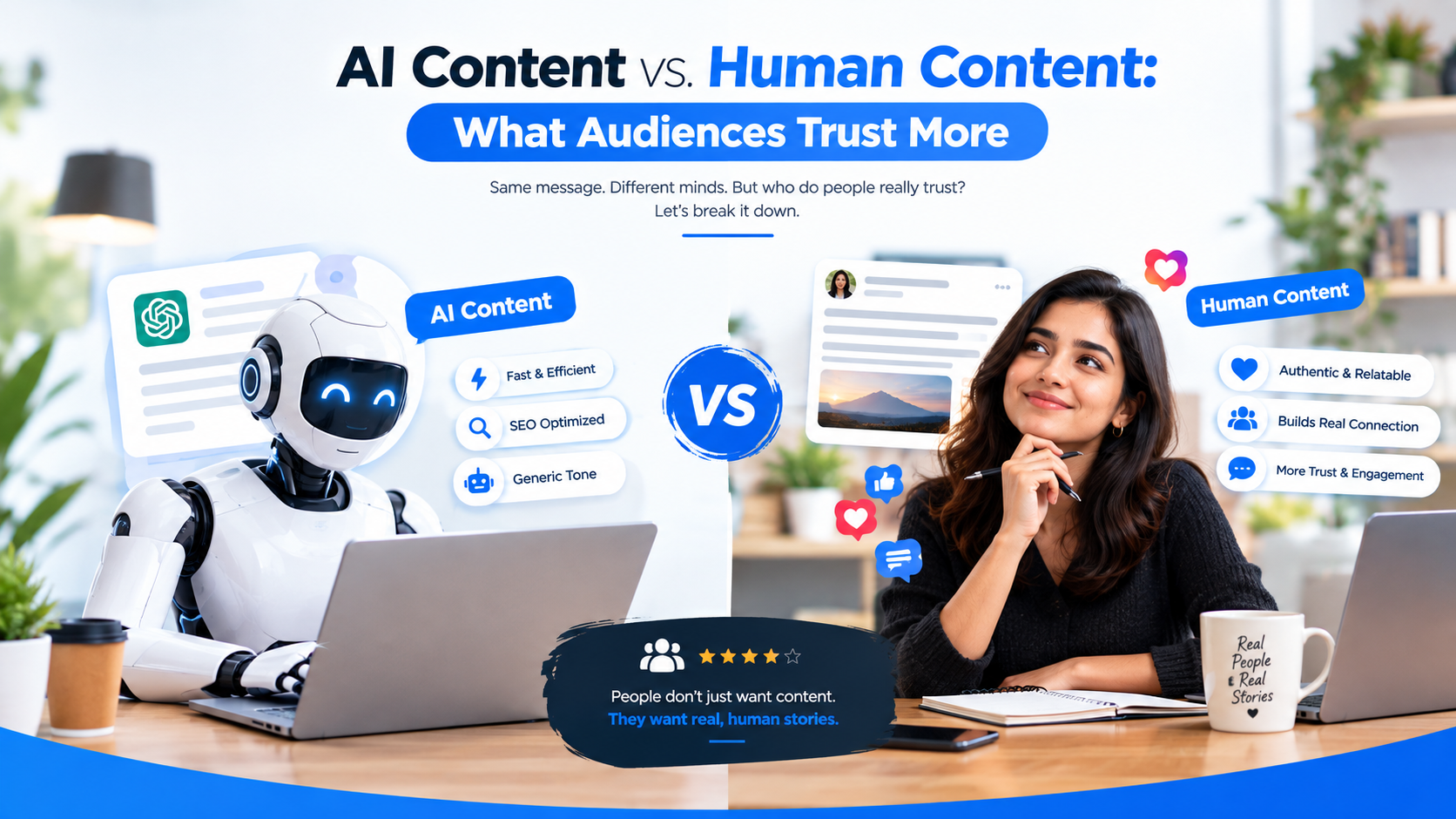
AI Content vs. Human Content: What Audiences Trust More
By a social media strategy consultant with 10+ years of experience helping small and medium businesses across Gujarat and India build audiences that convert.
The Day a Customer Said, "This Doesn't Sound Like You"
Hetal Shah runs a saree showroom in Surat's textile belt, selling Bandhani, georgette and Surat silk to customers as far away as Pune and Kolkata. Most of her orders arrive on WhatsApp. Last January, tired of late-night caption writing, she started letting an AI tool write her Instagram posts. Daily posts, perfect grammar, lots of emojis. "Elevate your ethnic wardrobe with this stunning drape," every post began.
Within three months, something felt wrong. Her post count had doubled, but WhatsApp enquiries had slipped from roughly 40 a week to about 15. Likes came from strangers; her regular customers went quiet.
Then a longtime customer from Ahmedabad sent her a message that changed everything: "Hetalben, have tame lakhta nathi ne? Pehla jevu lagtu nathi." (You're not writing these anymore, are you? It doesn't feel like before.)
That stung, because it was true. The next morning Hetal put her phone on a tripod at her weaver's workshop and recorded a 40-second voice note in her natural Gujarati-Hinglish: how long one Bandhani took, why the colour bled in the last batch, what her karigar's family had cooked that day. It was unpolished and it was hers. That single video drew more enquiries than the previous month of AI captions combined.
(Hetal's story is an illustrative composite based on patterns I see repeatedly in client work.)
The Shift That Is Already Underway
Since ChatGPT went public in late 2022, AI-written content has flooded every feed, blog and inbox. For a small business it is tempting: it is fast, cheap and never tired. IAMAI-Kantar estimates put India's internet users well beyond 800 million, and every one of them is now scrolling past thousands of near-identical, machine-polished posts.
Audiences have noticed, and the data shows their trust is not automatic:
• Edelman Trust Barometer (2024) found that global trust in AI companies fell from 61% to 53% over five years, showing that public comfort with AI is falling even as adoption rises.
• Stackla's Consumer Content Report found that about 90% of consumers say authenticity is important when deciding which brands they like and support.
• Sprout Social's research found that 86% of consumers say transparency from businesses is more important than ever.
Google has taken a similar line. Its Search guidance says it rewards helpful, people-first content that shows real experience, expertise, authoritativeness and trust (E-E-A-T), however the content is produced, and its spam policies target mass-produced pages made mainly to rank. The message from both audiences and algorithms is the same: efficiency gets you published, but only authenticity gets you believed.
India adds its own twist. Trust here is rarely built through a single ad; it is built through repeated, personal contact: a shopkeeper who remembers your name, a family doctor who explains in your language, a cousin's recommendation in the family WhatsApp group. Social media is simply the digital version of that counter. When a brand's content sounds mechanical, it feels like a stranger who walked into that relationship uninvited.
Note: the Sprout Social figure comes from research on US consumers. Indian audiences, who build trust through personal relationships, tend to be at least as sensitive to it.
Why Authenticity Matters: Trust Is the Real Currency
Expert insight: Seth Godin. Godin, author of This Is Marketing, argues that people don't buy on features; they buy on belonging. His much-repeated idea is that we choose things because "people like us do things like this." Trust comes from shared values and a visible point of view, not from polish.
Why this matters
A customer can't touch your product on Instagram, so they judge the person behind it. In Gujarat, where business runs on jaan-pehchaan (personal familiarity) and word of mouth, a brand voice that sounds like nobody in particular breaks that chain. AI models learn from the average of the internet, so they produce the average of the internet. Your brand can't afford to be average.
Indian business example
Dr. Riddhi Patel, who runs a dental clinic in Satellite, Ahmedabad, was posting AI-written "5 Tips for Healthy Teeth" carousels that looked like every other clinic's. She switched to short Gujarati clips answering real questions her patients ask, like "Root canal dukhe che?" (Does a root canal hurt?), in her own voice and from her own chair. Patients began mentioning the videos at reception, and several said they booked because "you seem honest."
The Human Touch: What AI Can't Fake
Expert insight: Ann Handley. Handley, Chief Content Officer at MarketingProfs and author of Everybody Writes, teaches that great content is empathy in action: write for the reader's problem, in a voice that is recognisably human, and let the customer, not the brand, be the hero.
Why this matters
AI has never stood in a workshop, lost a client, or apologised for a delayed order. It can imitate tone, but not lived experience, and audiences increasingly sense the difference. Specific details (the smell of the dye house, the tile that failed a load test, a mistake you learned from) are what make people say "this person knows their craft." They are also what search engines increasingly treat as evidence of first-hand experience.
This is also why regional language matters so much. A Gujarati customer reading a stiff, machine-translated line about "premium quality" feels the distance instantly, while a casual "aa vakhte quality ekdam top che, jaate joi lo" (quality is top-notch this time, see for yourself) feels like a neighbour talking.
Indian business example
Jayesh Kotecha, who owns a mid-sized tile manufacturing unit in Morbi, stopped posting AI-written product blurbs on LinkedIn. Instead he filmed his supervisor showing a slab passing a breakage test and explaining why a batch was rejected. Buyers from Mumbai and Hyderabad started messaging him directly, quoting the "rejected batch" video. Admitting a flaw made his quality claims more believable.
AI Content Mistakes, and How to Balance AI With Creativity
Expert insight: Ethan Mollick. Mollick, a Wharton professor and author of Co-Intelligence, advises treating AI as a capable but fallible co-worker and always keeping "the human in the loop." AI is a powerful collaborator, not a replacement for judgment.
Why this matters
AI itself is not the problem; unsupervised AI is. The most common mistakes I see in Gujarat businesses:
• Generic voice: posts that could belong to any brand in any city.
• Factual errors: invented statistics, wrong prices or made-up product claims.
• Cultural misses: wrong festival references, clumsy Gujarati translations, tone-deaf timing.
• Volume over value: posting daily with nothing to say.
• No fact-check or brand review before publishing.
Indian business example
Nidhi Trivedi, who runs an online ethnic-wear boutique in Vadodara, let AI draft 30 captions at once. One promoted a garba chaniya choli as "perfect for your Diwali celebrations" a week before Navratri, and followers noticed. She now uses AI only for first drafts and idea lists. She rewrites the opening line herself, adds a local detail, and checks every claim before posting. Her editing time is 15 minutes a day, and comments have become friendlier.
Building Trust Over Time: The Psychology of Showing Up
In 1968, psychologist Robert Zajonc described what became known as the mere exposure effect: the more often people encounter something, the more they tend to like it, even without realising why. Robert Cialdini's work on influence adds a related principle, that we say yes more readily to people we know and like.
Here is the catch for AI. Repeated exposure builds familiarity with whatever you show. Post consistently in a distinctive, human voice, and familiarity turns into fondness and trust. Post consistently in a generic voice, and you become familiar but forgettable, which is arguably worse.
This is where the smart balance lies. AI can help you stay consistent by batching ideas, scheduling, and cutting production time. Your human voice makes that consistency recognisable. A Rajkot service business posting three real, useful posts a week for six months will almost always beat one posting 30 anonymous posts in a burst and then disappearing. Trust is built on rhythm, not bursts. Aim for a schedule you can sustain for a year, then protect it.
The Business Case: Trust Pays
Trust isn't just a feel-good metric. Research by Bain & Company's Fred Reichheld, published in Harvard Business Review, found that increasing customer retention rates by just 5% can increase profits by 25% to 95%. Loyal customers buy again, spend more, refer friends, and cost far less to serve than new ones.
For an Indian SMB, the math is intuitive. If you spend ₹800 in ads to win each new customer, but trust-driven content brings referrals and repeat orders that cut that cost by even a quarter, you save ₹200 on every customer, and the effect compounds. In a WhatsApp-driven market, one delighted customer forwarding your catalogue to her family group is worth more than a dozen paid impressions.
Think of it as a simple chain: authentic content builds trust, trust drives enquiries, good service converts enquiries into customers, and consistent content keeps those customers coming back. AI can speed up the first link, but if it weakens the chain at the trust stage, everything downstream gets more expensive.
Human, credible content also lifts what you can charge. Customers pay a premium for people they believe. AI can lower the cost of producing content; only trust raises the value of what you sell.
Back to Hetal: Closing the Loop
Hetal didn't abandon AI. She uses it to plan her content calendar, tidy her English captions, and suggest hashtags. But the voice notes from the weaver's workshop are hers, recorded on her phone, in her language, with the occasional cough in the background. Within two months her weekly enquiries were back above 40, and her repeat customers were forwarding her videos on their own.
She replied to that customer in Ahmedabad: "Tame sachu kahyu. Aa pachi hu j lakhish." (You were right. From now on I'll write it myself.)
So, what do audiences trust more, AI content or human content? They trust content that feels like it came from a real person who cares. Use AI to save time. Use your humanity to earn belief. The businesses that win in Gujarat and across India will be the ones that master both.
FAQ Section (Schema-Ready)
Q1. Do audiences trust AI-generated content or human-written content more?
Audiences generally trust content that feels authentic and human. Stackla research found about 90% of consumers say authenticity matters when choosing brands to support, and Edelman's 2024 Trust Barometer showed global trust in AI companies falling from 61% to 53% over five years. AI-assisted content works when a real person shapes the voice and checks the facts.
Q2. Can Google detect and penalise AI-written content?
Google says it rewards helpful, people-first content regardless of how it is produced. However, its spam policies target mass-produced, low-value pages created mainly to manipulate rankings. Content that shows real experience, expertise and accuracy (E-E-A-T) can perform well whether or not AI helped draft it.
Q3. What are the biggest mistakes businesses make with AI content?
The most common are a generic brand voice, unchecked facts or prices, cultural and language errors (such as wrong festival references or poor Gujarati translations), and posting high volume with little value. Fixing these is simple: keep a human in the loop, fact-check every claim, and have a native speaker review translations.
Q4. How can a small business use AI without losing authenticity?
Use AI for the first draft: brainstorming, outlines, and hashtag ideas. Then add your own opening line, real examples, and opinions. A short brand voice guide helps the tool sound like you. Many small businesses save several hours a week this way while keeping the personal voice that customers recognise.
Q5. How often should I post to build audience trust?
Consistency matters more than volume. Psychologist Robert Zajonc's mere exposure effect shows that repeated exposure increases familiarity and liking. For most SMBs, three to four genuinely useful posts a week, sustained for six to twelve months, will outperform sporadic bursts of daily posting.
Q6. Does building trust with content really affect revenue?
Yes. Bain & Company's Fred Reichheld found that a 5% increase in customer retention can lift profits by 25% to 95%. Trust-driven content encourages repeat purchases and referrals, which are especially valuable in India's word-of-mouth and WhatsApp-driven markets, and reduces long-term customer acquisition costs.
Ready to Build Content Your Audience Actually Trusts?
At Help Me Buddy IT Pvt Ltd, we help small and medium businesses build content workflows that blend AI efficiency with genuine human voice, so you save time without losing trust.
Visit: helpmebuddy.in
Comments
Share your thoughts about this post.