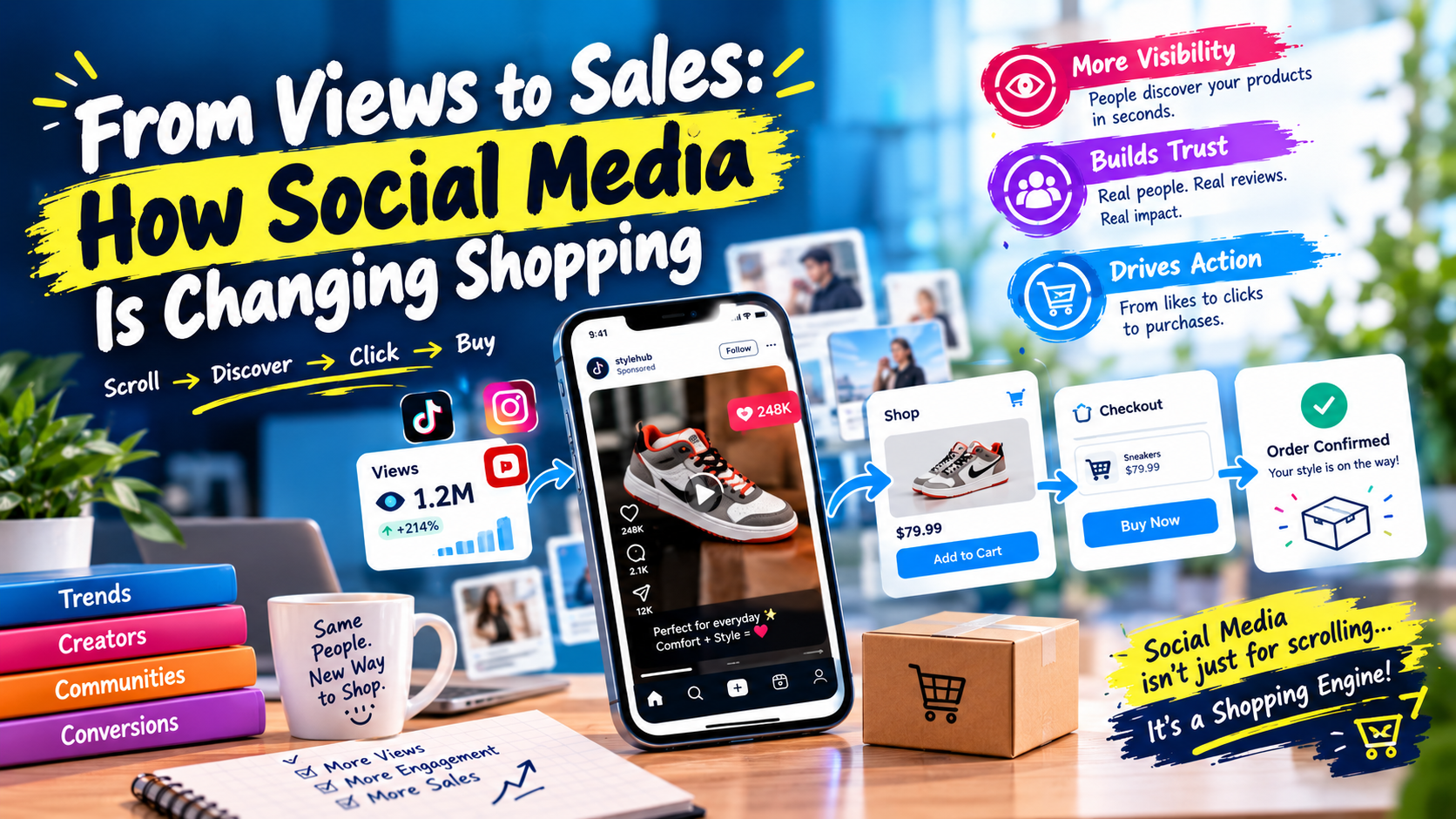
From Views to Sales: How Social Media Is Changing Shopping
By a social media strategy consultant with 10+ years of experience helping small and medium businesses across Gujarat and India build audiences that convert.
The Reel That Changed Everything
Meera Ben ran a small bandhani saree and dupatta shop tucked into a narrow lane near the old town of Bhuj, in Kutch. For fifteen years, the business survived on word of mouth, wedding-season orders, and a loyal but slowly shrinking base of regular customers. When a large showroom opened two streets away with glass counters and aggressive discounting, her footfall dropped by nearly 40% in six months. A newspaper ad brought silence. A local radio spot brought nothing at all.
Her nephew, home from college for the summer, suggested she film a 30-second video of the actual bandhani process — her fingers twisting thread into tiny knots, the fabric dipping into indigo dye, the pattern unrolling in the sun to dry. She resisted. “Who wants to watch me tie thread?” she asked. He filmed it anyway and posted it on Instagram.
By the next morning, the reel had crossed 40,000 views. Comments asked where to buy, whether she shipped outside Kutch, whether the sarees came in mustard or maroon. She replied to each one, sent a WhatsApp catalogue, and closed her first-ever sale to a customer in Pune she had never met and never would meet in person.
Eighteen months later, Meera Ben’s WhatsApp Business catalogue brings in more monthly revenue than her physical counter ever did. She hasn’t stopped filming since — and her story is no longer unusual. It is becoming the default way small businesses across Gujarat, and India, are learning to sell.
The Shift That Is Already Underway
What happened to Meera Ben is not a lucky break — it is a measurable shift in how people discover and decide what to buy. Shopping has stopped being a straight line from advertisement to store visit. It now happens inside the same scroll where people watch friends, follow creators, and message businesses directly, often without ever opening a separate shopping app.
Sprout Social’s annual Index has repeatedly found that a majority of consumers have made a purchase directly because of something they saw from a brand on social media, with product discovery now ranking among the top reasons people follow brand accounts in the first place — ahead of traditional advertising recall.
The Edelman Trust Barometer has tracked a parallel change in who consumers trust: everyday people, creators, and “people like me” now rank well above traditional advertising and even above brand spokespeople when it comes to believability. This is precisely why a shopkeeper’s own hands, not a polished ad film, is what stopped the scroll for Meera Ben’s audience.
Meta’s internal business research on Instagram and Facebook shopping behaviour has similarly pointed to a large share of users saying they discover new products on the platform and go on to research or purchase them, while industry estimates from firms such as Bain & Company and RedSeer have projected India’s social commerce market to grow many times over this decade, driven by WhatsApp, Instagram, and short video as the entry point into buying, not just browsing.
Together, these signals point to one direction: entertainment and commerce are no longer separate. The feed is the shop window, the comment section is the sales floor, and the DM inbox is the checkout counter.
1. Social Discovery Is the New Shop Window
“Document, don’t create.” — Gary Vaynerchuk, entrepreneur and marketing commentator, on why raw, real, behind-the-scenes content consistently outperforms polished, over-produced advertising on social platforms.
Why this matters
Platforms like Instagram and YouTube Shorts are built to reward content that feels native to the feed, not content that feels like an interruption. A process video, a customer reaction, or an honest “here’s how we make it” clip signals to the algorithm — and to the viewer — that this is worth watching, not skipping. For small businesses without a large ad budget, this is the single biggest equalizer social media has created: discovery is now earned through relevance, not bought through reach alone.
Indian business example
A small carpentry workshop in Rajkot began posting short reels of raw teak wood being shaped into furniture, with no scripts and minimal editing. Within four months, the account grew from roughly 200 followers to over 15,000, and Instagram inquiries began outnumbering walk-in customers at the workshop — something the owner had not thought possible for a trade he assumed “people only buy after touching the wood.”
Practical Implementation Checklist
• Post 3–4 short process or behind-the-scenes reels every week, even if filmed on a phone.
• Use trending audio, but always tie it back to a genuine product or workshop moment — not a generic trend for its own sake.
• Add on-screen text with price ranges, availability, or “DM to order” cues so viewers don’t have to ask the obvious.
• Pin your best-performing reels to the top of the profile so they act as a permanent shop window for new visitors.
• Reply to every comment within a few hours — fast replies boost reach and turn curiosity into conversation.
2. Creators Have Replaced the Middleman
“People don’t follow brands, they follow people.” — a core idea from marketing author and consultant Mark Schaefer, who has written extensively on why human, creator-led content now outperforms institutional brand messaging.
Why this matters
A creator with five thousand genuinely engaged followers in your own city often converts better than a celebrity with a million distant ones, because trust travels through familiarity, not fame. Creator content also solves the credibility problem small businesses have always faced — a stranger recommending a product feels more honest coming from a peer than from the seller itself. This is the engine behind social commerce: creators do the convincing, and the platform’s in-app shopping tools do the closing.
Indian business example
A kidswear label based out of Surat stopped chasing large influencers and instead partnered with five local mothers in Surat and Vadodara, each with 5,000–10,000 followers, giving each a small commission and a unique discount code. Within one festive season, creator-driven codes accounted for close to a third of total online orders — at a fraction of what a single large influencer campaign would have cost.
Practical Implementation Checklist
• Identify 5–10 micro-influencers (roughly 5,000–50,000 followers) in your city or niche rather than one large name.
• Offer product plus a modest commission instead of a flat upfront fee, so cost stays tied to actual sales.
• Give each creator a unique discount code or link so you can track exactly what they generate.
• Repurpose creator content as paid ads (with permission) to retarget people who engaged but didn’t buy.
• Set up product tagging on Instagram/Facebook Shop so tapping a tagged item leads straight to checkout, not a separate search.
3. DMs and WhatsApp: Where Discovery Becomes a Sale
Chris Messina, the technologist credited with coining the term “conversational commerce,” has argued that the future of shopping looks less like a checkout page and more like a conversation — exactly the pattern Indian buyers and sellers have followed for generations, now digitized through chat.
Why this matters
India is a WhatsApp-first market, with the app used by several hundred million people for everything from family updates to business inquiries. The DM or WhatsApp chat is where an Indian customer has always done their real shopping — asking “is this available in another colour,” negotiating gently, building enough trust to pay before delivery. Social platforms have simply moved that same behaviour online, and businesses that treat their inbox as seriously as their storefront convert far more of the curiosity their content generates.
Indian business example
An artificial jewellery and home-decor seller in Ahmedabad set up a WhatsApp Business catalogue with clear pricing and automated quick replies for common questions, paired with an Instagram DM prompt on every reel. Inquiry-to-sale conversion through DMs and WhatsApp reportedly settled around 30%, well above what the same business saw from cold website traffic.
Practical Implementation Checklist
• Set up a WhatsApp Business Catalogue with clear photos, pricing, and availability for every product line.
• Use a greeting message and quick replies to answer the five most common questions automatically.
• Add a visible “Message on WhatsApp” sticker or link to every reel, post, and story.
• Follow up on unanswered DM inquiries within 24 hours — most lost sales are simply lost attention.
• Use WhatsApp broadcast lists, not groups, for festive offers to past customers, keeping messages personal rather than promotional-feeling.
Why Consistency Beats a Single Viral Moment
Psychologist Robert Zajonc’s research on the mere exposure effect found that people develop a preference for things simply because they encounter them repeatedly — familiarity itself breeds trust, even before a rational reason to buy exists. This is why one viral reel rarely builds a lasting business on its own, while a steady, unglamorous rhythm of posting does.
Most customers do not buy on the first view of a product. They see it, half-notice it again a week later, see a creator mention something similar, and only then message to ask a question — often around the seventh or eighth exposure, not the first. Meera Ben’s early customers rarely bought from that first viral reel; many messaged weeks later, after seeing two or three more posts, once the bandhani process had become familiar rather than novel. Businesses that post inconsistently — a burst of activity followed by weeks of silence — lose this compounding effect and effectively restart from zero each time, since platform algorithms also reduce reach for accounts that go quiet.
The Business Case: Why This Isn’t Just Marketing, It’s Retention
Frederick Reichheld’s research at Bain & Company, one of the most cited findings in customer strategy, found that increasing customer retention by just 5% can increase profits by 25% to 95%, depending on the industry. Social selling through DMs and WhatsApp is, at its core, a retention channel disguised as a discovery channel — every past customer added to a WhatsApp broadcast list or Instagram follower base is someone a business can sell to again for close to zero additional marketing spend.
This is the real reason the shift from views to sales matters for small and medium businesses in particular. A large brand can afford to keep paying for new customer acquisition. A neighbourhood business in Bhuj, Rajkot, Surat, or Ahmedabad cannot — and social commerce, done consistently, is one of the few channels where the second, third, and tenth sale to the same customer becomes almost free.
Back to Bhuj
Meera Ben’s shop counter is quieter these days than it was fifteen years ago — but her phone rarely stops buzzing. A customer in Jaipur wants to know if a particular dupatta comes in indigo. A creator in Ahmedabad wants to feature her next collection. A regular from Pune has placed her third order this year, all without ever stepping inside the shop on that narrow lane in Kutch. The store didn’t disappear. It just grew a second, much larger front door — one that opens every time someone scrolls.
That is the shift underway across Gujarat and India right now: not a replacement of traditional business, but an extension of it, from views into real, repeatable sales.
FAQ Section (schema-ready)
Q1. How is social media changing the way people shop in India?
Shopping is moving from a separate, deliberate search to something that happens inside everyday scrolling. Industry research such as the Sprout Social Index shows a majority of consumers have bought directly because of something seen on social media, while Meta’s own studies point to large shares of Instagram users discovering products directly on the platform rather than through search or ads alone.
Q2. What is social commerce and how is it different from e-commerce?
Social commerce is the discovery and purchase of products within a social platform itself — through in-app shops, product tags, or DMs — rather than clicking out to a separate website. Analysts including Bain & Company and RedSeer have projected India’s social commerce market to grow into a multi-billion-dollar category this decade, driven largely by WhatsApp and Instagram-based selling.
Q3. How can a small business in Gujarat start selling through Instagram and WhatsApp?
Start with a WhatsApp Business Catalogue for clear pricing and availability, then post consistent, low-production reels showing the product or process, with a visible “Message on WhatsApp” prompt on every post. Businesses in cities like Bhuj, Rajkot, and Surat have seen DM-to-sale conversion rates around 30% once this basic system is in place.
Q4. Do I need a large following to sell through social media?
No — micro-influencers with 5,000 to 50,000 followers often convert better than large accounts because their audiences trust them as peers, per the Edelman Trust Barometer’s findings on “people like me” being trusted above traditional advertising. Many Gujarat-based SMBs have built meaningful sales with followings well under 20,000.
Q5. How much should a small business spend on influencer or creator marketing?
A commission-based model — product plus a small percentage per sale via a unique discount code — keeps spend tied to actual results rather than upfront guesswork. One Surat-based kidswear brand generated close to a third of its festive-season orders through five local micro-influencers on this model, at a fraction of the cost of a single large campaign.
Q6. How long does it take to see real sales results from social media efforts?
Most businesses see meaningful traction after 8–12 weeks of consistent posting, not from a single viral moment. This lines up with the psychological “mere exposure effect” — customers typically need several exposures to a brand before they message or buy, so steady, repeated visibility matters more than one big spike.
Ready to Turn Your Views Into Sales?
Help Me Buddy IT Pvt Ltd works with small and medium businesses across Gujarat and India to build social media strategies that go beyond likes and views — covering content, creator partnerships, and WhatsApp-driven selling systems built for how Indian customers actually buy.
Get in touch:
• Website: helpmebuddy.in
Comments
Share your thoughts about this post.