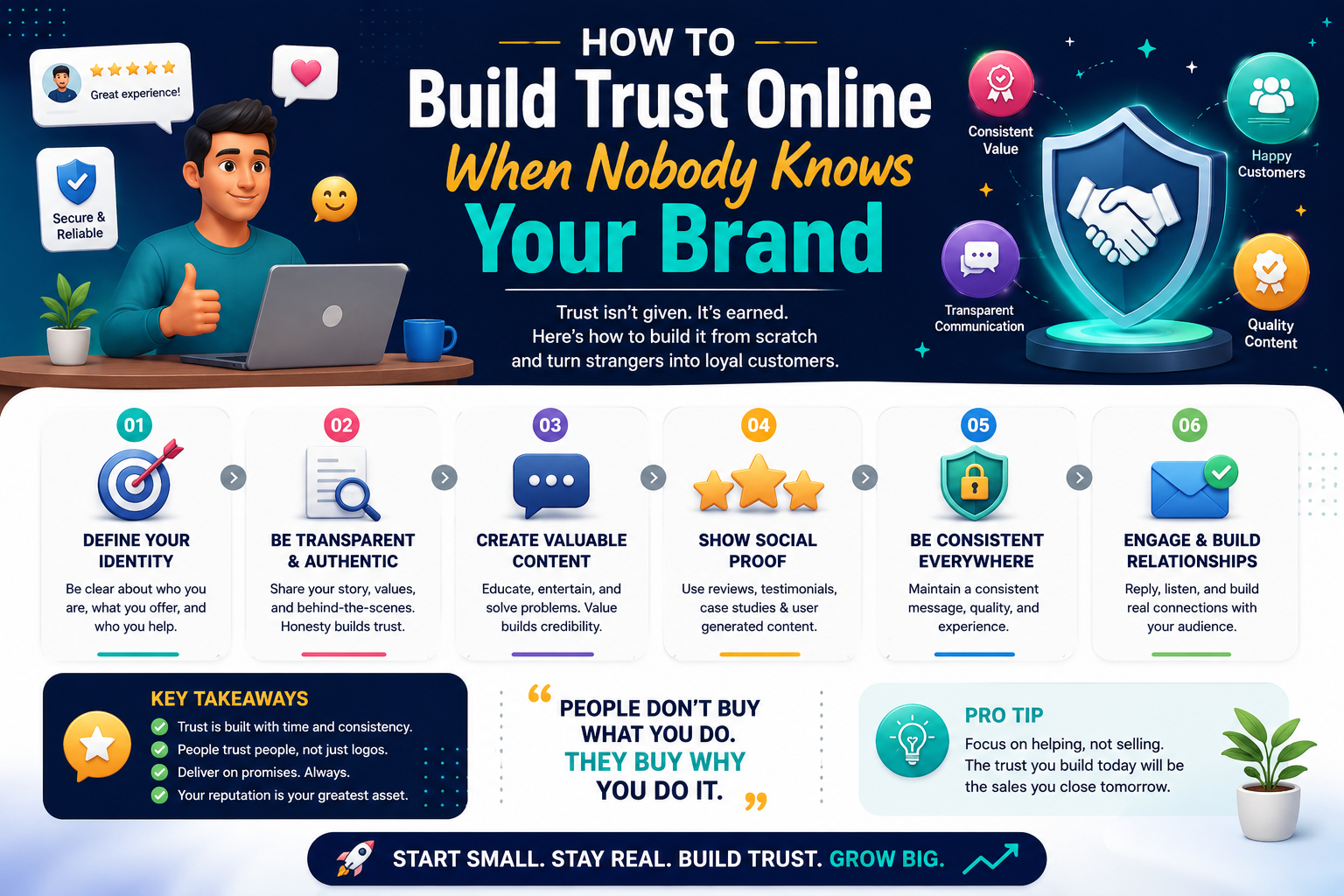
How to Build Trust Online When Nobody Knows Your Brand
By a digital marketing consultant with 10+ years of experience helping new businesses across Gujarat and India build credibility and convert online visitors into paying customers.
Kruti spent two years in her small Vadodara lab before she sold a single bottle.
She had a chemistry degree, a genuine obsession with formulation, and a notebook full of research on actives underrepresented in the Indian skincare market. She tested her face wash, serum, and moisturiser on friends, family, her college roommate, her mother. She reformulated the serum three times before she was satisfied.
By the time she launched in early 2023, her products were genuinely good. Her website was clean and well-designed. Her Instagram had careful, well-lit photography. She had done, as far as she could tell, everything right.
For the first ten weeks, she sold four units. All four were to people she already knew personally.
I met Kruti at a small business networking event in Vadodara six months after her launch. She was not frustrated with her product — she was frustrated with a question she could not answer: "Why does no one trust me?"
The answer, once we sat down and looked at her presence together, was immediately clear. A stranger landing on her website had no reason to believe her. Not because her claims were false — they were true — but because there was no evidence. No reviews. No before-and-after photos from real customers. No documentation of her formulation process. Nothing a stranger could find to verify what she was saying.
This article documents the five things that build that evidence — grounded in published research, real business outcomes from across Gujarat, and a decade of working with new businesses trying to answer the same question Kruti was asking.
Why Building Trust Online Is Harder Than It Has Ever Been
Here is what a stranger experiences when they land on a new brand's website for the first time.
They are not consciously running through a checklist. But their brain is. In seconds, they are forming a judgment: does this look like a real business? Have other people tried this? What happens if this is not what it claims to be?
Offline, this evaluation happens differently. In a physical shop, a customer can see the space, talk to a person, pick up the product and feel its weight. Those sensory signals build trust quickly and automatically. Online, none of that exists — every trust signal has to be deliberately constructed and placed where the customer will encounter it.
What the research confirms: Edelman's Trust Barometer — one of the most comprehensive longitudinal studies on consumer trust, run annually across 28 countries — found that 81% of consumers say they need to trust a brand before making a purchase. Critically, this figure has remained consistent even as more purchasing has moved online, suggesting that the requirement for trust has not diminished with the growth of e-commerce — if anything, it has intensified because the cues that build it in physical environments are absent.
For a new business in Gujarat competing against established national brands and a scroll of Instagram alternatives, every visitor who does not trust you enough to buy is a visitor you have permanently lost. The Baymard Institute, which conducts peer-reviewed research on e-commerce user experience, identified lack of trust in a business as one of the top five reasons people abandon a purchase online — ranking alongside price, shipping concerns, and account registration friction. For a new brand specifically, it often ranks first.
A note on what this article will and will not do: This article gives you five trust-building strategies grounded in research and real outcomes. It does not promise overnight transformation — trust is built over months of consistent action, not days of intense activity. Every business featured here built credibility through sustained effort, not a single campaign.
1. Reviews: The Trust Evidence That Works Before You Speak
Think about the last time you considered something you had never tried before — a restaurant in an unfamiliar part of Ahmedabad, a contractor found through Google, a supplement advertised on Instagram. What did you do before deciding?
You looked for what other people had said.
This behaviour is so consistent and so well-documented that consumer psychologists have a name for it: social proof. The principle, first formalised by Dr. Robert Cialdini in his landmark work Influence: The Psychology of Persuasion, describes how people under uncertainty look to the behaviour and experience of others to reduce their own risk. When we do not know what to believe about a new business, we look for what people who have already tried it believe.
BrightLocal's Local Consumer Review Survey puts scale on this: 98% of consumers read online reviews before deciding on a local business, and 49% trust online reviews as much as a personal recommendation from a friend or family member. Nearly half of Indian consumers are treating a stranger's Google review as equivalent to advice from someone they know and trust.
For Kruti, the absence of reviews was the single largest trust gap on her entire website. A stranger reading her ingredient list had no way to independently verify her claims — but a review from someone in Ahmedabad saying "my skin looked noticeably different after two weeks" could cross that gap in a single sentence.
How to get your first reviews when you have none
The mistake most new business owners make is waiting for reviews to appear organically. They will not — at least not at the speed required. You have to ask, directly and personally.
Start with people who have already tried your product, even informally — beta testers, early friends-and-family customers, people who received a sample. Ask them by name, over WhatsApp: "Would you be comfortable sharing your honest experience as a review? Even a few sentences would genuinely help our small business." Most people who had a positive experience will say yes when asked personally.
Then eliminate all friction. Send the direct Google review link in the same message — not the name of your business and a search instruction. Every additional step you require reduces the number of people who complete the action by approximately 50%, according to UX research from the Nielsen Norman Group on form completion rates.
Practical implementation tip: Generate your Google review short link from your Google Business Profile dashboard, save it as a text shortcut on your phone (most Android devices support text shortcuts under Settings → System → Language → Advanced), and send it within 24 hours of every positive customer interaction while the experience is still fresh.
Respond thoughtfully to every review — positive, neutral, and negative. A business that responds to a critical review calmly and helpfully shows future readers that there is a real person behind the brand who takes customer experience seriously. In a 2022 study by Harvard Business Review, businesses that responded to negative reviews consistently saw a 0.12-star improvement in overall rating — not because they removed bad reviews, but because the tone of their responses changed how future customers perceived the brand.
Within four months of systematically applying this review request process, Kruti had 31 reviews across Google and her website. Her conversion rate from visitor to purchase — which had been below 1% — nearly tripled.
2. Testimonials: Turning Customer Words Into Strategic Conversion Assets
Reviews and testimonials are related but serve distinct functions. A review is short, star-rated, and hosted on a third-party platform for discovery purposes. A testimonial is something you actively collect, curate, and place precisely where a prospective customer is making their decision — your homepage, your product page, your pitch deck, your sales WhatsApp message.
The difference between a testimonial that converts and one that does not
Here is the version of a testimonial for Kruti's serum that does nothing:
"Amazing product, my skin loves it!"
And here is the version that actually builds trust:
"I had been struggling with dull, dehydrated skin for almost a year — especially through Ahmedabad's dry winter. I started using this serum in November and by mid-December my skin felt genuinely more hydrated, and people started commenting that I looked fresher. — Priya M., Ahmedabad"
The second works because it is specific enough to be believable, grounded in a real place and real season (Ahmedabad's dry winter is something every local reader immediately relates to), and detailed enough for a prospective customer to imagine their own results.
Expert insight: Marketing researcher and author Jonah Berger, whose research on word-of-mouth and social transmission has been published in the Journal of Marketing Research, identifies specificity as the primary predictor of whether a testimonial or word-of-mouth recommendation will influence a purchasing decision. His research shows that vague positive statements ("great product, highly recommend") activate almost no decision-making response, while specific, contextualised accounts ("I had this specific problem, I used this product, I saw this specific change") activate the same trust pathways as personal recommendations. The implication for testimonial collection: always elicit specific detail, not general enthusiasm.
The three questions that produce excellent testimonials:
Ask satisfied customers these questions rather than a generic testimonial request. Their answers, lightly edited for clarity, become your marketing assets:
- "What problem were you facing before you found us — and how long had you been dealing with it?"
- "What specifically changed after you started using our product or working with us?"
- "What would you say to someone who is uncertain about trying this?"
Feature testimonials prominently — on your homepage, on individual product or service pages, in sales conversations — not buried on a separate testimonials page that fewer than 5% of visitors navigate to.
3. Case Studies: Proof That Shows How You Think, Not Just What You Achieved
For service businesses, B2B companies, and anyone where the purchase is significant enough to warrant careful evaluation, a testimonial is often insufficient. Prospective clients need to see not just what you achieved, but how you approached the problem — because that process assessment is how they judge whether you would approach their problem well.
This is the unique function of a case study: it gives a prospective client a window into your thinking, not just your outcomes.
The structure that makes case studies work
A strong case study follows three beats — situation, approach, result — and is written for a prospective client who can recognise themselves in the situation described.
For a digital marketing consultant in Surat, a case study documenting a textile export client might read:
Situation: A textile manufacturer in Sachin GIDC had no digital presence and was losing international buyers who required a verified online presence before placing orders. Their competition was already appearing in Google search; they were not.
Approach: Built a professional six-page website with a portfolio section showcasing manufacturing capacity and quality certifications. Set up and optimised a Google Business Profile. Created a monthly content calendar of three educational posts about their fabrics and sourcing process.
Result: Four months after launch, seven qualified enquiries arrived through the website from international buyers, leading to two confirmed export orders with a combined value of ₹14 lakhs.
That case study communicates something no testimonial can: this consultant can diagnose a visibility problem, build appropriate infrastructure, and generate measurable commercial outcomes within a defined timeline. A prospective client reading it is evaluating process and judgment, not just results.
When you do not yet have client case studies
Three approaches work for businesses too new to have documented client outcomes:
A personal case study documenting your own journey. Kruti's most-read website page — generating consistent search traffic and regular DM enquiries from new potential customers — is the story of her two-year formulation process: why she chose specific actives, how she tested them, what she changed and why. It is a case study of her own expertise that gives a stranger a detailed basis for trusting her knowledge.
A pilot project case study: offer your service free or at significantly reduced cost to one client specifically in exchange for permission to document the process and results. One thoroughly documented case study outperforms six satisfied but undocumented clients in terms of new business generation.
An anonymised industry case study: describe a situation and outcome in enough detail to be meaningful and recognisable, without the identifying details. "A mid-size garment manufacturer in South Gujarat" is sufficient context for a reader in that industry to see their own situation in the description.
Implementation tip: Begin documenting every significant client outcome you produce, from your very first client, with their permission. The cost of not doing this is permanently lost evidence — outcomes that happened but cannot be referenced or shared. Keep a simple record: client type, situation, what you did, measurable result. Even a basic spreadsheet maintained from day one will provide the raw material for case studies six months later when you have enough to write them.
4. Professional Branding: The Silent Trust Assessment That Happens in Three Seconds
Every review, testimonial, and case study you build is encountered after a stranger has already made a preliminary assessment of your business based on how it looks. This assessment happens in approximately three seconds and is nearly entirely visual.
Stanford University's Web Credibility Research Project, one of the most widely referenced studies on online trust formation, found that 75% of consumers judge a business's credibility based on visual design quality — not content, not pricing, not even reviews. Design quality. The way the business looks to the eye in the first seconds of encounter.
For a new business with no existing reputation, this means the visual quality of your presence is the first — and sometimes only — opportunity to establish the premise of trust that everything else builds on. A strong testimonial on a visually unprofessional website converts poorly. The same testimonial on a website that communicates professionalism converts well.
Professional branding for a small business does not require a large agency budget. It requires four things executed with consistency and care:
A coherent visual identity across every customer touchpoint. The same logo, colour palette, and typography on your website, Instagram, packaging, printed materials, and business cards. Visual inconsistency — different fonts here, a logo cropped differently there — registers subconsciously as disorganisation, which maps directly onto perceptions of unreliability.
Photography that communicates intention. Kruti invested ₹8,000 in a product photographer in Vadodara for a single afternoon. The measurable impact on her Instagram engagement over the following month exceeded everything else she had done in the preceding five months combined. For product businesses especially, the photographic quality of your product imagery is one of the highest-leverage investments available at any stage.
A complete and verifiable digital presence. A working website (not just a social media page), a verified Google Business Profile with real photos and current information, an active and complete Instagram or Facebook profile, and a professional email address at your own domain (yourname@yourbusiness.in rather than a Gmail address). Together these signal: this business is real, is operating, and has the digital maturity of an established operation.
Writing quality across all communication. For a new, unknown brand, every word on your website and in your customer communications is a trust signal. Grammatical errors, inconsistent tense, awkward phrasing — these register as indicators of carelessness and disproportionately damage trust when a brand is new, because written quality is one of the few things a stranger can evaluate independently before they have tried your product.
Practical implementation: Conduct a "stranger audit" of your own brand — set up a new browser window with no history or cookies, visit your own website, and spend 30 seconds looking at it the way someone who has never heard of you would. What does the visual quality tell you? Is the photography strong? Are the fonts consistent? Does the layout feel deliberate? What is missing? This exercise, done honestly and done regularly, surfaces the gaps that familiarity with your own brand makes invisible.
For Kruti, the branding upgrade was a series of small changes that each cost little but compounded significantly: a redesigned label that belonged next to established brands rather than looking home-made, a printed ingredient explanation card included with each order, branded tissue paper replacing generic courier packaging, and a handwritten thank-you note. None were expensive individually. Together, they transformed how receiving her product felt — and customers who feel good about receiving something are measurably more likely to review it, recommend it, and repurchase.
5. Content Marketing: The Trust That Does Not Require Borrowed Credibility
Here is what separates content marketing from every other trust-building approach: it lets strangers evaluate your expertise directly, without relying on anyone else's opinion.
Reviews tell a stranger that other people trust you. Testimonials tell them that specific people had specific good experiences. Case studies show how you solved a specific problem. All of these require the stranger to extend some trust — in the reviewer, in the testimonial subject, in the case study framing.
Content is different. When Kruti began posting about the science behind her ingredients — why specific actives work for specific skin concerns, how to read an INCI ingredient list, common skincare myths that cost Indian consumers money — she was not asking anyone to trust her. She was demonstrating her knowledge in a forum where any reader could evaluate it independently. Someone with skincare chemistry knowledge could assess her explanation of hyaluronic acid molecular weights and verify its accuracy. Someone without that knowledge would read it and come away understanding more than they did before — which feels like being helped, not sold to.
Expert insight: Mark Schaefer, author of Marketing Rebellion and one of the most frequently cited researchers on content marketing effectiveness, identifies what he calls the "content shock" problem — the exponential growth in content volume competing for the same audience attention. His research conclusion, drawn from analysis of hundreds of small business content strategies, is that specificity and genuine expertise consistently outperform volume in trust-building content. One post demonstrating deep knowledge of a specific, narrow topic builds more credibility than ten generic posts on broad subjects. For a new brand with limited time and resources, this means choosing depth over breadth in every content decision.
Demand Gen Report's research on B2B content engagement found that businesses publishing educational content consistently generate 67% more leads than those publishing primarily promotional content. For a brand unknown to its potential audience, this gap is typically larger — because educational content is simultaneously creating awareness and building the credibility that makes that awareness valuable.
Content types that build trust most effectively for new businesses:
Educational content answering questions your ideal customer is already asking. A new CA firm in Gandhinagar can build genuine local credibility by publishing: "What documents do you actually need for a sole proprietorship registration in Gujarat?" or "The three GST filing mistakes that get Ahmedabad manufacturers into trouble." These posts attract exactly the right audience and immediately demonstrate knowledge that is worth paying for.
Founder and process content that makes the business human. Kruti's lab videos — showing ingredient sourcing decisions, formulation testing, quality check processes — did not just perform well on Instagram. They changed the nature of her audience's relationship with her brand. She was no longer an unknown product. She was a specific person with specific knowledge and specific passion, sharing it openly. People who feel they know the founder of a business trust that business at a fundamentally deeper level.
Honest buying guides and comparison content that help the reader make a good decision even when that decision is occasionally not your product. A water purifier company in Rajkot that publishes "How to choose the right water purifier for your home — and when you genuinely don't need the expensive one" is making a calculated, courageous trade. They will lose a small number of sales where a cheaper alternative was genuinely appropriate. In exchange, they build the kind of credibility that makes readers trust their recommendation when an expensive model is the right answer — and that trust has a significantly higher long-term value than those forgone sales.
Practical implementation: Identify the single most common question your target customer asks before they decide to buy. Write a genuinely thorough, expert answer to that question — 600 to 1,000 words, with no sales pitch at the end. Publish it. Then identify the second most common question and repeat. These two posts will attract more qualified, trusting readers than ten promotional posts about your product's features, because they are answering questions people are actively searching for answers to.
The Implementation Sequence: Building Trust Without Burning Out
These five elements work best as a layered sequence. Attempting all five simultaneously is how good intentions become paralysis.
Phase one (weeks 1–4): Fix the visual foundation. Branding, photography, a professional website, and complete digital profiles. This is the substrate that everything else builds on. Reviews placed on a visually unprofessional website will not convert. Content published from an incomplete Instagram profile will not earn the engagement it deserves.
Phase two (weeks 5–8): Actively collect reviews and testimonials. From anyone who has genuinely experienced your product or service, including informal early testers. Use the three-question framework for testimonials. Set up your Google review short link and send it within 24 hours of every positive interaction.
Phase three (weeks 9–16): Build a content rhythm. Choose one platform where your ideal customers spend time. Commit to one to three pieces of educational content per week — starting with the most common questions your customers ask. Add behind-the-scenes and founder story content alongside. Do not switch platforms until you have maintained this rhythm for at least six weeks.
Phase four (ongoing): Document outcomes as case studies. Every significant client result, from your very first clients, documented with permission. As these accumulate, write them up as proper case studies and feature them prominently — on your website, in sales conversations, in your pitch materials. This becomes more valuable over time as your library of documented evidence grows.
Conclusion: Trust Is Earned Through Evidence, Not Claims
Kruti's skincare brand now does over ₹4 lakhs in monthly revenue. Her Google reviews number in the hundreds. Her formulation journey case study — the story of two years of research, testing, and reformulation — is one of the most-read and most-shared pages on her website. She is regularly approached by beauty editors and stockists who found her through content she published eighteen months ago and only just discovered.
None of this happened because she made bigger claims. It happened because she built, systematically and patiently, the evidence that allowed strangers to evaluate her claims for themselves.
That is the principle behind everything in this article. Reviews give strangers other people's verified experience. Testimonials give them specific, believable detail. Case studies give them a transparent view into your process and judgment. Professional branding gives them visual signals that this is a real, established operation. Content lets them evaluate your expertise independently.
Together, these five things do not just build trust — they make trust the rational, evidence-based response to encountering your business for the first time.
Build the evidence. The trust follows. And the customers follow the trust.
5 — FAQ section (schema-ready)
How do I build trust online when my business is brand new?
Start with the visual foundation: professional branding, consistent photography, a complete website, and a verified Google Business Profile. Then actively collect your first reviews from anyone who has genuinely experienced your product or service, using the direct Google review link to eliminate friction. As you gather customers, collect detailed testimonials using specific questions about the problem they had and the result they experienced. Begin sharing educational content on one platform where your ideal customers spend time. These four steps, in sequence, build the evidence that lets strangers trust a new brand.
How do I get my first Google reviews with no existing customers?
Start with anyone who has genuinely experienced your product or service, even informally — friends and family who tested it, beta users, people who received a sample. Ask them directly by name over WhatsApp, using a personal message rather than a mass request. Send the direct Google review link in the same message to eliminate the need to search. Most people who had a positive experience and are asked personally will leave a review. Once reviews start arriving, respond to every one — this signals to future visitors that there is a real, attentive person behind the business.
What makes a customer testimonial actually convincing?
Specificity is the single most important factor. A testimonial that says "great product, highly recommend" provides nothing a prospective customer can evaluate. A convincing testimonial names the specific problem the customer had, the specific change they experienced, and the timeframe in
which it occurred — along with the customer's name and location for credibility. Collect testimonials by asking three specific questions: what problem were you facing before finding us, what specifically changed after working with us, and what would you tell someone who is hesitant?
What is the difference between a review and a testimonial?
A review is typically short, star-rated, and hosted on a third-party platform like Google, Amazon, or Flipkart. It is primarily used for platform discovery and cannot be controlled in terms of placement. A testimonial is detailed customer feedback you actively collect and feature where prospective customers are making their decision — your homepage, product pages, sales conversations, and marketing materials. Both build trust, but in different moments: reviews catch customers searching for you, testimonials convert customers who have already found you.
Does content marketing really help build trust for a new business?
Yes — and it does so in a way that reviews and testimonials cannot. Reviews tell a stranger that other people trust you. Content lets a stranger evaluate your expertise directly, in their own judgment, without relying on anyone else's opinion. A new CA firm posting detailed, accurate answers to GST questions is demonstrating knowledge a potential client can assess independently. Demand Gen Report research found that businesses publishing educational content consistently generate 67% more leads than those producing primarily promotional content. For a new brand unknown to its audience, this effect is typically even stronger.
How important is visual branding for building online trust?
Extremely important — and it operates before any other trust signal is encountered. Stanford University's Web Credibility Research Project found that 75% of consumers judge a business's credibility based on visual design quality, before reading any content, reviews, or pricing. For a new business with no existing reputation, visual quality is often the only signal a stranger has in the first three seconds of visiting your website or social profile. Professional photography, consistent branding across all touchpoints, and a complete digital presence are not cosmetic — they are the foundation that makes everything else credible.
Ready to Close the Trust Gap for Your Brand?
If you are starting a new business, or generating website traffic that is not converting to sales, the answer is almost always in these five areas — and the gap between where you are and where you need to be is usually smaller than it feels.
Help Me Buddy IT Pvt Ltd has worked with new businesses across Gujarat — skincare brands in Vadodara, CA firms in Gandhinagar, textile manufacturers in Surat, retailers in Ahmedabad and Rajkot — to build the trust infrastructure that turns first-time visitors into confident first-time buyers.
🤝 Book a free brand trust audit. We will review your complete online presence — website, reviews, content, and branding — identify the specific trust gaps that are reducing your conversion, and give you a prioritised, practical plan to close them.
Visit helpmebuddy.in or send us a message on WhatsApp.
Because the strangers visiting your website right now are making their trust decision in seconds. The evidence they find — or do not find — is what determines whether they contact you.
Comments
Share your thoughts about this post.