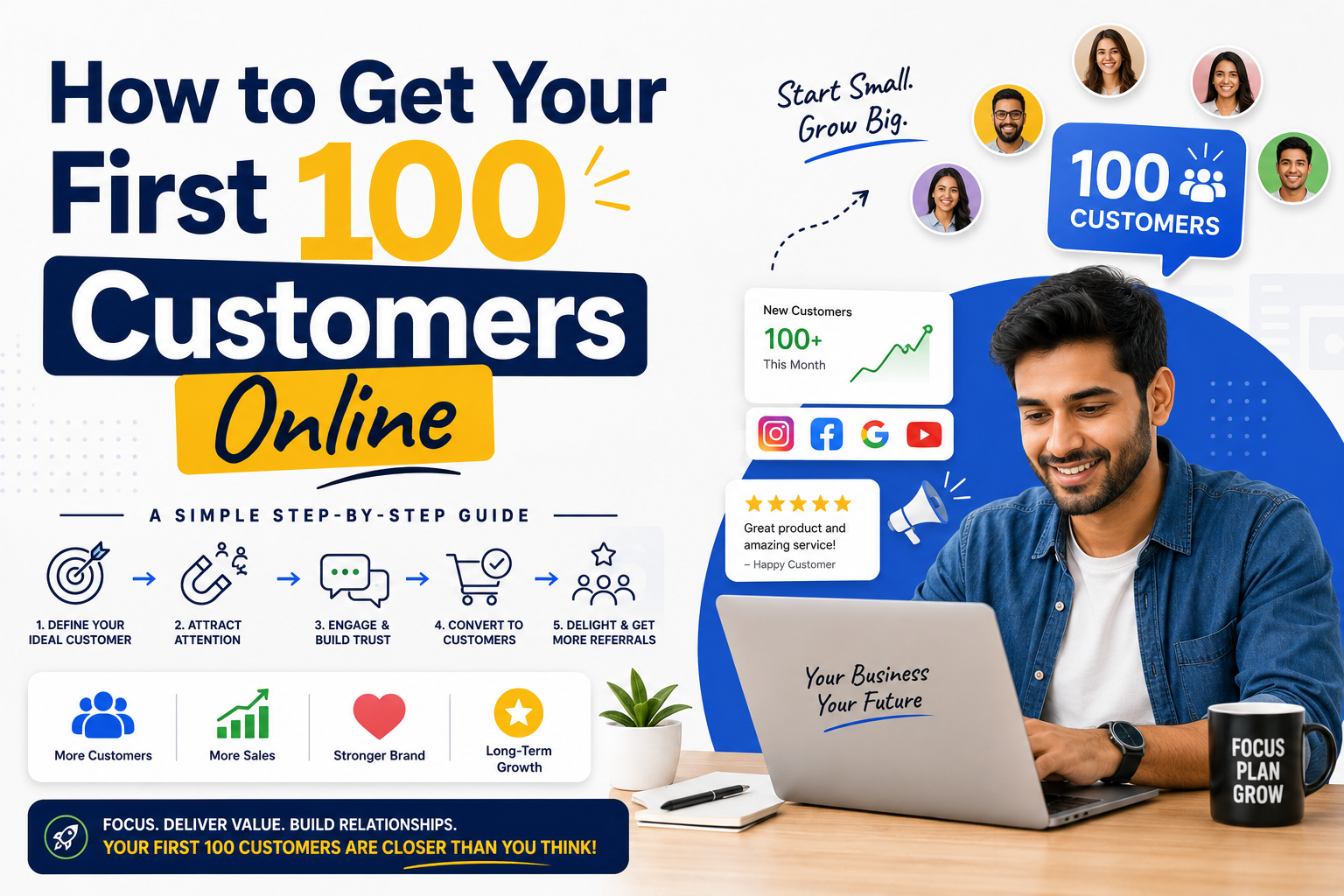
How to Get Your First 100 Customers Online (2026 Guide)
By a digital marketing consultant with 10+ years of experience helping new and growing businesses across Gujarat and India build their first customer base.
Divyaben started her home-based catering business in Vastral, Ahmedabad during the lockdown of 2020. Her husband had taken a pay cut. Her two children were home from school. She had always cooked — really cooked, the kind of dal dhokli and undhiyu that took three hours and smelled like a Sunday at her mother's house in Rajkot — and a neighbour suggested, half-jokingly, that she should start selling.
So she did. Gujarati thalis: dal, sabzi, rotli, chaas, one sweet. The kind of food that office workers eating alone in rented rooms genuinely missed. Everyone who tried it said it was the best they had eaten since leaving home.
For the first three months, she had exactly four customers.
She was not failing because her food was bad. She was failing because nobody outside her immediate social circle knew she existed — and because the handful of people who did hear about her had no easy way to verify that she was a real, trustworthy business worth ordering from.
That gap — between a genuinely good product and a paying customer base — is the problem this article solves. The path from four customers to a hundred is more systematic than most new business owners expect. It does not require a large budget or a marketing team. It requires five things done consistently over ninety days, and an understanding of why each one matters.
What Google's Own Research Says About How Customers Find New Businesses
Before the five steps, a piece of context that shapes all of them.
Google's Think With Google research has consistently found that the vast majority of purchase decisions — including for local products and services — begin with an online search or involve online research before any contact is made. For Indian consumers specifically, smartphone penetration and affordable mobile data have made this even more pronounced: a potential customer who hears about your business from a friend is now almost certain to search it on Google or check your Instagram before messaging you.
This means two things for any new business. First, your online presence is not supplementary to your product or service — it is the first version of your product that most potential customers experience. Second, the signals those customers encounter in the first few seconds of finding you online — your photos, your reviews, your business description, whether a website exists — directly determine whether they contact you or move on.
The five steps below address each stage of this process: being found, being trusted, removing friction, accumulating social proof, and staying visible.
Step One: Build Credibility Before You Spend a Rupee
Here is the most consistent pattern I have observed across a decade of working with new businesses in Gujarat: the first businesses to attract customers are almost never the ones with the best product. They are the ones that look the most trustworthy to a stranger in the first five seconds of encountering them online.
When someone hears about a new catering business in Vastral, they search the name on Google. They look at the listing photo. They check if there are any reviews. In five seconds — before they have read a word of description — they have made a preliminary judgment about whether this looks like a real, established business or a side project that might not exist next week.
If the signals are wrong — a GBP listing with three photos and no reviews, an Instagram profile with no bio and twelve posts, no website — potential customers quietly move on. Not because your product is worse. Because the indicators of professionalism and permanence were absent.
What the research confirms: Stanford University's Web Credibility Research Project found that 75% of consumers judge a business's credibility based on the quality of its digital presence — including design, completeness, and photographic quality. For a new business with no existing reputation, your digital presence is your reputation, and it is assessed within seconds.
Set up your digital infrastructure — in this order
Google Business Profile first. Claim and verify it at business.google.com before anything else. Fill every field: a specific business category (not a generic one), accurate hours including festival days, a genuine 750-character description that names your specific products and service area, and a minimum of 15 photographs. The GBP listing is where local customers find you in Google search and Google Maps — it is the single most important credibility signal available to a local business in India, and it is entirely free. We have written a complete optimisation guide for this specifically — but if you do one thing this week, make it this.
WhatsApp Business second. Not your personal app — the dedicated business app. Set up your professional display name, a clear business description with your hours and service area, and a product catalogue with photos and prices. When a potential customer messages you for the first time, they see your profile before they read your reply. Three seconds of that profile impression shapes whether they proceed or close the conversation.
A basic website or link-in-bio page third. You do not need ₹40,000 and two months of development time to start. A clean four-page website on a template — or a well-designed bio.site or Linktree page — gives you a destination that feels more credible than a bare phone number. For service businesses, this distinction is particularly significant: the presence of a professional website is one of the most reliable signals that a service provider is established and serious.
Trust-building implementation tip: Register your business domain name today — even if your website is not ready yet. A .in domain costs approximately ₹800 to ₹1,200 per year. Use it immediately for a professional email address (yourname@yourbusiness.in). A business quotation or inquiry reply sent from yourname@gmail.com and one from yourname@divyascatering.in send completely different signals about the maturity of the operation behind them.
The two things that do the most for first impressions
Professional photographs. Not selfies. Not photos taken in poor light. If you sell food, photograph it in natural daylight against a clean, neutral background. If you offer a service, photograph yourself in the act of doing the actual work — not standing against a wall.
A ₹2,000 ring light and an afternoon dedicated to photography will transform how your business looks to a stranger more than any other single investment you can make in the first week. Sixty to eighty percent of a first-time visitor's impression of your business is visual — this is not something to leave to chance or phone-camera convenience.
A specific, detailed business description. The difference between these two versions of Divyaben's description is the difference between looking like a hobbyist and looking like a business:
Version 1: "Quality home-cooked food delivered with love."
Version 2: "Home-cooked Gujarati thali — dal, sabzi, rotli, chaas, and one sweet — delivered within 5 km of Vastral, Monday to Saturday, orders accepted until 11 AM, minimum order 2 thalis."
Specificity signals that this is a real operation with real systems and a clear service offer. Vagueness signals the opposite. Every field in your digital profiles is an opportunity to be specific — and specificity builds trust in a way that warm language alone never achieves.
Step Two: Create Offers That Make the First Try Feel Risk-Free
Once your digital presence signals credibility, the next barrier is inertia. A potential customer can genuinely like what they see — and still not act. Because placing an order with someone they have never bought from before involves uncertainty, and uncertainty makes people delay.
Your first offer needs to eliminate that uncertainty by reducing the cost of the first decision to near zero.
The introductory offer that lowers the barrier
Divyaben thought about this carefully. A small discount on a ₹80 thali did not feel like it would change anyone's behaviour — the saving was not significant enough to overcome the uncertainty of trying something new. So she made a bolder decision: the first thali in any order of two or more was free. Not discounted. Free.
Her reasoning was clear and worth understanding: if someone tries the food and loves it, they will order again next week and every week after. If they try it and are not satisfied, she needs to know that now — that information is worth more than the cost of a thali, and discovering it early is better than discovering it after six months of building a business on the wrong product.
In the first month of extending this offer — through personal WhatsApp messages to every contact in her phone who might be interested, sent by name, not as a broadcast — she had fourteen new trial customers. Nine returned the following week at full price. The cost of the five who did not convert: ₹400 in thalis. The value of the nine regulars over the following three months: substantially more.
Expert insight: Robert Cialdini, social psychologist and author of Influence: The Psychology of Persuasion — one of the most widely studied books in consumer behaviour — documents extensively that the principle of "reciprocity" is one of the most powerful drivers of purchasing behaviour. When a business gives something genuine before asking for payment, it creates a psychological sense of obligation in the recipient that makes them more likely to engage and more likely to return. This is the mechanism behind free trials, free samples, and introductory offers — and it works across cultures, including Indian consumer behaviour.
For service businesses, the equivalent of the free thali is the free first session. A yoga instructor in Rajkot's Satellite area runs every newcomer through a free trial class before a monthly package is discussed. A financial planning consultant in Vadodara offers a free 30-minute assessment to every new enquiry. A home cleaning service in Bopal, Ahmedabad offers a free single-room clean so the customer can assess the standard before booking the whole house. Each of these offers costs something. Each of them removes the uncertainty that makes first-time customers hesitate.
Practical implementation: Design your introductory offer before you start any outreach or marketing. Write it out as a clear, specific sentence — not "special discount for new customers" but "your first thali is on us with any order of two or more — WhatsApp us to claim." Specificity and clarity in the offer statement itself make it more likely to be acted on.
The guarantee that signals genuine confidence
Most new businesses avoid explicit guarantees. The concern is being taken advantage of. The businesses I have seen grow fastest in their first year almost always do the opposite.
A prominent, specific, easy-to-claim satisfaction guarantee accomplishes two things simultaneously: it reduces the risk of the first purchase for the customer, and it signals to every potential customer who reads it that you are genuinely confident in your product or service.
"If you are not completely happy with your thali, we will refund you in full — no questions, no hassle."
In Divyaben's first six months with this guarantee displayed, she gave three full refunds. She also collected 47 Google reviews and built a waiting list for new weekly subscription slots. The three refunds cost ₹240. The trust the guarantee created was worth multiples of that figure in customers who chose her over competitors because she was the only one willing to stand behind her product that clearly.
Bundle to convert trial customers into recurring ones
A single order at full price is a transaction. A subscription or bundle is the beginning of a relationship — and relationships are the foundation of a stable, predictable small business.
Once Divyaben had fourteen trial customers, she introduced a weekly subscription: five thalis for the price of four, paid in advance on Sunday evening for the coming week. Eight of her fourteen trial customers took it immediately. Her revenue for the following week was, for the first time, a known number before Monday morning. Her customers felt they had a meaningful deal. She could plan her shopping with confidence.
The same principle applies across categories: a Surat salon offering a monthly grooming membership, an Ahmedabad CA firm bundling quarterly compliance into a fixed annual retainer, a Gandhinagar tuition teacher offering a semester rate. Each bundle converts an occasional buyer into a committed one — which is the most valuable category of customer any small business can have.
Step Three: Use Local SEO to Reach People Who Have Never Heard of You
Steps One and Two work on the people who have already heard of you in some way — through a WhatsApp forward, a friend's mention, a social media encounter. This step is fundamentally different: it is how complete strangers find your business when they search Google for what you offer, with no prior knowledge of your existence.
Local SEO — optimising your presence so Google shows your business in local search results — is the most sustainable, cost-free channel for customer acquisition available to any small business. Unlike paid advertising, its effects compound over time rather than stopping the moment you stop spending.
What the data shows: BrightLocal's 2024 Local Consumer Review Survey found that 98% of people used Google to find local business information in the past year, and that businesses appearing in the top three local map pack positions receive the overwhelming majority of clicks and calls from those searches. For a home catering business in Vastral, a cleaning service in Bopal, or a salon in Rajkot, being in that top three is worth more than almost any other marketing investment.
The three local SEO moves that matter most in the first 90 days
Build your Google review base systematically. A GBP listing with 25 recent, genuine reviews outranks one with 3 reviews in almost every local search scenario, regardless of how complete or well-optimised the lower-review listing is. The way to build reviews is not complicated: ask every satisfied customer directly, give them the link immediately, and send the request within 24 hours of the completed order or service while the positive experience is still fresh.
Here is the exact WhatsApp message Divyaben used, word for word:
"Namaste! Hope you enjoyed today's thali. If you have two minutes, a Google review would genuinely help our small business reach more families in Vastral. Here's the direct link: [GBP review short link]. Khub khub aabhar!"
She sent this to every customer within 24 hours of every order. In two months, she had 23 reviews. Her listing began appearing in local searches for "thali delivery Vastral" within six weeks of her first ten reviews arriving.
Get listed on the right Indian directories. JustDial, Sulekha, and for food businesses the Swiggy and Zomato business owner portals — each one is a free citation that tells Google's local algorithm your business is real, cross-referenced, and established. The rule for all of these is NAP consistency: your business Name, Address, and Phone number must be letter-perfect identical across every listing. Inconsistencies reduce the ranking benefit these citations provide.
Use location-specific language everywhere. In your GBP description. In your Instagram captions. In your WhatsApp Business profile. In your website page titles. "Home-cooked Gujarati thali delivery in Vastral, Ahmedabad" is a searchable phrase. "Quality home-cooked food" is not. Location-specific language in your content makes you findable for the search queries your ideal customers are actually entering.
Practical implementation: Generate your GBP review short link from your GBP dashboard (under "Get more reviews"), save it as a text shortcut on your phone, and make sending it after every completed order a non-negotiable part of your service process. Treat it like locking up after closing — something you always do, without exception.
Step Four: Collect Social Proof Deliberately and Continuously
There is a well-documented principle in consumer psychology that researchers call social proof: the human tendency to use other people's choices and endorsements as signals for our own decisions. In the context of a new business, it explains why a catering service with 40 reviews and 200 Instagram followers is dramatically easier to sell to new customers than one with an identical product but no visible track record.
For a new business, social proof does not accumulate on its own. It needs to be deliberately collected, prominently displayed, and continuously refreshed.
Expert insight: Robert Cialdini's research on social proof — documented in Influence and validated by decades of subsequent consumer behaviour studies — shows that social proof is most powerful when it comes from people the potential customer perceives as similar to themselves. For an Indian home catering business, a testimonial from a 28-year-old software engineer living away from home carries more weight than a testimonial from anyone else — because the business's ideal customer is that exact person. Collecting and displaying testimonials from your most representative customers is not just good marketing; it is targeting.
The social proof assets that move people most effectively
WhatsApp message screenshots are the most powerful social proof available to any Indian small business — and the most consistently underused. When a customer sends you a happy message — formal or casual, in Gujarati, Hindi, or English — that message is authentic evidence of a real customer's real experience. Screenshot it with the customer's permission (almost always given eagerly) and post it on your Instagram Stories, your GBP photos section, and your WhatsApp Status.
Divyaben's most shared and most influential piece of content in her entire first year was not a professional photo or a designed graphic. It was a voice note transcript. A customer from Nikol had sent her a voice message saying her thali tasted exactly like his mother's cooking and that eating it made him less homesick. She turned the transcript into a simple graphic with a photo of the thali behind it and posted it to Instagram Stories. It was reshared by six people in 48 hours, generating eleven new enquiries and seven new orders from people she had never interacted with before.
User-generated content — photos and posts that customers create publicly and tag you in — provides third-party credibility that your own content cannot replicate. It signals that real people are voluntarily choosing to associate your business with their public identity. Encourage it by making your product visually appealing (good packaging, beautiful presentation, something that makes people want to photograph it), by occasionally offering a small incentive for customers who post publicly, and by resharing every piece of UGC you receive on your own profile.
Before-and-after documentation for service businesses. A painter in Ahmedabad who photographs a room before and after. A tailor in Surat who photographs a blouse before and after alteration. A physiotherapist in Vadodara who — with explicit patient consent — documents mobility improvement over six sessions. These posts require no caption. The visual evidence carries itself.
Specific numbers in your bio and description. "Serving 63 happy customers across Vastral and Nikol" is more convincing than "delighting customers with home-style food." Numbers feel verifiable. Verifiable things feel trustworthy. Update this number every month as it grows.
Practical implementation: Create a simple system for collecting testimonials. After every positive interaction, send this message: "We are so glad you are happy! Would you mind if we shared your feedback on our Instagram? It really helps other customers know what to expect." Almost everyone says yes. Screenshot immediately before the conversation continues. Store these in a dedicated folder on your phone so you have a library to draw from.
Step Five: Use Content Marketing to Build Trust at Scale
The first four steps convert people who are already aware of you in some way — people who have heard your name, received a WhatsApp forward, or arrived at your listing through a search. Content marketing is how you create awareness in people who have never encountered you at all — by sharing genuinely useful information that attracts potential customers before they have thought about needing what you offer.
For a home catering business, a solo service provider, or a small product business, "content marketing" does not mean a professional blog, a podcast, or a YouTube channel. It means showing up consistently on one platform, sharing things that your specific ideal customer genuinely values, and building a reputation over time as someone worth following — before you ask them to buy anything.
Expert insight: Marketing professor Mark Schaefer, author of Marketing Rebellion, has documented through analysis of hundreds of small business case studies that content consistency — showing up in the same place, in the same voice, for the same audience, week after week — is a more powerful predictor of content marketing success than content quality. His finding: a business that posts three useful, genuine pieces of content per week for six months will consistently outperform a business that produces one brilliant piece and then nothing for three months. For a new business with limited resources, this means consistency matters more than polish.
One platform, done consistently, beats six platforms done partially
The most common content marketing mistake I see from new business owners is launching on every platform simultaneously after reading an article like this one. Instagram, Facebook, YouTube, LinkedIn, and a blog — all started in the same week, all producing mediocre content because no single platform gets enough time or focus. Three weeks later, everything is abandoned.
Pick the single platform where your ideal customer type spends the most time. Research it if needed — ask three existing or potential customers which platforms they use daily.
For Divyaben, the answer was Instagram. Her target customers — young professionals and students in their 20s and 30s living away from home — scrolled food content daily and responded strongly to photography. Her strategy was deliberately simple: one photo of that day's thali every day for sixty days. A two-line caption about the dish or an ingredient or the season. One line reminding people that orders were open via WhatsApp. Nothing more.
By day sixty, she had 847 followers she had never personally met. Roughly a third had ordered at least once. Her first hundred customers came from those sixty days of simple, consistent posting combined with the four preceding steps running simultaneously.
The platform matches the business type. A CA firm in Rajkot belongs on LinkedIn — one post per week explaining a GST concept that confuses small business owners, written without jargon and without a sales pitch at the end. A handloom textile seller in Surendranagar belongs on Facebook — daily photos of new arrivals, with the story of the weave and the artisan behind it. A personal trainer in Surat belongs on Instagram Reels — one 30-second exercise tip every morning, filmed in the society gym where she works.
What determines success on any of these platforms is not production quality or posting frequency alone. It is the consistent delivery of genuine value to a specific audience, over enough time that the platform's algorithm begins promoting your content to people who have not yet discovered you.
Practical implementation: Before choosing your platform, spend one week observing where your ideal customers actually spend time — ask them directly if needed. Then commit to a simple, sustainable posting rhythm: one piece of content per day for Instagram Stories or WhatsApp Status; three posts per week for Instagram feed or LinkedIn; one video per week for Reels or YouTube Shorts. Simple, specific, sustainable — the content strategy that new businesses can actually maintain.
The 90-Day Customer Acquisition Plan
Getting your first 100 customers is a ninety-day project, not a sprint. Here is the specific week-by-week structure that builds them:
Days 1–14: Infrastructure
- Claim, verify, and complete your GBP listing in full
- Set up WhatsApp Business with catalogue, description, and professional profile
- Photograph your product, workspace, and yourself — minimum 20 usable images
- Create your basic website or bio page
- Write your introductory offer as a clear, specific sentence
- Design your guarantee statement and display it prominently
Days 15–45: Activate your existing network
- Send your introductory offer to every relevant contact in your phone — personally, by name, not as a broadcast
- Follow every trial customer with a review request within 24 hours
- Post on your chosen platform every day
- Post on WhatsApp Status every morning — one piece of content
- Track every customer source in a simple spreadsheet: how did they hear about you?
Days 46–90: Expand beyond your existing network
- Ask every satisfied customer for one specific referral by name
- Identify and approach one complementary business for a mutual referral arrangement
- Begin a small paid boost on Instagram or Facebook (₹500 to ₹1,000 per week) targeted to your city and relevant interests, using your best-performing organic content
- Publish one educational, non-promotional piece of content per week
- Review your source tracking spreadsheet and double down on the channel generating the most customers
By day 90, you have data — not just customers. You know which of the five steps is working hardest for your specific business, which type of content generates the most enquiries, and which channel your most loyal customers came from. That knowledge is what shapes your next hundred customers, and the hundred after that.
Conclusion: 100 Customers Is a System, Not a Lucky Break
Divyaben hit her hundredth customer at the end of week twelve. Her hundredth customer had been referred by her twenty-third, who had been referred by her ninth, who had been one of those original fourteen trial thali orders from that first month of personal WhatsApp messages.
That chain — four customers to fourteen trial customers to forty regulars to one hundred — did not happen by accident. It happened because she built credible digital infrastructure before spending anything on marketing. She created an offer that made the first try feel free. She collected reviews systematically. She documented her happiest customer moments as social proof. She showed up on Instagram every day for sixty days.
None of these things required significant money. All of them required consistency.
The first hundred customers are the hardest because you are building trust from zero. No reviews, no history, no reputation that precedes you. You are asking strangers to take a chance on an unknown quantity — which is why every step above is specifically designed to reduce the risk, increase the trust signals, and make the first decision as easy as possible.
But they are also the most valuable customers you will ever acquire. They become your reviews, your referrals, your content, and your social proof. They are the people who will tell others about you before you have any marketing budget to do it yourself. They are the foundation that makes everything after them possible.
Build credibility first. Create a risk-free first offer. Get found in local search. Collect social proof deliberately. Show up with useful content consistently. Those five things, executed in the right sequence over ninety days, are the system. The product provides the reason for people to come back. The system ensures they find you in the first place.
5 — FAQ section (schema-ready)
How long does it take to get your first 100 customers online?
For most small businesses in India, getting the first 100 customers takes between 60 and 90 days when all five strategies — building credibility, creating low-risk offers, using local SEO, collecting social proof, and consistent content — are implemented together. Businesses in highly visual categories like food, fashion, and beauty typically move faster because social media discovery works quickly. Service businesses and B2B companies usually take closer to 90 days because trust-building involves more touchpoints before a first purchase.
How do I get my first customer when I have no reviews and no followers?
Start with your existing personal network — friends, family, colleagues, and community contacts who might genuinely benefit from what you offer. Send personal WhatsApp messages by name (not mass broadcasts) with a low-risk introductory offer that makes the first try feel free or nearly free. Your first five to ten customers will almost always come from your personal network. Use their experience, with permission, to collect your first reviews and social proof — which then makes it easier to convert complete strangers.
Do I need to spend money on ads to get my first 100 customers?
No — and for most new businesses in India, paid advertising is not the right investment in the first 90 days. The five strategies in this guide — GBP optimisation, WhatsApp outreach, local SEO, social proof collection, and consistent organic content — can generate the first 100 customers at minimal cost, typically under ₹5,000 in tools and equipment. Paid advertising becomes valuable in phase three (days 46 to 90) and beyond, once you know which content and channels are already generating customers organically.
What is the fastest way to build credibility for a new business online?
The three fastest credibility-building moves for a new business in India are: claiming and completing your Google Business Profile (free and immediately visible in local search), taking 20 high-quality photographs of your product or service and uploading them across your platforms, and getting your first five Google reviews from people who have genuinely experienced what you offer. Together, these three steps can be completed in under two weeks and immediately differentiate you from competitors who have not done them.
How do I use WhatsApp to get my first customers for a new business?
Set up WhatsApp Business (the dedicated business app, not the personal version) with a professional profile, business description, and product catalogue. Then contact your existing network personally by name — not as a broadcast — with a specific introductory offer. After each successful order or service, send a review request within 24 hours with your Google Business Profile review link. Use WhatsApp Status daily to share photos of your product, completed work, or customer testimonials. These three WhatsApp habits together are among the most effective customer acquisition tools available to any Indian small business at zero cost.
Should a new business offer free trials or discounts to get first customers?
A genuine free trial or low-risk first offer is often more effective than a discount, because it removes the uncertainty of trying something new rather than simply reducing its price. The most effective first offers for Indian small businesses are: a free first unit with a minimum purchase (as in the thali example in this article), a free initial consultation for service businesses, or a satisfaction guarantee that makes the first purchase fully refundable. The goal is to make the cost of being wrong about your business feel negligible — which makes the decision to try it easy.
Ready to Build Your First 100 Customers?
The framework in this article works. What makes it work for your specific business — your customer type, your product category, your city, your budget — is the application.
Help Me Buddy IT Pvt Ltd has helped home-based businesses in Vastral, product sellers in Surat, service businesses in Vadodara and Rajkot, and professional practices across Ahmedabad build their first hundred customers using exactly this system — adapted to their specific situation, their specific customers, and the specific channels where those customers spend time.
We start every engagement the same way: by understanding your business before recommending anything. Not a package. Not a template. A strategy built around your situation.
📞 Book a free 30-minute consultation. We will review where you are, identify your fastest path to your first hundred customers, and give you a clear, specific action plan — no commitment and no pressure to proceed.
Visit helpmebuddy.in or send us a message on WhatsApp.
Because a hundred customers is not a distant milestone. It is ninety days of the right actions, in the right order, done consistently.
Comments
Share your thoughts about this post.