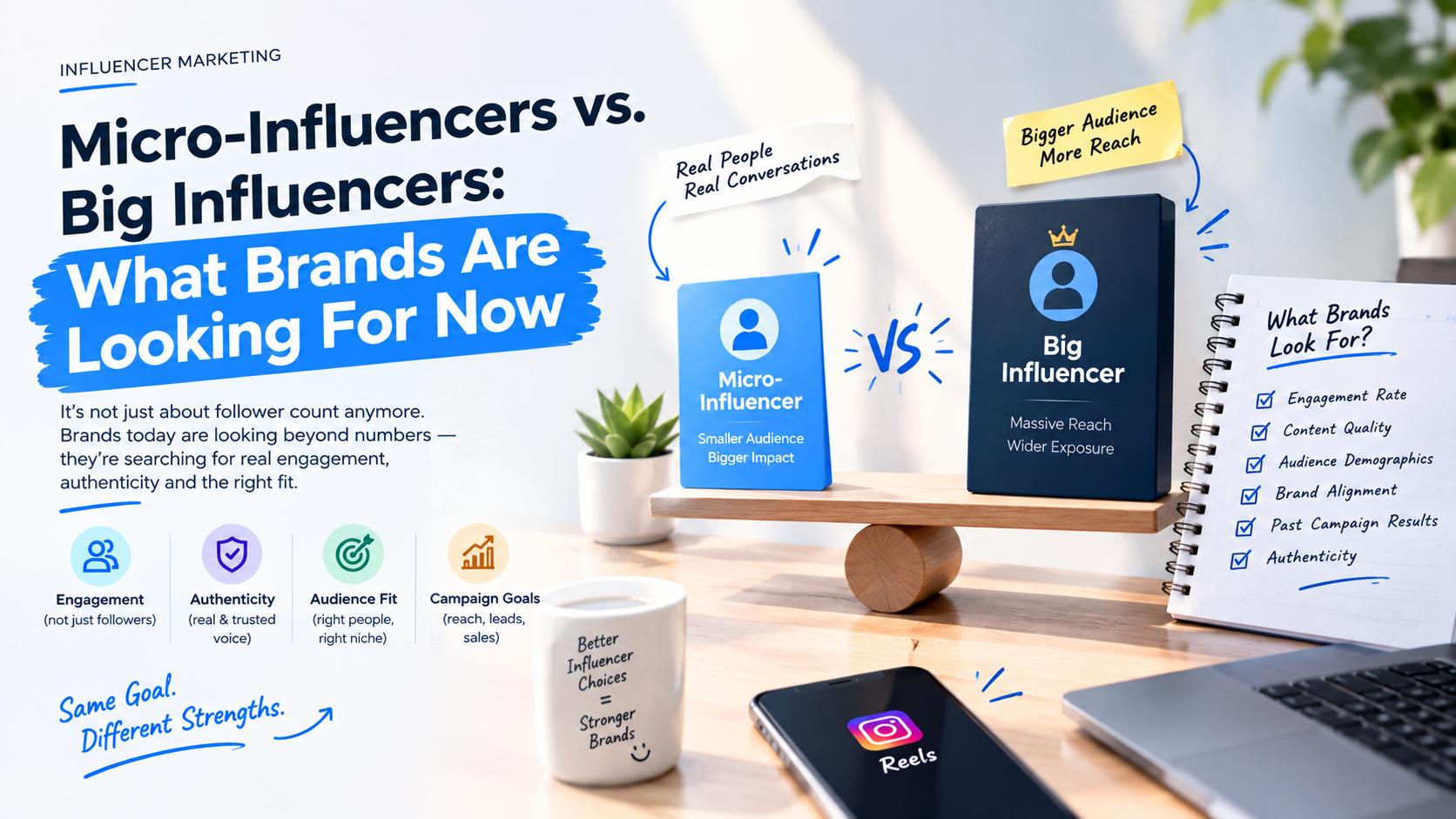
Micro-Influencers vs. Big Influencers: What Brands Are Looking For Now
By a social media strategy consultant with 10+ years of experience helping small and medium businesses across Gujarat and India build audiences that convert.
The Order That Never Came
Ketan Sanghavi runs a third-generation zari and embroidery unit in Surat's Sarthana textile belt. In early 2023, he did what every consultant, every LinkedIn post, and every nephew-with-an-opinion told him to do: he paid a Mumbai-based lifestyle influencer with 4.2 lakh followers to feature his festive-wear collection in a 30-second reel.
The reel got 89,000 views in four days. Ketan's WhatsApp Business number lit up with congratulatory messages from relatives. His Instagram followers jumped from 1,800 to 6,400 almost overnight. And then—nothing. Not one genuine inquiry. Not one order. When he finally messaged the influencer's team to ask why, the reply was polite and useless: "Reach doesn't always convert to sales, sir, that's normal."
Ketan had spent nearly ₹45,000 on a campaign that brought him vanity metrics and a bruised bank balance. What stung more was that his own cousin, who sold handloom stoles from a single room in Bhuj, had spent ₹6,000 on four local Kutch-based influencers—women with 3,000 to 9,000 followers each, all genuinely into sustainable fashion—and sold out her entire festive stock in ten days.
That was Ketan's turning point. Six months later, working with five micro-influencers across Surat and Ahmedabad—a bridal makeup artist, a Gujarati home-decor blogger, a saree-styling college student, and two mid-size fashion pages—Ketan didn't just see likes. He saw people walking into his showroom holding screenshots of the reels, asking specifically for "the mustard zari dupatta from the Instagram video." His revenue from social media-driven footfall grew by roughly 60% that wedding season. The follower count barely moved. The bank balance did.
The Shift That Is Already Underway
Ketan's experience isn't an isolated Gujarati anecdote—it mirrors a global recalibration in influencer marketing that data has been confirming for several years now.
According to Sprout Social's Influencer Marketing Report, 61% of consumers say they trust influencer recommendations more when the creator has a smaller, more niche following, and brands increasingly rate micro-influencers as delivering the strongest ROI per rupee (or dollar) spent compared to celebrity-tier creators.
The Edelman Trust Barometer has tracked a parallel pattern for years: trust in "a person like me" consistently outperforms trust in celebrities and even CEOs when it comes to believing information about a company or product. Edelman's research puts peer trust and everyday-expert trust well ahead of famous-person endorsement, precisely because audiences read relatability as honesty.
Meta's own Business research on creator partnerships has found that campaigns using multiple smaller creators in a niche category frequently outperform single celebrity placements on cost-per-engagement and on-platform actions like saves, shares, and profile visits—the very signals that predict purchase intent, especially in category-specific verticals like fashion, food, and home.
And Bain & Company's consumer research on trust and purchase decisions has repeatedly found that recommendation credibility, not exposure volume, is what most reliably shortens the path from "I saw this" to "I bought this."
The pattern across all of this data is consistent: brands are not chasing eyeballs anymore. They are chasing believability. And believability, it turns out, scales down, not up.
1. Trust Over Followers: Why Smaller Feels More Honest
The Expert Insight
“People don't trust reach. They trust proximity.” — Mark Schaefer, marketing consultant and author of “Marketing Rebellion,” has long argued that the future of marketing belongs to what he calls the “Alpha Audience”—a smaller, highly engaged group whose recommendations carry outsized influence precisely because they are seen as peers, not performers.
Why This Matters
A follower scrolling past a celebrity's sponsored post has learned, consciously or not, to discount it—they assume money changed hands and the enthusiasm is manufactured. But when a micro-influencer they've followed for two years, whose kitchen or living room or daily routine looks like theirs, recommends a product, the endorsement reads as testimony, not theatre. Scale kills intimacy, and intimacy is the actual currency of persuasion.
Indian Business Example
A home-bakery brand in Vadodara, run by a homemaker named Foram, ignored the temptation to chase a big food blogger and instead sent free hampers to eight Vadodara-based “mommy bloggers” with 2,000–8,000 followers. Because these women genuinely used the product for their own children's birthday parties, their captions read as real reviews. Foram's business went from weekend orders to a booked-out order calendar within two festive months, entirely without paid ads.
2. Niche Audiences: Depth Beats Breadth
The Expert Insight
“The riches are in the niches.” This idea, popularised by digital marketing strategist Neil Patel across his writing on content and influencer strategy, captures a core truth: a creator who speaks to 5,000 people who all care intensely about, say, Kolhapuri-style footwear or Kutchi mirror-work jewellery, will move product faster than a generalist speaking vaguely to a million people about “lifestyle.”
Why This Matters
Reach without relevance is just noise. A fitness page with 500,000 followers is largely useless to a brand selling handwoven Patola sarees, no matter how impressive the number looks in a proposal deck. Niche audiences have already self-selected into a specific interest, which means the creator's followers arrive pre-qualified—closer to a warm lead list than a cold billboard.
Indian Business Example
A Rajkot-based brass and metal handicrafts exporter struggled for years to get traction with broad “Indian handicrafts” influencers whose audiences spanned everything from travel to tech. The turning point came when they partnered with three niche “slow home decor” and “sustainable interiors” creators, each with under 15,000 followers but a hyper-specific audience of people actively furnishing or renovating homes. Inquiries from that campaign converted at nearly four times the rate of any previous broad-audience collaboration.
3. Creator-Brand Fit: The Collaboration Has to Make Sense
The Expert Insight
Influencer marketing pioneer and Later.com's creator-economy research consistently emphasizes that mismatched partnerships—a creator promoting something outside their established content identity—damage both the creator's credibility and the brand's, because audiences can sense when a collaboration doesn't fit the creator's established world.
Why This Matters
A creator known for budget student cooking who suddenly promotes a luxury skincare brand creates cognitive dissonance for their audience—it reads as a paid post rather than a preference, which erodes trust for both parties. Fit is what makes sponsored content feel like a natural extension of the creator's existing content rather than an interruption to it.
Indian Business Example
An Ahmedabad-based ayurvedic skincare startup initially approached fashion influencers with broad beauty content, seeing mediocre results. When they shifted to partnering with creators who specifically produced “clean beauty” and “ayurveda in daily life” content—even ones with modest followings under 10,000—engagement rates on sponsored posts roughly tripled, and repeat-purchase rates from those campaigns were noticeably higher than from the earlier, broader collaborations.
Why Consistency Beats a Single Big Splash
There's a well-documented psychological principle at play here called the mere exposure effect—first studied extensively by psychologist Robert Zajonc in the late 1960s—which shows that people develop increasing preference for things simply through repeated, familiar exposure. A single dramatic post from a mega-influencer is a spike; it fades from memory within days. But seeing the same trusted micro-influencer mention a brand three or four times over two months, in different contexts (a haul video, a casual mention in a vlog, a follow-up review), builds a slow-drip familiarity that eventually reads as endorsement, then as habit, and finally as brand loyalty.
This is precisely why Ketan Sanghavi's second campaign in Surat worked where his first one didn't: five smaller creators, each posting two to three times over a wedding season, created cumulative familiarity across overlapping local audiences—people were seeing his zari work mentioned again and again by voices they already trusted, not once by a stranger they didn't.
For brands working with limited budgets, this reframes the entire strategy question. It is rarely better to spend the full budget on one large influencer for one big moment. It is almost always better to spread that same budget across several well-fitted micro-influencers over a sustained period, letting repetition do the persuasive work that a single flashy post cannot.
The Business Case: What the ROI Data Actually Shows
This isn't only about feeling more “authentic”—it shows up directly in business numbers. Industry analyses, including Sprout Social's benchmarking of influencer partnerships, have repeatedly found that micro-influencer campaigns deliver meaningfully higher engagement rates (often several times higher) than celebrity or macro-influencer campaigns of comparable spend, largely because engagement rate tends to fall as follower count rises—a pattern documented across multiple platform studies.
For small and medium Indian businesses in particular, this translates into a much more favourable cost-per-acquisition. A brand that might spend ₹50,000 on one macro-influencer post can typically fund 8–10 micro-influencer collaborations for the same amount, each with a smaller but far more convertible audience. Repeat-customer data from businesses that consistently work with niche micro-influencers also tends to show stronger retention, since these campaigns attract buyers who found the brand through a trusted recommendation rather than a passive ad impression—and trust-driven customers are statistically more likely to become repeat customers than impression-driven ones.
For a Gujarat-based SME watching every rupee of marketing spend, that difference between “reach” and “retained revenue” is not academic. It's the difference between a campaign that photographs well in a report and one that keeps the lights on.
Back to Sarthana
Today, Ketan Sanghavi still gets the occasional pitch from agencies offering “access” to influencers with lakhs of followers. He listens politely and says no. His showroom now works with a rotating group of eleven micro-influencers across Surat, Ahmedabad, and Rajkot—stylists, brides-to-be documenting their own shopping journeys, and regional fashion pages—each posting consistently, each genuinely connected to his product.
His follower count is still modest by influencer-marketing standards. His order book is not. The lesson he learned the expensive way is the same one the data has been quietly confirming for years: brands aren't looking for the biggest microphone anymore. They're looking for the most trusted voice in the room—even if that room is small.
FAQ Section (Schema-Ready)
Q1. Are micro-influencers actually better than big influencers for small businesses?
For most SMEs, yes. Sprout Social's research shows micro-influencers typically deliver higher engagement rates than macro or celebrity influencers, and their audiences are more niche and trust-driven. For a limited budget, several micro-influencer partnerships usually outperform one large celebrity post on both engagement and actual sales conversion.
Q2. How many followers count as a “micro-influencer” in India?
Most industry definitions place micro-influencers between roughly 10,000 and 100,000 followers, with “nano-influencers” below that (1,000–10,000). What matters more than the exact number is engagement rate and niche relevance to your product category, which is a stronger predictor of ROI than raw follower count.
Q3. How much should a small business in Gujarat budget for an influencer campaign?
There's no fixed number, but a common approach is to allocate the amount you might spend on a single macro-influencer post (often ₹30,000–₹60,000) across 6–10 micro-influencer collaborations instead. This spreads risk, builds the mere-exposure repetition effect, and typically produces a lower cost-per-acquisition.
Q4. How do I measure whether an influencer campaign actually worked?
Move beyond likes and follower growth. Track saves, shares, direct messages, unique discount-code redemptions, and footfall or inquiries directly attributable to a campaign. Edelman's trust research and Meta's creator studies both point to engagement depth (saves, shares, comments) as a far stronger predictor of purchase intent than reach.
Q5. Should I ever work with a big influencer instead of micro-influencers?
Large influencers can still be useful for pure brand awareness or a major launch moment, especially for bigger budgets. But for most SMEs focused on direct sales and limited marketing spend, niche micro-influencers with strong creator-brand fit consistently deliver better ROI, as multiple industry studies including Bain & Company's trust research confirm.
Q6. How long does it take to see results from a micro-influencer campaign?
Because the mere exposure effect relies on repetition, most businesses see meaningful traction after 6–10 weeks of consistent posting across multiple creators, rather than from a single post. Ketan Sanghavi's Surat campaign, for example, showed strong results over one full wedding season rather than overnight.
Ready to Build an Influencer Strategy That Actually Converts?
If you're a business owner in Gujarat or anywhere in India wondering whether your influencer budget is working as hard as it should, Help Me Buddy IT Pvt Ltd helps SMEs identify the right creator partnerships, build consistent campaigns, and measure results that go beyond follower counts.
Get in touch:
• Website: helpmebuddy.in
Comments
Share your thoughts about this post.