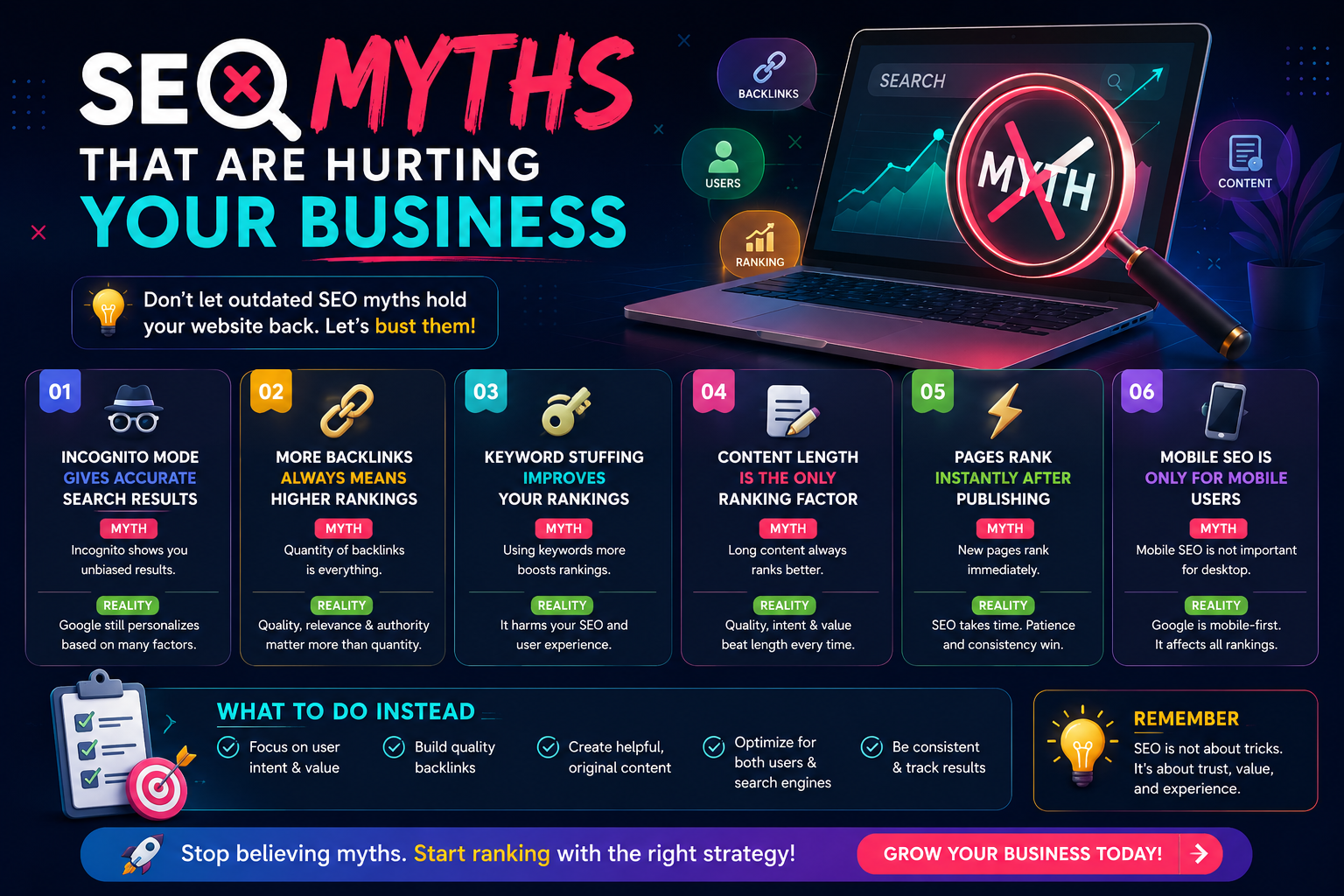
SEO Myths That Are Hurting Your Business
By a digital marketing and SEO consultant with 10+ years of experience working with small and medium businesses across Gujarat and India.
Maheshbhai has been making ceramic tiles in Morbi since 2009. His factory is modest — twelve workers, two production lines, a product quality he is genuinely proud of. When export enquiries started going to competitors who had websites and he had only a WhatsApp number, he decided in 2022 that it was finally time to go online.
His nephew found a freelancer. The pitch was confident: first page of Google in 30 days, ₹8,000 per month, guaranteed results.
Maheshbhai paid two months upfront. Sixteen thousand rupees.
What arrived, though he did not know it at the time, was exactly the wrong kind of help. His website pages were stuffed with keywords until the text was nearly unreadable. Two hundred "backlinks" were created — from Chinese directories, generic blog networks, and unrelated international websites with nothing to do with tiles, Morbi, or India. And then one morning he opened Google Search Console and found something called a "manual action." A Google reviewer had flagged his site for violating quality guidelines.
His website dropped from page three — where it had quietly appeared before any of this started — to being essentially invisible.
The freelancer stopped responding to messages.
It took four months and a legitimate recovery process to undo the damage. I know this because I was one of the people Maheshbhai called when he was trying to understand what had happened to him.
His story is not rare. In the time I have been working with businesses in Gujarat, I have seen versions of it more times than I can comfortably count — a business owner who trusted the wrong person, paid real money, and came out worse than when they started. The frustrating part is that every single technique that harmed Maheshbhai's ranking was presented to him as standard SEO practice.
This article documents five of the most damaging SEO myths circulating in India's small business market — where they came from, what the published evidence says about why they fail, and what legitimate alternatives look like.
Why These Myths Survive Despite Consistently Failing
Before the specific myths, the structural reason they persist.
The honest answer to "how long does legitimate SEO take?" is three to six months for initial traction and twelve or more months for competitive, meaningful results. That is an accurate answer but a difficult one to sell to a business owner who needs customers next quarter. So a certain class of SEO provider has built a market by telling people what they want to hear instead of what the evidence shows.
What Google's own data reveals: Google's Search Quality Rater Guidelines — a public document that outlines how Google trains human reviewers to evaluate website quality — describes the target as content that demonstrates "Experience, Expertise, Authoritativeness, and Trustworthiness" (EEAT). Every myth in this article represents a shortcut that tries to simulate these qualities rather than build them genuinely. Google's spam prevention team published data showing over 2.9 million manual actions taken against websites in a single recent reporting period — the majority targeting the exact techniques sold to small businesses as "quick wins."
Google penalties are not self-correcting. Unlike a slow website or a poorly written page, the damage from a manual action or an algorithmic penalty requires active remediation — identifying every problem, submitting documentation to Google, and waiting through a review process that can take weeks. Understanding what these penalties look like before you encounter them is the most effective protection available.
Myth One: More Keywords Means Higher Ranking
There are still freelancers in India actively selling keyword density as a primary ranking strategy. The pitch has a surface logic: Google is a search engine, it looks for keywords, so more keywords should make it think your page is more relevant.
This was partially true in the late 1990s. At that time, Google was largely a keyword-counting machine. If you used a term more frequently than your competitor, you often outranked them. That window closed over two decades ago.
Expert insight: The 2011 Panda update — Google's first major content quality algorithm — specifically targeted pages that used keyword repetition as a manipulation tactic. Gary Illyes, a technical analyst at Google's Search Quality team, has stated in multiple public forums that Google's current natural language processing identifies keyword stuffing as a negative quality signal, not a positive relevance one. Google's models can understand that "income tax filing," "ITR submission," and "file your taxes" all refer to the same concept — it does not need to see any one of them repeated to understand what your page is about.
A direct example from my audit files: a CA firm in Ahmedabad had a homepage that used the phrase "best CA in Ahmedabad" fourteen times in a 400-word page. Not twice. Fourteen. The text was functionally unreadable to any human who encountered it. Their bounce rate — the proportion of visitors who arrived and immediately left without taking any further action — was above 90%. The page had not ranked for any meaningful commercial search term in over a year, despite the keyword density that was supposed to be helping.
This is the mechanism by which keyword stuffing now harms rather than helps: Google increasingly uses user behaviour signals to assess page quality. When visitors consistently arrive on a page and immediately leave — what is called "pogo-sticking" — Google interprets that as evidence that the page failed to satisfy the search. A page that drives visitors away is a page Google progressively stops recommending.
Practical implementation: Write content that fully answers what the searcher is actually asking. Use your primary keyword in the page title, the main H1 heading, and once or twice in the body where it arises naturally. Include semantically related terms — Google's knowledge graph understands topic coverage, not just keyword frequency. The most reliable editorial test: read the finished content aloud. If it sounds like a normal person wrote it for another normal person to read, it will perform better than anything engineered for an algorithm.
Implementation tip: In Google Search Console, navigate to Performance → Search Results and filter by queries. This shows you the actual search terms bringing visitors to each page. Pages with high impressions but low click-through rates often have title and description mismatches with user intent — a more useful diagnostic than keyword density.
Myth Two: Buying Backlinks Is a Legitimate Shortcut
The logic behind this myth is grounded in something real, which is part of why it persists.
Backlinks — links from other websites pointing to yours — are genuinely one of Google's most significant ranking signals, a fact confirmed repeatedly in Googler statements and SEO research going back to the PageRank paper Larry Page and Sergey Brin published before founding Google. When reputable websites link to yours, Google interprets it as evidence that your content has value worth referencing. That signal has been part of Google's algorithm since the beginning.
The myth is in what people conclude from this: that quantity is what matters, that 500 backlinks are better than five, and that you can purchase them in packages.
Expert insight: In 2012, Google's then-head of search spam, Matt Cutts, described the Penguin update as specifically targeting "webspam" — including paid link schemes and link networks. In the years since, Penguin has been incorporated into Google's core algorithm rather than running as a periodic update. This means Google's link quality assessment runs continuously rather than in waves — there is no longer a "between Penguin updates" window during which purchased links provide safe temporary benefits before being detected. Google's John Mueller has stated publicly that Google can now detect the majority of unnatural link patterns algorithmically, with manual review reserved for the cases the algorithm flags as particularly egregious.
A single mention in a credible Indian industry publication — a textile trade journal covering a Surat fabric exporter, a pharmaceutical industry directory listing for an Ahmedabad APIs manufacturer — is worth more for ranking purposes than 500 links from unrelated directories, foreign blog networks, or link farms that exist only to sell links. What Google's Penguin algorithm measures is not the count of links but the pattern of acquisition: natural, gradual, topically relevant link growth from credible sources is what signals genuine authority.
The consequences of an unnatural link profile are severe and often disproportionate to what the buyer expected. A manual review can result in a site being partially or completely removed from search results. Algorithmic devaluation can make purchased links worth exactly zero — you paid for a signal Google is ignoring. In the worst cases, the artificial pattern actively reduces ranking below what the site would have achieved organically.
Maheshbhai's two hundred "backlinks" were exactly this category of damage. Every one of them signalled to Google's quality systems that something artificial was happening. The manual action was the consequence.
Practical implementation for earning genuine links:
A tile manufacturer in Morbi builds legitimate link authority through a specific sequence — not through purchasing anything. First, accurate and complete listings on IndiaMart, TradeIndia, the Gujarat Chamber of Commerce directory, and GIDC industrial estate listings create foundational citations that are topically relevant and locally credible. Second, producing genuinely useful content — a detailed guide to tile thickness specifications for different floor applications, a comparison of ceramic versus vitrified tile suitability for Gujarat's climate — gives architecture firms, construction companies, and interior design blogs something worth linking to because it is actually useful to their readers. Third, earned mentions from trade publications covering the Morbi tiles industry create the highest-value links, because they come from the most authoritative and relevant sources.
None of these links can be purchased. All of them compound over time.
Myth Three: A Guarantee of First Page Rankings Is a Signal of Competence
When I speak at business events in Ahmedabad and Surat, I ask the room: how many of you have received a WhatsApp message, a brochure, or a cold call promising first page Google results in 30 days?
Consistently, most hands go up.
What Google itself says: Google's official Webmaster Guidelines state: "Be wary of SEOs that claim to guarantee rankings, allege a 'special relationship' with Google, or advertise a 'priority submit' to Google." This is not a vague caution — it is Google's explicit public position that ranking guarantees are a red flag, not a sign of confidence. The algorithm changes hundreds of times per year. Rankings depend on competition from other businesses that have been building authority for months or years. No external party has access to Google's ranking system in a way that would allow them to guarantee a specific outcome.
The claim of "first page in 30 days" is one of three things in practice. The first is a zero-volume keyword scam: they deliver a genuine page-one ranking, but for a search term like "ceramic tiles manufacturer in Morbi near the GIDC ring road junction" that gets zero monthly searches from any real buyer. The claim is technically met. The result is completely without commercial value.
The second is a short-term black-hat technique — aggressive link buying, cloaking, or other tactics that briefly elevate rankings before triggering exactly the kind of manual action that hit Maheshbhai. The initial results look real. Then the penalty lands, the ranking collapses below where the business started, and the recovery costs more than the original service.
The third — and this one is specifically worth knowing about — is a personalised search screenshot. Google's results are personalised based on your location, your search history, and your browsing behaviour. If you have been searching for your own business name repeatedly, Google will often show your site in a higher position for relevant queries than it shows to any other searcher. A screenshot of these personalised results is not evidence of ranking performance visible to potential customers.
A colleague working in Vadodara regularly takes on clients who were "guaranteed page one" by a previous provider, for terms that show fewer than ten monthly searches in Google Keyword Planner. The clients did not know to verify search volume. They saw the ranking claim, believed it, and noticed only months later that no enquiries were arriving — and by then they had paid for several months of a service that was, functionally, worthless.
What to ask for instead of guarantees:
Request that any SEO provider share Google Search Console access with you before beginning work, so you have a baseline of current performance. Ask them to show you the specific keywords they plan to target and their search volume in Google Keyword Planner or a similar tool. Ask how they will track actual business outcomes — phone calls, form submissions, WhatsApp enquiries — not just ranking positions. And ask them to describe, in plain language, what their link-building approach involves and why it is consistent with Google's quality guidelines.
An SEO provider who answers all of these questions directly and transparently is probably worth working with. One who deflects, becomes evasive, or emphasises ranking guarantees over business outcomes should be treated with significant caution.
Myth Four: Publishing More Content Produces More Rankings
This myth arrived in full force in the early 2010s, when "content farm" approaches — publishing high volumes of thin, formulaic articles targeting keyword variations — genuinely produced short-term ranking results. Google's Panda algorithm update was specifically designed to eliminate that approach. It is worth noting that this was in 2011. The technique has not worked sustainably for over a decade, yet it continues to be sold.
Expert insight: Google's 2022 Helpful Content update — refined further through 2023 and 2024 — introduced what Google describes as a "site-wide" quality signal. This means that thin, unhelpful content does not just fail to rank on its own; it actively suppresses the ranking performance of good pages on the same website. John Mueller, Google's Search Advocate, confirmed in a public Q&A that the Helpful Content classifier evaluates websites holistically — a site with a significant proportion of low-quality content is treated as a lower-quality site overall, even if some individual pages are well-written and genuinely useful. The implication is significant: if you have published large volumes of thin content, it may be actively reducing the performance of your best pages.
The furniture dealer case from Rajkot: I reviewed their website six months after a content provider had published fifty blog posts in a single month. Every post was approximately 300 words. Every post covered the same general topic — home furniture selection — from a slightly different angle, with titles specifically engineered around keyword variations rather than genuine questions real buyers were asking. Organic traffic had not increased. The site's performance in Google Search Console showed declining click-through rates on the pages that had been performing reasonably before the publishing burst. The thin content had not helped. It had set back months of previous progress.
What the research confirms: A 2023 Semrush content analysis examining over a million published articles found that pieces over 3,000 words receive approximately three times more organic traffic and four times more referring backlinks than articles of average length. This is not an argument for word count as a target — it is evidence that depth and comprehensiveness correlate with genuine utility, and genuine utility is what earns both ranking and links over time.
Practical implementation: Rather than setting a publishing frequency target, start with a question audit. Identify the five to ten questions your ideal customer asks most consistently before buying — these are your content priorities. Write one genuinely complete answer to each question. "Genuinely complete" means someone who reads only your article would understand the topic well enough to make an informed decision, without needing to go anywhere else for clarification. Update these articles as your industry changes rather than replacing them with new thin content. This approach creates fewer pages with higher individual authority — which outperforms volume in sustained ranking performance.
Myth Five: Social Media Engagement Improves Google Rankings
This myth is relatively harmless if it motivates businesses to produce good social media content. It is worth addressing directly because it leads some businesses to invest heavily in social media with an incorrect expectation about what that investment will do for their search visibility.
What Google has confirmed: John Mueller has stated in multiple public formats that Google does not use social media signals — likes, shares, followers, comments, or engagement metrics — as direct ranking factors. The search index cannot reliably crawl or verify social media engagement data in a way that would make it a stable ranking input. An Instagram post that gets ten thousand likes in Ahmedabad will not move your website's position in Google's organic results.
The correlation between strong social media performance and strong search performance is real, but the causation runs through a third factor: businesses that produce content people find genuinely useful and interesting tend to produce it consistently across multiple channels. The quality is the cause; both social engagement and search ranking are effects.
The indirect mechanisms do exist and are worth understanding:
Social media content that generates enough engagement to be covered by journalists or industry publications creates genuine backlinks to your website — the real ranking signal, arriving through the content's quality rather than the engagement itself. Social media profiles consistently rank in the top three to five results when someone searches for your brand name — not a search ranking signal, but a real visibility and credibility signal for the person evaluating your business. And social media traffic that lands on your website, if those visitors engage genuinely with good content, contributes to the behavioural signals Google uses to assess page quality.
Practical implementation: Do not produce social media content with the primary goal of improving your Google ranking — it will not work directly and you will likely be disappointed. Produce social media content because it helps you reach and build relationships with your target customers in the channels they use. Track social media success through enquiries, direct sales, and brand awareness metrics. Track SEO separately through Google Search Console performance. If your social media content is consistently good, the indirect SEO benefits will accumulate naturally over time.
Conclusion: The Economics of Getting This Right
Maheshbhai's recovery cost ₹24,000 in legitimate SEO work — fixing the technical penalty, submitting a link disavow file, building proper content for his core product categories, and establishing accurate local citations across relevant Indian directories.
Add the original ₹16,000 spent on the work that caused the damage, plus four months of lost organic visibility during a period when his competitors were gaining ground. The total economic cost of a single misleading SEO pitch: significant, and largely unrecoverable.
Today, his website ranks on the first page for "ceramic tiles Morbi" and "floor tiles manufacturer Morbi Gujarat." He receives three to five qualified export and domestic enquiries every week from organic search. Nobody promised him a ranking. Nobody gave him a 30-day guarantee. The results arrived through patient, legitimate work over six months.
That is what good SEO actually looks like — and it is genuinely worth understanding, because the version that does not work is aggressively marketed while the version that does is often undersold by providers who are not comfortable making promises they know they cannot keep honestly.
Good SEO builds a digital asset. Every legitimate backlink continues to signal authority. Every well-written page continues to accumulate positive engagement signals. Every accurate local citation continues to tell Google that this business is real, established, and worth recommending to searchers. These signals compound over months and years rather than collapsing when a technique is detected and penalised.
The myths in this article promise a version of SEO that is fast and cheap. That version exists, briefly, before the penalty arrives. The version that does not carry that risk is available to every business willing to approach it honestly.
5 — FAQ section (schema-ready)
Does keyword stuffing still work for SEO in 2026?
No. Keyword stuffing has not been an effective SEO strategy since Google's 2011 Panda update. Google's current algorithm uses natural language processing to evaluate whether content genuinely helps the user — not keyword frequency. Pages that repeat keywords unnaturally generate high bounce rates and pogo-sticking, which Google uses as quality signals to reduce that page's ranking. Write content that fully answers what the searcher is asking, using your keyword naturally in the title, heading, and once or twice in the body.
Can buying backlinks get my website penalised by Google?
Yes — and it happens regularly. Google's Penguin algorithm, now running continuously as part of Google's core algorithm, detects unnatural link patterns. A website that suddenly acquires hundreds of links from unrelated, low-quality sources raises an algorithmic flag. The consequences range from purchased links being algorithmically ignored (you paid for nothing) to a manual action that removes your site from search results entirely. Building backlinks legitimately — through industry directories, local citations, and content that earns natural references — takes longer but carries no risk and compounds over time.
Can an SEO agency really guarantee first page Google rankings?
No. Google's own Webmaster Guidelines state explicitly that no one can guarantee a specific ranking on Google. The algorithm changes hundreds of times per year, rankings depend on competition, and realistic SEO timelines are three to six months for initial traction and twelve months or more for competitive results. Agencies that guarantee rankings in 30 days are typically using zero-volume keywords, black-hat techniques that briefly elevate rankings before triggering a penalty, or showing personalised screenshots that do not reflect what other users see.
How long does it take to see results from SEO?
For most small businesses in India, legitimate SEO produces initial measurable traction — increased organic impressions and early position improvements — within three to six months. Meaningful results in terms of enquiries and traffic from competitive keywords typically require six to twelve months of consistent effort. These timelines depend on your industry, local competition, the quality of existing content, and the technical health of your website. SEO results compound over time: a business that invests consistently for twelve months will see significantly better outcomes than one that invested the same total budget in three months and stopped.
Does having more social media followers improve Google ranking?
No. Google has confirmed explicitly and repeatedly that social media signals — likes, followers, shares, comments — are not direct ranking factors. The correlation between strong social media performance and strong search performance exists because high-quality businesses tend to produce useful content consistently across all channels. Social media can indirectly support SEO by driving traffic to your website, earning attention that leads to genuine backlinks, and improving brand visibility — but Instagram engagement does not directly move your Google ranking.
What is a Google manual action and how do you recover from one?
A Google manual action is a penalty applied by a human Google reviewer when a website is found to violate Google's quality guidelines — typically for keyword stuffing, unnatural link patterns, or cloaking. A manual action can partially or fully remove a website from Google's search results. Recovery requires identifying and fixing every policy violation, removing or disavowing problematic backlinks, and submitting a reconsideration request to Google explaining the changes made. Recovery typically takes four to eight weeks after the reconsideration request is approved, and the process must be thorough — partial fixes often result in the request being rejected.
Not Sure Whether Your Current SEO Is Helping or Harming?
If any of the techniques in this article sound familiar — keyword-stuffed pages, bulk backlink packages, guarantees that seemed too confident at the time — the most important thing is to find out what is actually happening before Google finds it for you.
Help Me Buddy IT Pvt Ltd conducts transparent, data-driven SEO audits for businesses across Gujarat and India. We check your site against Google's published quality guidelines, review any existing link profile for risk, and give you an honest assessment of what is working, what is not, and what needs to change — backed by actual data from Google Search Console, not screenshots and promises.
🔍 Book a free SEO audit. No 30-day ranking guarantees. No techniques we cannot explain clearly. Just an honest picture of where your site stands and what a realistic improvement path looks like.
Visit helpmebuddy.in or send us a message on WhatsApp.
Because the best time to address bad SEO is before Google takes action. The second-best time is now.
Comments
Share your thoughts about this post.