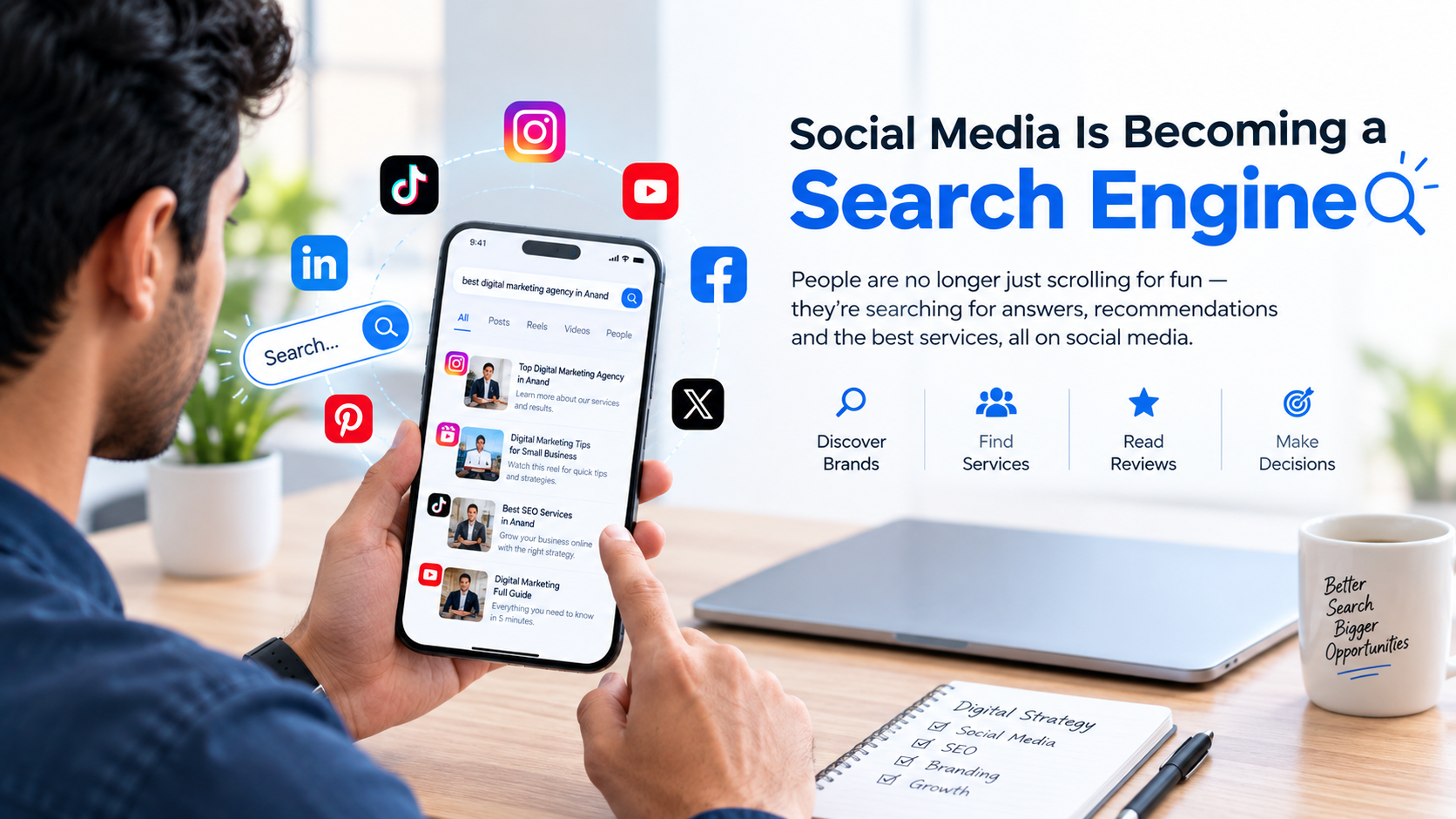
Social Media Is Becoming a Search Engine
By a social media strategy consultant with 10+ years of experience helping small and medium businesses across Gujarat and India build audiences that convert.
Ketan Rana had four generations of family craft riding on his phone screen, and he didn't even know it.
His workshop in Bhuj, Kutch, produces hand-tied bandhani sarees and dupattas — the kind of intricate tie-dye work that takes days per piece and has been passed down since his great-grandfather's time. For two years, Ketan posted photographs of his work on Instagram almost every day. The pictures were genuinely beautiful. The likes trickled in — sixty, maybe eighty, mostly from relatives and old school friends in Bhuj and Ahmedabad. But new customers? Almost none. He assumed, like a lot of small business owners do, that Instagram simply "didn't work" for a business like his, that the algorithm only rewarded big accounts with big budgets.
The turning point came from his nephew, home from college for Diwali. He opened Instagram, typed "bandhani saree Kutch" into the search bar, and showed Ketan the results. Ketan's posts were nowhere on the first three screens. What he did find, sitting near the top, were accounts reposting his own designs — sometimes his own photographs — with none of his family's name attached, but with captions that spelled out exactly what a buyer was typing: fabric, colour, region, occasion, price range.
Ketan wasn't invisible because his work lacked quality. He was invisible because his captions had nothing for the search bar to find — just a string of hearts and a stack of generic hashtags. Over the following ten weeks, he rewrote his bio, described every post in plain, specific language, and tagged his location on every single upload. The direct messages that started arriving weren't from people who had stumbled across his page while scrolling. They were from people who had gone looking for exactly what he made — and found him instead of a stranger who had copied him.
The Shift That Is Already Underway
For most of the last decade, social media was built for passive discovery — you opened the app, and the app decided what you saw. That model is being replaced, quietly but quickly, by something that looks a lot more like Google in 2010: people typing exactly what they want into a search bar and expecting a precise answer, inside the app, right now.
Sprout Social's Q2 2025 Pulse Survey, conducted with Glimpse across more than 2,200 users in the US, UK, and Australia, found that 41% of Gen Z now turn to social platforms first when they need information — ahead of traditional search engines at 32%, AI chat tools at 11%, and even friends or
family at 9%. The same research found that 37% of consumers across all age groups prefer to search social media first for product reviews and recommendations, and 35% do the same when looking for local restaurants and activities. Scott Morris, Sprout Social's Chief Marketing Officer, summed it up plainly: “Largely driven by Gen Z, social is becoming the new search engine.”
Edelman's 2025 Trust Barometer, now in its 25th year and drawn from over 33,000 respondents across 28 countries, points at why this shift is happening. Trust in traditional institutions — media included — continues to erode, and a majority of people say it's getting harder to tell whether information comes from a credible source or someone trying to mislead them. That erosion pushes people toward sources that feel personal and verifiable: creators, small business owners, and communities they can scroll through and judge for themselves, rather than a polished ad or a distant press release.
Meta itself has confirmed this isn't a side feature. Instagram's Head, Adam Mosseri, has published detailed explanations of how Instagram Search actually ranks results — a clear signal that the platform now treats search as core infrastructure, not an afterthought bolted onto a feed. For small businesses across Gujarat, from Rajkot's engineering workshops to Anand's dairy-based food brands, this means the customer who once Googled “best sweet shop near me” is now just as likely to type that same phrase directly into Instagram or YouTube.
What People Search For
Expert insight: Rand Fishkin, SparkToro
Rand Fishkin, founder of the audience-research firm SparkToro, has spent years documenting what he calls “zero-click search” — the growing share of searches that get fully answered inside the platform the person searched on, with no click to an outside website at all. His core argument is that businesses which only optimise for their own website are increasingly optimising for a shrinking slice of the actual customer journey, while the real decision-making now happens inside the search bars of Instagram, YouTube, and Pinterest.
Why this matters
If a customer's entire research process — discovering, comparing, and deciding — can happen without ever leaving the app, then a business's Instagram profile has to function like a mini-website. It needs to answer the literal question someone typed: “mehendi artist near me,” “custom furniture Ahmedabad,” “eggless bakery Vadodara.” Pretty pictures with vague captions simply don't surface for those queries, no matter how good the product is.
Indian business example
Priya Desai runs a home-based furniture restoration and reupholstery studio in Vadodara. For years her captions read like diary entries — “Love how this turned out!” — with no mention of the service
itself. Once she started writing captions that named the exact service and area (“sofa reupholstery in Vadodara,” “cane furniture repair near Alkapuri”), her profile began appearing when people searched those very phrases, and her enquiry volume nearly tripled within two months.
Practical Implementation
• List the 8–10 exact phrases a real customer would type before ever posting content around them.
• Weave your city or neighbourhood name naturally into captions and your bio, not just your hashtags.
• Answer the obvious follow-up questions — price range, turnaround time, how it's made — directly in the caption text.
• Use Instagram's own search bar as free keyword research: type your service and see who already ranks.
• Revisit your best-performing posts every few months and refresh the wording as customer language shifts.
Keywords on Instagram
Expert insight: Adam Mosseri, Head of Instagram
Adam Mosseri has laid out, in Instagram's own words, exactly what the search algorithm weighs: first, the text a person types, matched against usernames, bios, captions, hashtags, and locations; second, that person's own activity and past interactions; and third, popularity signals such as likes, shares, and follows. His practical advice for anyone hoping to be found is direct — choose a handle and profile name that contain a real keyword, add your location to your bio, and place your keywords and hashtags in the caption itself, not buried in the comments. More recently, in a mid-2026 Q&A,
Mosseri described how Instagram's search has evolved further, using embedding models that effectively “read” the photo or video itself and match it to the meaning of a search query — not just the words around it.
Why this matters
This means keyword placement isn't a growth hack anymore — it's closer to how the platform literally decides who gets shown a post at all. A gorgeous photograph paired with an emoji-only caption will frequently rank below a plainer photograph with a precise, descriptive caption, simply because the second one gives the algorithm something to match against.
Indian business example
Meera Joshi's home bakery in Vadodara was known locally as “Whisked,” with a bio that said only “Baker | Foodie | Blessed.” She changed her handle and bio to include “Eggless Cakes Vadodara,” began writing captions that named the flavour, occasion, and dietary details of every cake, and added her location to each post. Monthly enquiries grew from roughly 40 to over 150 within a single festive
season, almost entirely from people who had typed a cake-related search rather than scrolled to find her.
Practical Implementation
• Rewrite your Instagram bio to include your business category plus your city or area name.
• Write full-sentence captions describing what's actually in the image, not just a stack of hashtags.
• Use three to five specific, low-competition hashtags relevant to your niche rather than generic ones with millions of posts.
• Tag your location on every post, including Stories.
• Keep your caption's opening line keyword-rich, since it's what search and preview text show first.
Search-Friendly Content
Expert insight: Amanda Natividad, SparkToro
Amanda Natividad, VP of Marketing at SparkToro, is widely credited with popularising the term “zero-click content” — content built to deliver its full value inside the post itself, rather than functioning as a teaser for a click elsewhere. Her underlying idea is that trust and memorability, not traffic, are the real currency of modern content: a post that fully answers a question earns saves, shares, and repeat visits, which in turn tells the platform it's worth showing to more people searching for that same question.
Why this matters
Search-friendly content isn't only about the words in a caption — it's about the shape of the content. A carousel that walks through a process step-by-step, or a short video that speaks the answer aloud, tends to be favoured because it keeps people inside the app longer and earns the saves and shares that feed directly back into search ranking.
Indian business example
Suvarna Ayurveda, a small wellness brand in Rajkot, posted a simple carousel titled “How to Store Homemade Ghee-Based Hair Oil So It Doesn't Spoil.” It fully answered the question in five slides, with no need to visit a website. The post was saved and shared far beyond its usual reach, and the brand began appearing in searches for “ayurvedic hair oil Rajkot” within weeks.
Practical Implementation
• Build each post around one specific question, and answer it completely within that post.
• Use carousels with clear, labelled slides so both users and the algorithm can parse the intent quickly.
• Design for saves and shares first, likes second — these carry more weight in how content is ranked for search.
• Repurpose the same core answer across Reels, Stories highlights, and captions, keeping the keyword phrasing consistent.
• Pin your three most search-relevant posts to the top of your profile grid.
Common SEO Mistakes
A handful of habits quietly keep otherwise good businesses out of search results:
• Leaning on generic, high-volume hashtags like #love or #instagood, which carry zero purchase intent.
• Leaving city or area names out of the bio and captions entirely.
• Burying the real keywords in the comments section instead of the caption itself, where the algorithm weighs them far less.
• Putting all the important information as text inside an image, with none of it repeated in the caption where it can actually be indexed.
• Deleting and reposting the same content repeatedly, which resets accumulated engagement and search signals instead of compounding them.
Why Consistency Compounds: The Mere Exposure Effect
Psychologist Robert Zajonc's well-known mere exposure effect found that people tend to develop a preference for things simply because they've encountered them before — even without consciously recognising the earlier exposure. Applied to social search, this explains why a single well-optimised post rarely changes a business overnight, but consistent, keyword-aligned posting over months does.
Every time a business shows up in someone's search results or feed for the same core phrases — “bandhani sarees Bhuj,” “eggless cakes Vadodara,” “ayurvedic hair oil Rajkot” — it adds a small
deposit of familiarity. By the time that person actually sends a message or places an order, the brand often feels less like a stranger and more like something they already half-know and trust. This is the quiet compounding logic behind treating social search as a long-term habit rather than a one-time optimisation project.
The Business Case: Why This Is Worth the Effort
Getting discovered through search is only half the value. The same searchable, consistent content that brings in new customers also keeps existing ones engaged — and retention is where the real financial upside sits. Research from Bain & Company has repeatedly shown that increasing customer retention by just 5% can lift profits by 25% to 95%, depending on the industry. A steady stream of search-friendly, genuinely useful content does double duty: it pulls in new customers who are actively looking, and it keeps existing followers engaged enough to keep buying, referring, and returning.
For a small or medium business in Gujarat, that means the same content strategy that makes Ketan Rana findable to a first-time buyer in Mumbai is also the reason a repeat customer in Bhuj keeps coming back season after season.
How to Get Discovered
Bringing all of this together, here is the sequence worth following, in order:
1. Audit your current profile for keyword gaps — bio, handle, and your last ten captions.
2. Rewrite your bio and handle to include your business category and city or area.
3. Use the native search bar on Instagram and YouTube as free keyword research before you write captions.
4. Publish consistently, using full-sentence, descriptive captions rather than hashtag stacks.
5. Design content that fully answers one specific question per post, in a format built for saves and shares.
6. Track where enquiries and DMs are coming from, and double down on the phrases that are already working.
Back in Bhuj
Today, Ketan Rana's workshop still runs on the same hand-tied techniques his great-grandfather used. What's changed is who finds it. His bandhani sarees now ship to customers in Mumbai, Delhi, and occasionally further afield — people who never scrolled past his page by accident, but who typed the exact words his family's craft is known for and found him waiting on the other end. Four generations of craftsmanship finally became searchable, simply by learning to speak the language his customers were already using.
That's the real shift underway. Social media hasn't stopped being a place for scrolling and discovery
— but for a fast-growing share of customers, it has become the place they search first. Businesses that write for that search bar, deliberately and consistently, are the ones getting found.
FAQ Section
Is social media really replacing Google search?
Not entirely, but for a large and growing group of users, yes for many everyday queries. Sprout Social's Q2 2025 Pulse Survey found 41% of Gen Z now turn to social platforms first for information, ahead of traditional search engines at 32%. For product reviews and local recommendations, over a third of all age groups now search social first.
What should go in my Instagram bio for better search visibility?
Instagram's own Head, Adam Mosseri, has said the platform's search matches typed queries against usernames, bios, captions, and locations. That means your bio should include your business category and your city or area, written in plain language rather than only emojis or slogans.
Do hashtags still matter for Instagram SEO in 2026?
They matter less as a reach mechanism and more as a context signal. Three to five specific, relevant hashtags in the caption help the algorithm classify your content; generic, oversaturated hashtags with millions of posts add little value and rarely reflect real purchase intent.
How long does it take to see results from social search optimisation?
Individual posts can start appearing in search within weeks, but the compounding trust effect — rooted in the psychological mere exposure effect — typically builds over two to three months of consistent, keyword-aligned posting rather than overnight.
Which platforms besides Instagram are becoming search engines?
YouTube and Pinterest show similar patterns. Sprout Social's research found 35% of consumers across age groups now prefer searching social media first for local restaurants and activities, a behaviour spread across video and image-based platforms, not just Instagram.
What's the single biggest mistake small businesses make with Instagram SEO?
Placing keywords only in the comments section instead of the caption itself, and leaving out a city or area name altogether — both make a business effectively invisible to the exact local searches most likely to convert.
Need Help Getting Found?
If you'd rather have someone build and run this search-friendly strategy for you — from Instagram keyword audits to consistent, search-optimised content — Help Me Buddy IT Pvt Ltd works with small and medium businesses across Gujarat and India to do exactly that.
Get in touch: helpmebuddy.in | WhatsApp us to start a conversation about your Instagram search strategy.
Comments
Share your thoughts about this post.