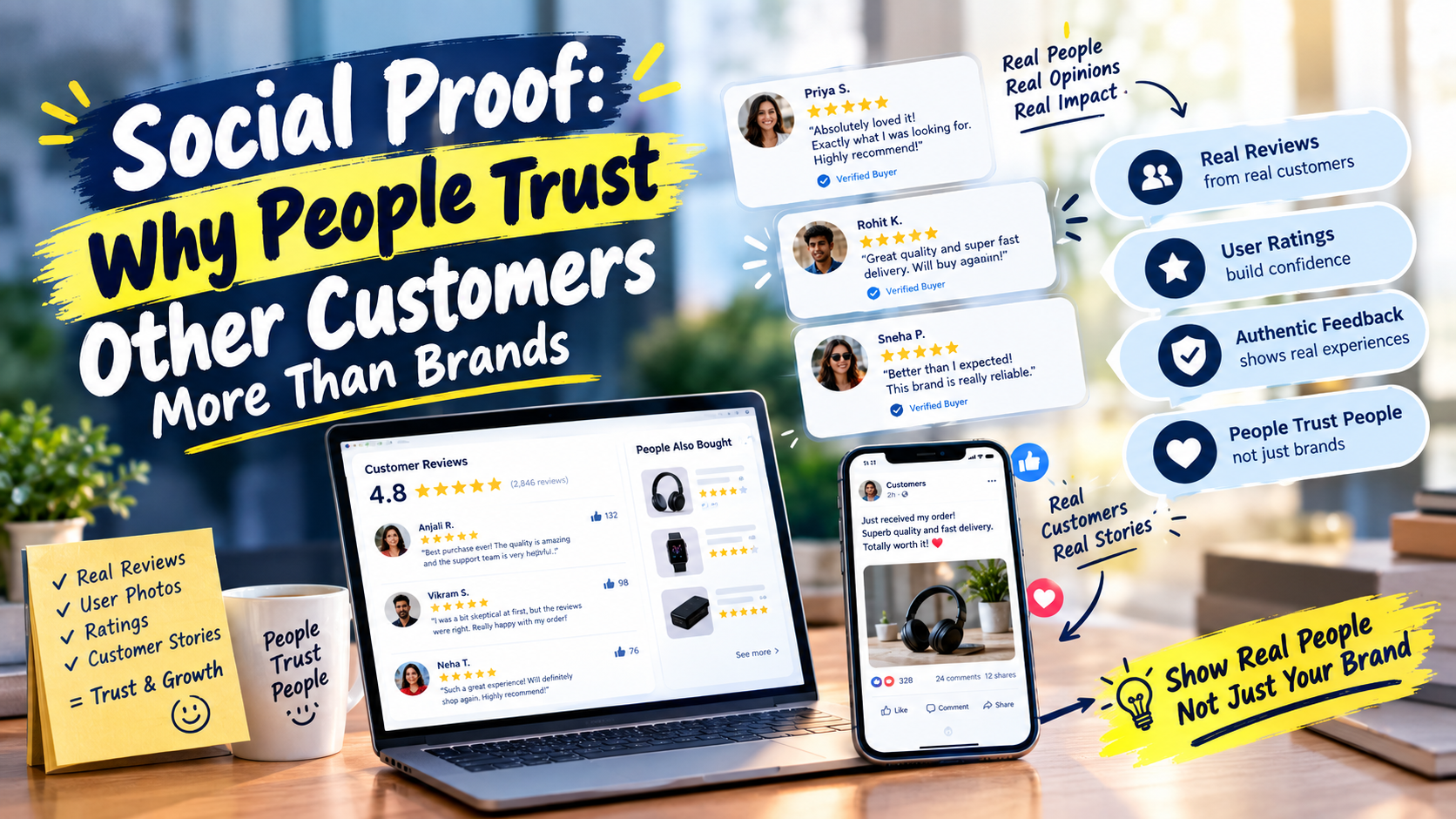
Social Proof: Why People Trust Customers Over Brands
By a social media strategy consultant with 10+ years of experience helping small and medium businesses across Gujarat and India build audiences that convert.
The Kurti Ad That Nobody Believed
Note: the business in this story is an illustrative composite based on patterns I see repeatedly with clients.
Nirali Shah runs a small embroidered-kurti label from a workshop in Adajan, Surat. Six artisans, beautiful chikankari-inspired work, fabric that easily beats what you find in a mall. For two years she did what every marketing video told her to do: studio-quality photos, a slick reel, and a caption that read "Premium Quality. Handcrafted Excellence."
The ads got clicks. They did not get orders. She was spending around ₹40,000 a month and closing 15 to 18 sales. "Everyone likes the post," she told me on our first call, "and then nobody buys."
The turning point came from a customer, not a campaign. Pooja, a buyer from Pune, sent Nirali a casual photo of herself wearing a sky-blue kurti at her sister's sangeet and asked, "Can I tag you?" Nirali hesitated. The photo was not professional. The lighting was yellow. But she reshared it.
By the next morning, eleven people had messaged her: "Is this the same kurti Pooja wore?" Not one asked about the brand story. Not one asked about the fabric first. They had seen a real woman in a real setting, and that was enough.
Nirali stopped talking about herself that week. She started letting her customers do it for her. Hold that thought; we will come back to her at the end.
The Shift That Is Already Underway
Social proof is the psychological tendency to look at what other people do, say and approve of before deciding what we should do. In marketing terms, it is every signal that says "people like you already chose this and were happy": reviews, testimonials, customer photos, creator recommendations, follower counts, badges and certifications.
The idea is not new, but the scale is. Buyers today are surrounded by brand messages, and they have learned to discount them. What they cannot easily discount is a stranger with no reason to lie. The data backs this up:
• Nielsen's Trust in Advertising research has consistently found that recommendations from people we know are the most trusted form of advertising, with roughly 88% of respondents in its 2021 survey saying they trust them, far ahead of brand-owned ads.
• Northwestern University's Spiegel Research Center found that displaying reviews can lift conversion rates by as much as 270% for a product, with the biggest gains seen in the first handful of reviews.
• Stackla's consumer research reported that around 79% of people say user-generated content highly impacts their purchasing decisions, while the Edelman Trust Barometer has repeatedly ranked "a person like yourself" among the most credible sources of information, often above CEOs and brand spokespeople.
In India the effect is amplified. With hundreds of millions of WhatsApp users, Google Maps reviews driving local discovery, and Instagram Reels acting as a shopping window, a recommendation travels faster here than almost anywhere. A Surat textile trader's "maal accha hai" in a family WhatsApp group can outsell a month of paid ads.
1. Reviews and Testimonials: Your Digital Word of Mouth
Expert insight: Robert Cialdini
Dr. Robert Cialdini, author of Influence and the psychologist who popularised the term "social proof," argues that in uncertain situations we determine what is correct by finding out what other people think is correct. The more uncertain the buyer, the more heavily they lean on the crowd.
Why this matters
Every purchase carries a small fear: "What if this is a waste of money?" A brand can reassure you, but the brand is obviously biased. A review from a stranger who spent their own money answers the fear directly. For small businesses without a famous name, reviews are borrowed credibility, and they are free.
Indian business example
A dental clinic in Navrangpura, Ahmedabad had a 3.9 rating on Google with only 41 reviews, despite excellent patient care. The owner began sending a polite WhatsApp message with a direct review link right after each treatment, and the receptionist replied personally to every review. Within five months the clinic crossed 300 reviews and a 4.7 rating, and the owner noted that "Google Maps" became the second-largest source of new patients after referrals.
Practical Implementation
1. Ask at the right moment. Send the review request within 24 hours, when the happy feeling is fresh.
2. Make it one tap. Share your Google review short link on WhatsApp instead of asking people to "search for us."
3. Reply to every review, including the negative ones, calmly and publicly. Prospects read your replies as closely as the reviews.
4. Turn the best lines into assets. With permission, convert testimonials into Instagram carousels, website banners and product-page quotes.
5. Use specifics. Encourage customers to mention what they bought and the result; "Delivered in Rajkot in 2 days, fabric exactly as shown" beats "Nice product."
2. User-Generated Content: Let Customers Be Your Content Team
Expert insight: Jonah Berger
Wharton professor Jonah Berger, author of Contagious, explains that people share things that make them look good and that are easy to talk about. Word of mouth persuades because it is naturally targeted and comes from a source we trust, which is exactly what a customer photo delivers.
Why this matters
User-generated content (UGC) is proof in action. A studio photo says "this is what we want you to see." A customer's photo says "this is what it actually looks like." That honesty is exactly why it converts. It also solves a practical problem for small businesses: you get a steady stream of content without a production budget.
Indian business example
A namkeen and farsan brand in Rajkot launched a simple "Chai-Time Challenge" during Navratri: customers posted a photo of their snack plate with a branded hashtag and were entered into a monthly hamper draw. Within eight weeks the brand had over 200 customer posts to reshare, and its Instagram Story replies started to include the question "Where can I order this?" instead of "What is the price?"
Practical Implementation
1. Create a branded hashtag and print it on packaging, bills and the shop counter.
2. Always ask permission before reposting, and credit the customer by name or handle.
3. Run small, festival-linked prompts such as Diwali gifting, Uttarayan or Navratri outfits, so posting feels natural.
4. Reward participation, not perfection. A hamper draw or a small discount on the next order works well.
5. Save UGC in Highlights grouped by product ("Real Customers," "Unboxings") so new visitors find it instantly.
3. Creator Recommendations and Trust Signals
Expert insight: Seth Godin
Marketer and author Seth Godin's often-quoted line from Tribes is that "people like us do things like this." We follow the behaviour of those we see as part of our group, and creators are the people in that group who happen to be visible.
Why this matters
Creators borrow their audience's trust for your brand. For local businesses, micro and nano creators (roughly 5,000 to 50,000 followers) often outperform celebrities because their audiences are local, engaged and believe the recommendation is genuine. Meanwhile, trust signals such as GST registration, FSSAI licence numbers, "Made in Gujarat" or GI-style origin claims, secure-payment badges, return policies and real addresses quietly remove the last doubts at checkout.
Indian business example
A Vadodara home-bakery selling eggless cakes invited three local food creators, each with about 10,000 to 20,000 followers, to taste and review honestly. It also added its FSSAI number, a real kitchen photo and a "Delivered fresh within Vadodara" promise to its bio. Orders from Vadodara doubled over one festive season, and repeat orders came mostly from people who had seen a creator and then checked the bakery's reviews.
Practical Implementation
1. Pick creators by audience fit, not follower count. A Surat food vlogger beats a national celebrity for a Surat restaurant.
2. Send the product, not a script. Let creators speak in their own words; audiences spot scripts instantly.
3. Display trust signals where decisions happen: GST and FSSAI details on your website footer, WhatsApp catalogue and Instagram bio.
4. State policies plainly: delivery times, return rules and payment options in one visible place.
5. Repurpose creator content (with rights agreed in advance) into ads and product pages to extend its life.
Consistency: The Mere Exposure Effect at Work
Here is the part most small businesses miss. Social proof is not a one-time campaign; it is a habit. In 1968, psychologist Robert Zajonc demonstrated the mere exposure effect: the more often we see something, the more familiar and, generally, the more likeable and trustworthy it feels, even without any new information.
Apply this to your brand. When a prospect sees a customer photo in March, a review in April, a creator mention in May and a Google rating when they finally search your name, each exposure adds a small amount of familiarity. By the time they buy, they feel they already "know" you. A marketing rule of thumb often quoted is that people need to see a message several times before acting, and while the exact number varies, the direction is reliable.
This is why one viral post rarely builds a business, but a steady weekly rhythm does. I usually advise clients to commit to a simple cadence: two customer-proof posts a week, one review-request batch a week, and one creator or community collaboration a month. It feels slow in month one. By month six, your feed and your search results tell the same trusted story.
The Business Case: Trust That Pays Back
Social proof does not just win the first sale; it protects the profit on the tenth. Research by Bain & Company and loyalty expert Frederick Reichheld found that increasing customer retention by just 5% can raise profits by 25% to 95%. Customers who buy because peers vouched for you arrive with realistic expectations and a sense of belonging, both of which make them likelier to return and refer.
Consider a simple illustration. If a Surat kurti label earns ₹800 gross margin per repeat order and even 100 more customers a year reorder twice because they feel part of a community, that is ₹1,60,000 in extra margin with no additional ad spend. Add Spiegel's finding that reviews can raise conversion, and you get a double benefit: lower cost of acquiring customers and higher lifetime value. Few marketing channels compound like that.
Back to Nirali: Closing the Loop
Four months after that photo from Pune, Nirali's monthly orders had moved from about 18 to roughly 70, on a lower ad budget. She now keeps a "Real Women, Real Kurtis" Highlight, sends a review link with every parcel, and features one customer story a week. Her studio photos are still there, but they are no longer the star.
What changed was not her product; it was who was speaking about it. Pooja's casual, yellow-lit photo did what two years of polished advertising could not: it made a stranger believe. That is the real lesson of social proof. You do not have to convince people. You have to let people like them convince each other.
FAQ Section (Schema-Ready)
Q1. What is social proof in marketing?
Social proof is the influence that other people's actions and opinions have on a buyer's decision. It includes reviews, testimonials, customer photos, creator recommendations and trust badges. Nielsen research shows about 88% of people trust recommendations from people they know, which is why social proof often outperforms brand-made advertising.
Q2. Why do people trust customer reviews more than brand ads?
Reviewers have no obvious reason to flatter a brand, so their words feel independent. Brand messages are seen as biased by design. Northwestern's Spiegel Research Center found reviews can increase conversion rates by up to 270%, showing how strongly peer opinion shapes buying behaviour.
Q3. How can a small business in Gujarat get more Google reviews?
Send a short WhatsApp message with a direct review link within 24 hours of a sale or service. Reply to every review publicly. Local clinics and retailers that build this habit often move from a few dozen to several hundred reviews within months, which improves local search visibility.
Q4. Is user-generated content really effective for conversions?
Yes. Stackla research reported that about 79% of consumers say UGC highly influences their purchase decisions. Customer photos show real-life results, so they feel more honest than studio images. Always ask permission and credit the customer when you reshare.
Q5. Do micro-influencers work better than celebrities for local brands?
Often, yes. Micro and nano creators have smaller but more engaged and geographically relevant audiences, so their recommendations feel like advice from a friend. For a Vadodara or Surat business, a local creator with 10,000 followers can drive more relevant orders than a national name.
Q6. How does social proof improve customer retention and profit?
Customers who join because peers vouched for you tend to arrive with accurate expectations and feel part of a community. Bain & Company research shows a 5% increase in retention can raise profits by 25% to 95%, so social proof adds value well beyond the first purchase.
Ready to Turn Your Customers Into Your Best Marketing?
At Help Me Buddy IT Pvt Ltd , we help Gujarat and India-based businesses build review systems, UGC campaigns, creator partnerships and trust-first social media strategies that convert.
Visit: helpmebuddy.in
Comments
Share your thoughts about this post.