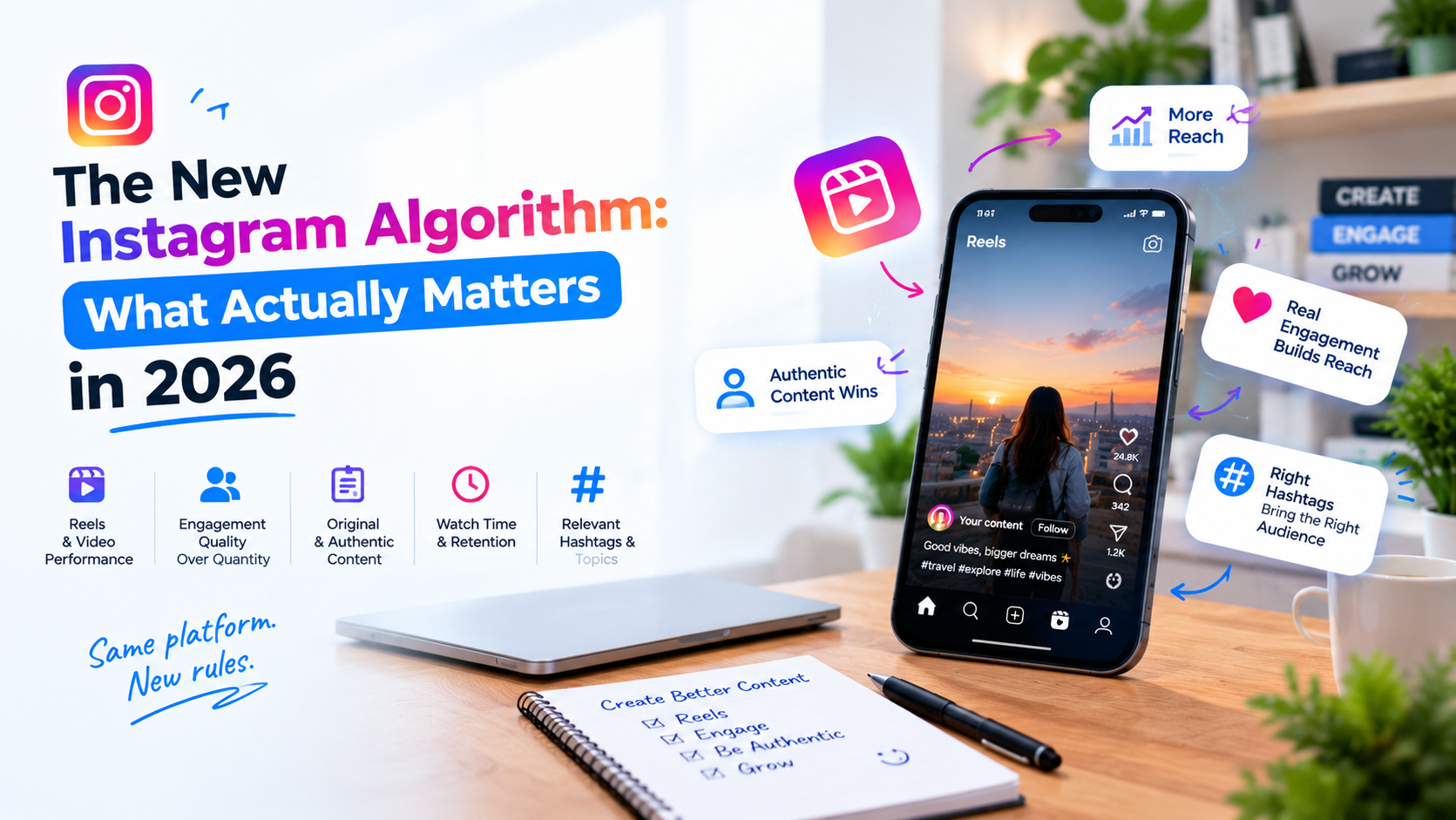
The New Instagram Algorithm: What Actually Matters in 2026
By a social media strategy consultant with 10+ years of experience helping small and medium businesses across Gujarat and India build audiences that convert.
When 14,000 Followers Felt Like Zero
Hetal Modi runs a chaniya choli label out of a small studio near Varachha in Surat. For three years, her routine never changed: photograph the new Navratri collection, add ten hashtags, post at 8 pm, and wait. Her account crossed 14,000 followers, and she was proud of that number. Yet each post reached barely 300 people, and most weeks she got two or three enquiries. Frustrated, she paid an agency for 8,000 “followers.” The number went up. The enquiries did not.
One evening in August, her lead karigar, Rekhaben, was hand-stitching mirror work on a bridal lehenga, and Hetal filmed 40 seconds of it on her phone with no music, no filter and no polish. She captioned it: “12 hours of work in one dupatta border.” She expected nothing.
By the weekend, that reel had been watched more than 60,000 times. What surprised her was not the views. People were replaying it, saving it and sending it to their sisters and cousins in Mumbai and Dubai. Eleven serious enquiries arrived in a week, and three became custom orders. Her follower count barely moved, but her business did. Hetal had stumbled onto what the Instagram algorithm now actually rewards.
(Hetal’s story is an illustrative composite based on patterns I see repeatedly with Gujarat businesses.)
The Shift That Is Already Underway
For years, Instagram worked like a notice board: you posted, your followers saw it, and the more followers you had, the more people saw it. That model is fading. Instagram has become a discovery engine, closer to YouTube or TikTok than to the friends-and-family app it started as. Three data points show how far the platform has moved.
• Video dominates attention. Meta has said that video now accounts for more than half of the time people spend on Instagram, and the company reported that Instagram crossed 3 billion monthly active users in 2025. India is one of its largest audiences, so your customers in Ahmedabad, Rajkot and Vadodara are competing for attention in a very crowded feed.
• Instagram is now searchable. Since 2025, public Instagram posts can appear in Google search results, according to Instagram’s own announcements. Your captions, keywords and on-screen text now work like SEO, not just decoration.
• Trust drives purchase. Edelman’s Trust Barometer special report on brand trust found that 81% of consumers said they must be able to trust a brand to do the right thing before they buy from it. Followers alone do not create trust. Consistent, useful, genuine content does.
The message across all three: the algorithm no longer asks, “How many people follow you?” It asks, “Does anyone actually want to watch this, keep this, and share this?”
1. How Discovery Has Changed: Watch Time and Replays
What the expert says
Adam Mosseri, the head of Instagram, has said publicly, including in a 2025 video explaining ranking, that the most important signals are watch time, likes per reach and sends (shares) per reach. In simple terms, Instagram tests your content on a small audience first and expands it only if people stay, react and pass it on. This is my paraphrase of his explanation; please check Mosseri’s original posts for exact wording.
Why this matters
A reel that 40% of viewers watch to the end will beat a reel that 90% of viewers scroll past in two seconds, even if the second has ten times more potential reach. Replays are especially powerful because they signal that the content was interesting enough to watch again. This levels the field: a small business in Bhavnagar with a strong first three seconds can out-perform a large brand with a lazy one.
Indian business example
A fitness studio in Vadodara run by a trainer named Karan Joshi kept posting polished 60-second workout compilations that people abandoned by second five. He changed to 20-second reels that opened with a single line (“Why your knees hurt on garba night”), showed one fix, and ended by looping back to the first frame. Average watch time improved sharply, replays appeared, and the studio filled two new morning batches in a month.
Practical Implementation
☐ Put the hook in the first 2 seconds: a bold on-screen line, a question or a surprising visual.
☐ Keep reels short (15–30 seconds) until your average watch-through is strong, then experiment with longer formats.
☐ Design loop endings so the last frame flows naturally into the first and invites a replay.
☐ Check Instagram Insights for “average watch time” and “skip rate” and copy the patterns of your top 3 reels.
☐ Cut every second that does not earn its place; slow intros are the top reason Gujarat brands lose viewers.
2. Saves and Shares: The Signals That Travel
What the expert says
Jay Baer, author of Youtility, argues that the best marketing is so genuinely helpful that people would pay for it. On Instagram, that idea now has a measurable form: a save says “this is useful, I will come back,” and a share (send) says “someone I know needs this.” Mosseri has also described sends as a
particularly strong signal for reaching new people, because a recommendation from a friend is worth more than any impression.
Why this matters
Likes are passive. Saves and shares are commitments. When someone sends your post to a family WhatsApp group, which is how a huge amount of content travels in India, you receive both algorithmic reach and social proof from a trusted source. This is why “dark social” sharing is the quiet engine behind many small-business success stories.
Indian business example
An interior designer in Ahmedabad, Pooja Trivedi, stopped posting only finished-flat photos. She started publishing carousels such as “7 Vastu-friendly changes for a 2BHK in Satellite” and “Budget breakdown:
₹6 lakh living room.” Those carousels were saved in large numbers and shared between couples planning their homes. Her enquiry mix changed from casual window-shoppers to people who already had a budget and a timeline.
Practical Implementation
☐ Create one “save-worthy” post per week: a checklist, price guide, comparison, recipe or mistake list.
☐ Add a soft prompt on the last slide or in the caption, such as “Send this to someone planning their wedding.”
☐ Make content specific to Gujarat moments: Uttarayan, Navratri, Diwali, wedding season and monsoon.
☐ Design carousels with a clear cover promise and one idea per slide so they are easy to screenshot and forward.
☐ Track saves and sends per reach monthly and double down on the formats that earn them.
3. Content Relevance and the Follower Count Myth
What the expert says
Marketer Seth Godin has long argued for serving the “smallest viable audience,” meaning a specific group of people you can truly help, instead of chasing everyone. This maps directly onto Instagram’s modern logic: the algorithm predicts which individual users will care about a piece of content based on their past behaviour, not on who follows whom.
Why this matters
Relevance is now the gatekeeper. If your reel is clearly about tile selection for Indian homes, Instagram can show it to people who watch tile and home-renovation content, whether or not they follow you.
Meanwhile, bought or unengaged followers actively hurt you, because they dilute your engagement rate and teach the system that your content is ignored. A page with 3,000 engaged local followers can now beat a page with 30,000 passive ones.
Indian business example:
A ceramic tile dealer in Morbi, Nilesh Kanjariya, had a large but mostly irrelevant following after years of giveaway contests. He stopped the giveaways, rewrote his profile to “Tile guide for home builders in Gujarat,” and started posting short explainers: floor vs wall tile, how to spot low-quality glazing, and what a fair rate per square foot looks like. His followers grew slowly, but his WhatsApp enquiries from contractors and architects rose because the audience finally matched the offer.
Practical Implementation
☐ Rewrite your bio, name field and pinned posts around one clear customer and one clear promise.
☐ Use natural keywords in captions, on-screen text and alt text (for example, “wedding photographer in Surat”), since Instagram search and Google now read them.
☐ Stop giveaways, follow-for-follow tactics and purchased followers, and remove obvious bot accounts.
☐ Judge success by reach to non-followers, saves, DMs and enquiries, not follower count.
☐ Post about one core theme 70% of the time so the algorithm can confidently classify your account.
The Psychology of Showing Up: Why Consistency Compounds
In 1968, psychologist Robert Zajonc published research on what became known as the mere exposure effect: people tend to develop a preference for things simply because they have encountered them repeatedly. You do not need a viral hit for this to work. You need to be present, recognisable and reliably useful.
This explains why the Surat sari trader who posts three times a week for a year often outsells the competitor who posts a flashy reel once a quarter. When a customer finally needs a wedding lehenga or a new tile floor, the brand they have seen a hundred times feels familiar, and familiarity feels safe. In markets like Gujarat, where trust and personal recommendation drive so many purchases, that feeling is worth a great deal.
Consistency also helps the algorithm. Regular posting gives Instagram more data about who responds to you, which improves targeting over time. A sensible rhythm for a small business is 3–4 reels or carousels a week, 3–5 Stories a day, and one long-term series people can look forward to, such as
“Karigar Monday” or “Client Question Friday.” Give it 90 days before judging results.
The Business Case: From Engagement to Retention and Profit
Engagement matters only if it turns into revenue, and the strongest case is about loyalty. Research by Frederick Reichheld of Bain & Company found that increasing customer retention rates by just 5% can increase profits by 25% to 95%, depending on the industry. Harvard Business Review has also reported that acquiring a new customer can cost five to 25 times more than retaining an existing one.
The algorithm’s new priorities fit this perfectly. Content that people save and share tends to attract better-matched customers, and educational content keeps existing customers engaged between
purchases. A Rajkot sweet shop that shares festival packing tips, or a Surat diamond jeweller that explains certification, is building the kind of repeat relationship that lifts lifetime value.
What Brands Should Do: A 30-Day Plan
• Week 1: Audit your last 20 posts. Note which earned the most saves, shares and watch time.
• Week 2: Fix your profile, bio and keywords around one audience and one promise.
• Week 3: Publish 3–4 hook-first reels and 1–2 save-worthy carousels per week.
• Week 4: Reply to every comment and DM within hours, and repost customer content with permission.
At the end of the month, compare enquiries, not just impressions. That is the metric that pays your rent.
Conclusion: Back to Hetal’s Studio
Hetal did not go viral because she found a secret trick. Her 40-second reel worked because it gave viewers something Instagram now values more than any follower count: a reason to watch, replay, save and share. It was specific to her craft, honest about the work, and useful to the right people. Since then she has turned it into a weekly series, and her studio now gets more relevant enquiries than her team can handle in the Navratri rush.
The 2026 Instagram algorithm is not something to fear. It is an opportunity for Gujarat’s small and medium businesses, because it rewards the qualities that local brands already have: craftsmanship, expertise and trust. Start with one honest, valuable post this week, and let consistency do the rest.
FAQ Section (schema-ready)
Q1. What matters most in the Instagram algorithm in 2026?
Instagram’s head, Adam Mosseri, has named watch time, likes per reach and sends per reach as top ranking signals. Video now makes up over half of time spent on the app, so strong hooks and shareable content matter most. Follower count matters far less than it did.
Q2. Do followers still matter for Instagram reach?
Much less than before. Instagram now recommends content to people who do not follow you, based on predicted interest. A small, engaged following can outperform a large passive one, and bought followers can drag down your engagement rate.
Q3. Are Instagram Reels better than photos or carousels?
Reels tend to have the highest reach to non-followers, while carousels often earn more saves. Video dominates time spent on Instagram, but a mix works best. Use Reels for discovery and carousels for depth and conversion.
Q4. How often should a small business post on Instagram?
A realistic target is 3–4 Reels or carousels per week plus daily Stories. Consistency matters more than volume, and the mere exposure effect shows familiarity builds preference over time. Review results after 90 days.
Q5. Why do saves and shares matter to the algorithm?
They show real value: a save means “I’ll need this later” and a share means “someone I know needs this.” Sends are especially strong for reaching new audiences. Many Indian shares happen through WhatsApp and DMs.
Q6. Can Instagram content help my business rank on Google?
Yes. Since 2025, public Instagram posts can appear in Google search results. Using clear keywords in captions, on-screen text and bios helps discoverability. Local terms such as “Surat” or “Ahmedabad” help attract nearby customers.
Ready to Make Instagram Work for Your Business?
Help Me Buddy IT Pvt Ltd helps Gujarat and Indian businesses build Instagram strategies focused on reach, enquiries and repeat customers, not vanity metrics.
Website: helpmebuddy.in
Comments
Share your thoughts about this post.