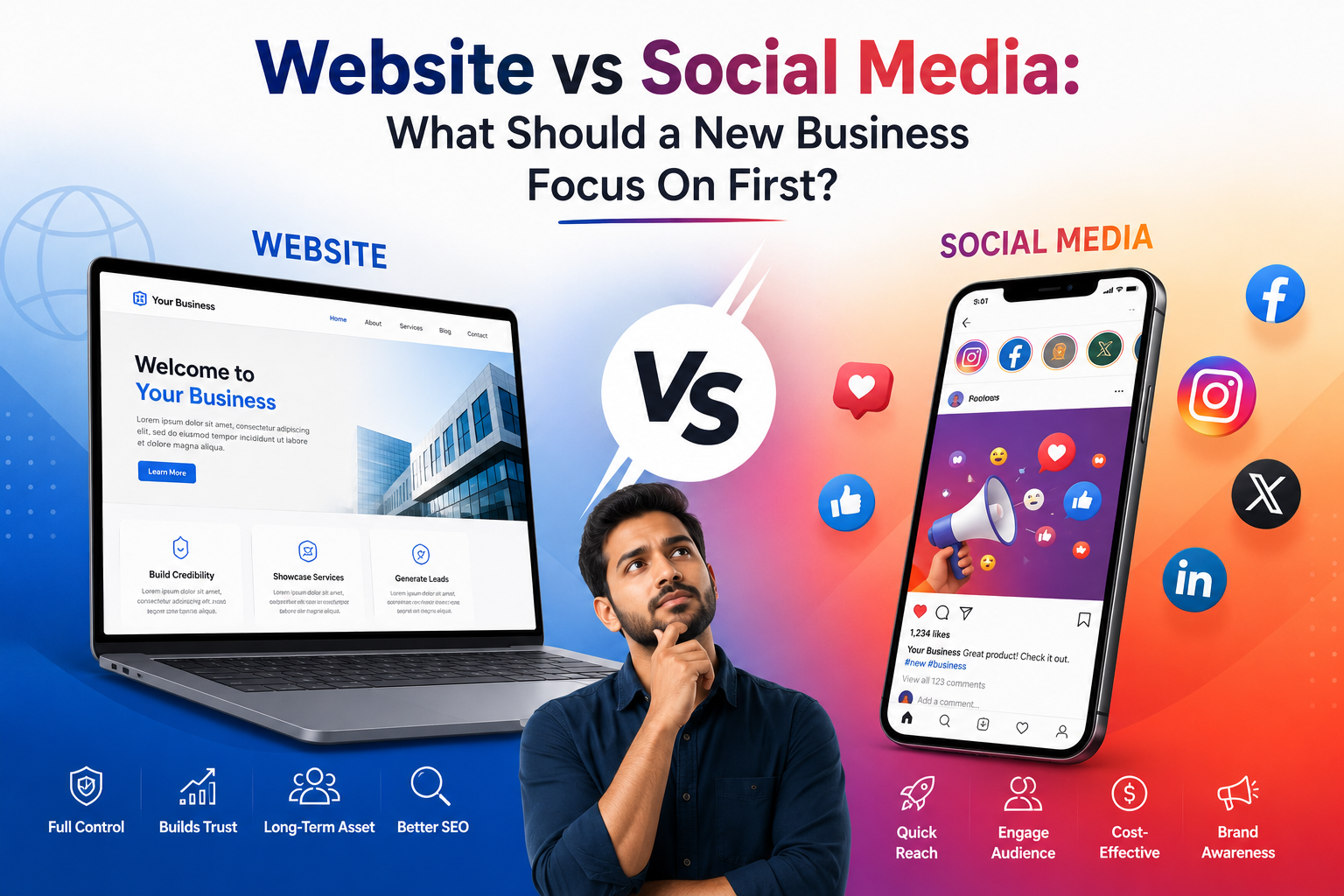
Website vs Social Media: What Should a New Business Focus On First? (2026 Guide)
By a digital marketing consultant with 10+ years of experience helping new and growing businesses across Gujarat and India build their first digital presence.
Priyankaben launched her handmade silver jewellery business from her kitchen table in Bopal, Ahmedabad in early 2023. She had been making jewellery as a hobby for seven years. Her friends had been telling her for just as long to sell it properly.
The week she decided to take it seriously, her husband sat down with her and asked the question that launches a thousand arguments between Indian couples starting businesses together: "Should we get a website made, or just start with Instagram?"
I have heard a version of this question from nearly every new business owner I have worked with over the past decade. A tuition centre owner in Rajkot who had just left a teaching job. A physiotherapist in Vadodara setting up his first independent clinic. A young architect in Surat ready to go on his own after three years at a firm.
The question sounds simple. The honest answer is more nuanced — and it depends on what kind of business you are building, who your customers are, and what you can realistically afford. This guide gives you a framework to think it through, real numbers to plan around, and a clear strategy to follow regardless of where you land.
Why This Debate Goes in Circles — and How to End It
The website-versus-social-media question keeps coming up because most people frame it as a competition for the same role. It is not. These two tools do fundamentally different jobs, and understanding that distinction makes every subsequent decision clearer.
A website is a destination. It is where someone who has already heard of you — through a referral, a Google search, a social media post — arrives to verify that you are legitimate, understand what you do, and decide whether to contact you. It works around the clock without requiring daily effort from you.
Social media is a discovery channel. It is where people who have never heard of you can encounter your business for the first time. It creates organic, algorithm-driven possibilities for strangers to find you — but it requires consistent effort: content, posting, engagement, repetition.
Once you understand these as complementary rather than competing tools, the question becomes: which one earns the most focus and investment in the first three to six months? And that answer is different for different businesses.
What the research confirms: Google's own Think With Google data consistently shows that the majority of purchase decisions — including decisions to visit physical shops — begin with an online search. Simultaneously, Meta's platform data shows that Indian users spend an average of 2.5 hours per day on social platforms. Both channels are where your customers are. The question is which one reaches them at the right moment in their decision process.
What a Website Does That Nothing Else Can
It is your Google search presence
When someone searches "CA near me Rajkot" or "interior designer Gandhinagar" or "event management company Ahmedabad" on Google, the first results they see are websites and Google Business Profile listings — not Instagram profiles, not Facebook pages.
This matters because the customer who searches on Google is often the highest-value customer: they have a specific problem, they have decided to solve it, and they are actively comparing options. They are not casually browsing. They have purchasing intent. And if you are not findable in Google search, this entire category of customer — often the most valuable kind — cannot find you.
A website is the only tool that reliably captures Google search traffic for your business. Social media does not do this job.
Expert insight: Neil Patel, one of the most cited digital marketing researchers globally, has documented across thousands of audited businesses that organic search traffic consistently delivers the highest-quality leads of any digital channel — visitors with higher intent, higher conversion rates, and lower acquisition cost than social media traffic. His analysis specifically notes that small businesses which establish search visibility early maintain a compounding advantage over competitors who focus solely on social media.
Practical implementation: When planning your website, identify the top five search terms your ideal customer might use to find you — include your city or area in each one (e.g. "wedding photographer Surat," not just "wedding photographer"). Build a page or section specifically optimised for each term. This is the foundation of local SEO and it starts with your website, not your Instagram.
You own this — nobody can take it from you
Your Instagram account exists at Instagram's discretion. Your Facebook page gets the reach that Meta's algorithm decides to give it — organic reach for business pages has declined consistently since 2018. Your WhatsApp Business account operates under WhatsApp's terms of service, which can and do change.
Your website, on a domain you register and hosting you pay for, belongs entirely to you. No algorithm change can reduce its reach. No platform policy can get it suspended. No competitor can report it and have it taken down.
I have had this conversation enough times to be direct about it. A homemade achaar seller in Anand who had built a Facebook following of 4,200 people over three years saw her page flagged and restricted under a food business policy update in 2022. She lost her entire audience overnight. Businesses that had websites and email lists during the 2018 Facebook reach collapse barely noticed. Businesses that had built everything on their Facebook page lost access to audiences they had spent years developing.
Build on rented land for reach. Build on owned land for stability. Do both — but understand the difference.
Expert insight: Marketing strategist and author Seth Godin has written extensively on the distinction between "rented attention" (social media platforms you depend on but do not control) and "owned media" (email lists, websites, direct relationships). His core argument — supported by two decades of observation across thousands of businesses — is that rented attention is valuable but fragile, and that businesses which build only on rented platforms consistently find themselves vulnerable to decisions made by platform companies whose interests do not align with theirs.
Practical implementation: Register your business domain name today if you have not already — even if your website is not ready yet. A .in domain costs approximately ₹800 to ₹1,200 per year. Owning your domain means nobody else can claim it while you are preparing your site. Use it immediately for your professional email address (yourname@yourbusiness.in) — a step that costs nothing beyond the domain itself and signals professionalism to every person who receives an email from you.
The credibility signal that closes deals quietly
Stanford University's Web Credibility Research Project found that 75% of consumers judge a business's credibility based on its website design. What this means in practice is not that every potential customer consciously evaluates your website — it is that the absence of one creates a small but real doubt about whether your business is established and worth engaging with.
A nutritionist in Ahmedabad I worked with in 2022 had been posting consistently on Instagram for six months before she launched her website. She had a genuine following of engaged people. Two of them had been commenting on her posts, asking questions in DMs, and clearly interested in booking — for six months.
The week her website went live, both of them booked a paid consultation within four days. She asked why they had waited. Both said roughly the same thing: "I just wanted to see a proper website first."
They were not sceptics. They were interested buyers who had a completely understandable need to verify legitimacy before spending money. The website closed a trust gap that Instagram alone could not close, regardless of the quality of her content.
Trust-building fact: According to a 2024 survey by Clutch (a B2B research firm), 46% of small business customers say a professional website is the most important factor in deciding whether to trust a company they have never worked with before — ranking above reviews, referrals, and social media presence. For service businesses and professional services specifically, this number is higher.
Practical implementation: Your website does not need to be elaborate to close the trust gap. A clean, professional four-to-six page site — Home, About, Services, Portfolio or Work Samples, and Contact — with a real address, a professional phone number, and domain-based email accomplishes this job. What it must not be: cluttered, slow-loading, or last updated three years ago. A neglected website is worse than none.
What Social Media Does That a Website Cannot
Your customers are already there — without any search intent required
The critical advantage of social media over search is that it reaches customers who are not actively looking for you yet. Instagram, Facebook, and YouTube can place your business in front of someone who has never searched for your category, never considered needing your product, and had no intention of buying anything — until they saw your content.
This is audience creation from zero, and no website can do it. A website is a net: it catches people already swimming toward you. Social media is a lure: it attracts people who did not know they were hungry.
India's social media numbers make this concrete: over 500 million active users, 2.5 hours of daily average usage, with Instagram Reels and YouTube Shorts generating some of the highest organic reach available to any content creator in any market. For a new business with no existing audience and no Google search ranking yet, social media is often the fastest path to the first sale.
One share can change everything
When a customer in Surat shares your Reel with their sister-in-law who is planning her wedding, something happens that no website can produce independently: your business appears in front of a warm, trusted recommendation in someone's personal feed. The referral and the discovery happen simultaneously, at zero cost.
For Priyankaben's jewellery business, this was the defining early moment. A phone video of her making a silver necklace — shot in her kitchen with available light and a steady hand — was shared by a customer's cousin in Bopal. That single share generated nine enquiries and five sales within 48 hours, from people who had never heard of her before. Her website provided the credibility that converted enquiries into purchases. Instagram provided the discovery that created the enquiries.
Neither tool alone would have produced that result.
Visual businesses have a structural social media advantage
For jewellery, fashion, food, interior design, fitness, beauty, handmade crafts, architecture, photography — categories where the product or outcome needs to be seen to be appreciated — social media is structurally the superior discovery channel.
A mehendi artist in Surat posting a Reel of her bridal work every afternoon is running a free, daily showreel to thousands of potential brides and their families. A furniture maker in Rajkot showing a time-lapse of a teak dining table being hand-carved is demonstrating craftsmanship in a way that no written description and no static product photo can match. A home baker in Ahmedabad filming the cross-section of a perfectly layered cake creates appetite and desire in a way that a website page about baked goods cannot.
For these businesses, Instagram is not an optional extra. It is the primary showcase.
Expert insight: Social media researcher and author Gary Vaynerchuk has documented through platform data analysis that small local businesses consistently outperform large brands in local social media engagement when their content is genuine, process-oriented, and creator-specific. His observation — backed by Meta's own creator economy research — is that authenticity generates engagement that advertising budgets cannot replicate, and that the personal, maker-led content that small businesses naturally produce is exactly the content type that performs best on short-form video platforms.
Practical implementation: Before posting anything, identify which of three content types fits your business best: process content (showing how you make or do what you do), outcome content (showing the result your customers experience), or expertise content (teaching something useful related to your field). Build your content calendar around one of these primary types. Consistency within a content type builds a recognisable identity faster than variety across all three.
Which Investment Comes First: The Decision Framework
This is where most articles give a vague answer. Here is a specific one.
For these business types, lead with social media
Home-based and micro businesses where the founder is the brand and demand needs to be validated before infrastructure is built — a home baker in Naranpura, a freelance photographer in Rajkot, a personal trainer operating from a society gym in Surat. Here, Instagram or Facebook can generate early revenue before committing to website development. If thirty days of consistent posting generates zero enquiries, that is important information you gathered for free.
Highly visual product businesses — jewellery, handloom textiles, handmade crafts, specialty food, home decor — where the product does the selling and where Instagram is genuinely the primary discovery channel for the target customer. Build your Instagram presence first, generate early revenue, and use that revenue to fund your website.
Businesses starting with a total marketing budget under ₹15,000, where every rupee must demonstrate value before further commitment. Start with free tools, validate the product or service, then invest in infrastructure.
For these business types, lead with a website
Professional service businesses — CA firms, legal practices, clinics, dentists, physiotherapists, architects, management consultants — where credibility is the primary purchase driver. Before a prospective client calls a professional service provider, they will almost always look for a website. In this category, the absence of one is often disqualifying — regardless of how good your Instagram content is.
B2B businesses of any kind — packaging suppliers, industrial manufacturers, software companies, logistics firms, staffing agencies — where buyers conduct research before purchasing, involve multiple decision-makers, and need to verify legitimacy through a professional online presence.
High-value transaction businesses — custom furniture, home renovation, commercial construction, event management, vehicle sales — where customers evaluate options carefully over a longer consideration period. When a family is deciding who to trust with a ₹5 lakh kitchen renovation, they will spend time on your website before calling. Instagram posts alone do not provide enough information for this kind of decision.
Businesses whose primary customers are over 40, who are significantly more likely to Google a business than discover it on Instagram, and who place greater weight on a professional web presence as a credibility signal.
Real Numbers: What This Costs in 2026
This is the section most marketing articles avoid. Here are actual costs based on current Gujarat market rates.
Website investment
A genuinely functional professional website — five to seven pages, mobile-optimised, fast-loading, with proper contact forms, Google Analytics, and basic on-page SEO — costs ₹15,000 to ₹40,000 from a reputable developer or agency in Gujarat. Below ₹10,000, you are receiving a template installation with minimal customisation and no strategic thinking applied. The output quality difference is immediately visible.
Annual running costs: domain (₹800–₹1,200), hosting (₹3,000–₹8,000 for reliable shared hosting — avoid the cheapest options as they affect loading speed, which affects Google ranking), maintenance (₹5,000–₹12,000 if you want updates, security checks, and content changes handled). Realistic year-one total: ₹20,000 to ₹55,000 depending on complexity.
Social media costs
Platforms: free. Real cost: time — approximately 5 to 10 hours weekly if you are managing it personally. If outsourcing in Gujarat: ₹5,000 to ₹15,000 per month for a freelance social media manager doing basic content creation and posting; ₹15,000 to ₹40,000 per month for an agency with broader scope. Paid content promotion (boosting posts) produces meaningful results starting at ₹2,000 to ₹5,000 per month.
The sensible starting allocation for a new business
For a total six-month marketing budget of ₹25,000 to ₹35,000, here is what tends to produce the best results across business types:
- ₹15,000 to ₹20,000: clean, professional website and Google Business Profile setup
- ₹3,000 to ₹5,000: ring light, tripod, and any other basic content creation equipment
- ₹4,000 to ₹6,000: boosted social posts — two to three per month at ₹1,000 to ₹2,000 each, targeting your specific city or area
- Personal time: consistent content creation and community engagement
This combination gives you a credibility foundation, a local Google search presence, and a growing discovery channel — all within reach for a business in its first year.
What This Looks Like In Practice: Yashbhai's First Year in Surat
Yashbhai qualified as an architect in 2021 and spent three years working for a firm in Surat. In January 2024 he went independent — "before I talked myself out of it," as he said when I met him.
He had ₹25,000 for marketing in his first six months. Here is the exact allocation and what it produced.
₹16,000 went to a six-page website: Home, About, Portfolio, Services, Process, Contact. Clean, mobile-optimised, photographed over a weekend using a DSLR borrowed from a college friend. His Google Business Profile went live the same week as the website and was verified within ten days. ₹3,500 went to a ring light and tripod.
His content strategy was simple and consistent: two Instagram posts per week (one project update or design detail, one practical tip for homeowners), one LinkedIn post per week (a case study, an observation about sustainable building in Gujarat's climate, a comment on a local development). No paid ads. No boosted content. Just consistent posting and a website that looked like it belonged to a credentialed, established architect.
By month four: three Instagram enquiries (each had checked his website before contacting him through the form), two Google enquiries (people who had searched "architect Surat" and found his GBP). Five clients from a ₹25,000 investment. By month eight, the referrals from those five clients had made the original channels almost irrelevant — he was receiving more work than he could handle from word of mouth alone.
The specific combination — website for credibility, Instagram for discovery, LinkedIn for professional positioning, GBP for local search — was what made this possible. Any one of these alone would have produced a fraction of the result.
The Three-Phase Implementation Plan
Based on working with new businesses across Gujarat for a decade, here is the specific sequence I recommend:
Phase 1: Months one and two — foundation
Build and launch a simple, professional website (four to six pages). Set up and verify your Google Business Profile — this is free and takes about a week for verification. Create your social media profiles on one or two platforms appropriate to your business type, and complete every profile field. Do not spend on ads yet. Use the first two months to observe what content your audience engages with before committing budget to amplifying it.
Checklist: domain registered ✓ website live ✓ GBP verified ✓ social profiles complete ✓ professional email address active ✓
Phase 2: Months three to six — momentum
Post on social media three to four times per week — consistency matters more than production quality at this stage. Use WhatsApp Status daily. Collect Google reviews from your first customers by asking directly at the point of service and sending the GBP review short link via WhatsApp immediately after. Begin adding content to your website: two articles per month answering the questions you hear most often from customers. These articles improve your Google ranking over time and demonstrate expertise to visitors.
Checklist: weekly content calendar in place ✓ WhatsApp Status daily ✓ review request process active ✓ first blog posts published ✓
Phase 3: Month six onwards — amplify
By month six you know which content generates enquiries. Put a small paid budget (₹2,000 to ₹5,000 per month) behind the platform and content type that is performing best. Begin building your email list from website visitors and WhatsApp contacts. Request an analytics review — which pages on your website get the most traffic? Which search terms are people using to find you? Use this data to optimise your website for the terms that are already bringing visitors, and create more content around the topics that are already generating interest.
Checklist: paid promotion budget allocated ✓ email list building started ✓ analytics reviewed monthly ✓ website content updated quarterly ✓
Conclusion: The False Choice That Costs New Businesses Time
Priyankaben spent six weeks overthinking the website-versus-Instagram question after she decided to go serious with her jewellery. Her neighbour's husband was a developer who could build her a website for ₹12,000. Her cousin worked in digital marketing and insisted Instagram was all she needed to start. She went back and forth between them until a school friend told her to just launch both and figure it out as she went.
She did. A four-page website with her portfolio and a contact form. An Instagram account updated every other day with videos of her making jewellery. Within three months she had more orders than she could make on her own and had started training her mother-in-law to help.
The website gave her the credibility that turned Instagram enquirers into actual buyers. Instagram gave her the discovery channel that produced those enquirers in the first place. Neither one alone would have done what both together did.
The debate was always a false one — not because the answer is "do both and figure it out" but because the right question was never which tool to have. It was always: for my specific business and customer type, which one should I build first, how much should I invest in each, and how do they support each other?
Answer those three questions correctly for your situation. Build your foundation systematically. Execute consistently for six months before evaluating. That is not a guarantee of success — no honest marketing guide can offer that. But it is the approach that I have seen work, repeatedly, for new businesses across Gujarat and India, regardless of category or budget.
Not Sure Which Path Is Right for Your Business?
Every business I have mentioned in this article had a different starting point, a different budget, and a different target customer. The right sequence for Priyankaben's jewellery business was not the same as the right sequence for Yashbhai's architecture practice. What worked for the Anand achaar seller would not have worked for the Vadodara physiotherapist.
Getting the sequencing right for your specific situation is the most valuable thing a marketing consultant can do for a new business — and it is something Help Me Buddy IT Pvt Ltd has been doing for businesses across Ahmedabad, Surat, Vadodara, Rajkot, Gandhinagar, and across Gujarat for years.
We do not offer packages. We start with your business — your customers, your category, your budget — and recommend exactly what you need, in the right order, at a cost that makes sense for where you are right now. If a four-page website and Instagram are all you need at this stage, that is what we will tell you. If you need more, we will show you why and by how much.
📞 Book a free 30-minute consultation. We will ask the right questions, understand your situation, and give you a specific, honest recommendation — no commitment and no pressure to proceed.
Visit helpmebuddy.in or send us a message on WhatsApp.
Because the most expensive marketing mistake a new business makes is starting in the wrong place. The second most expensive is spending six weeks going back and forth before starting anywhere at all.
Comments
Share your thoughts about this post.