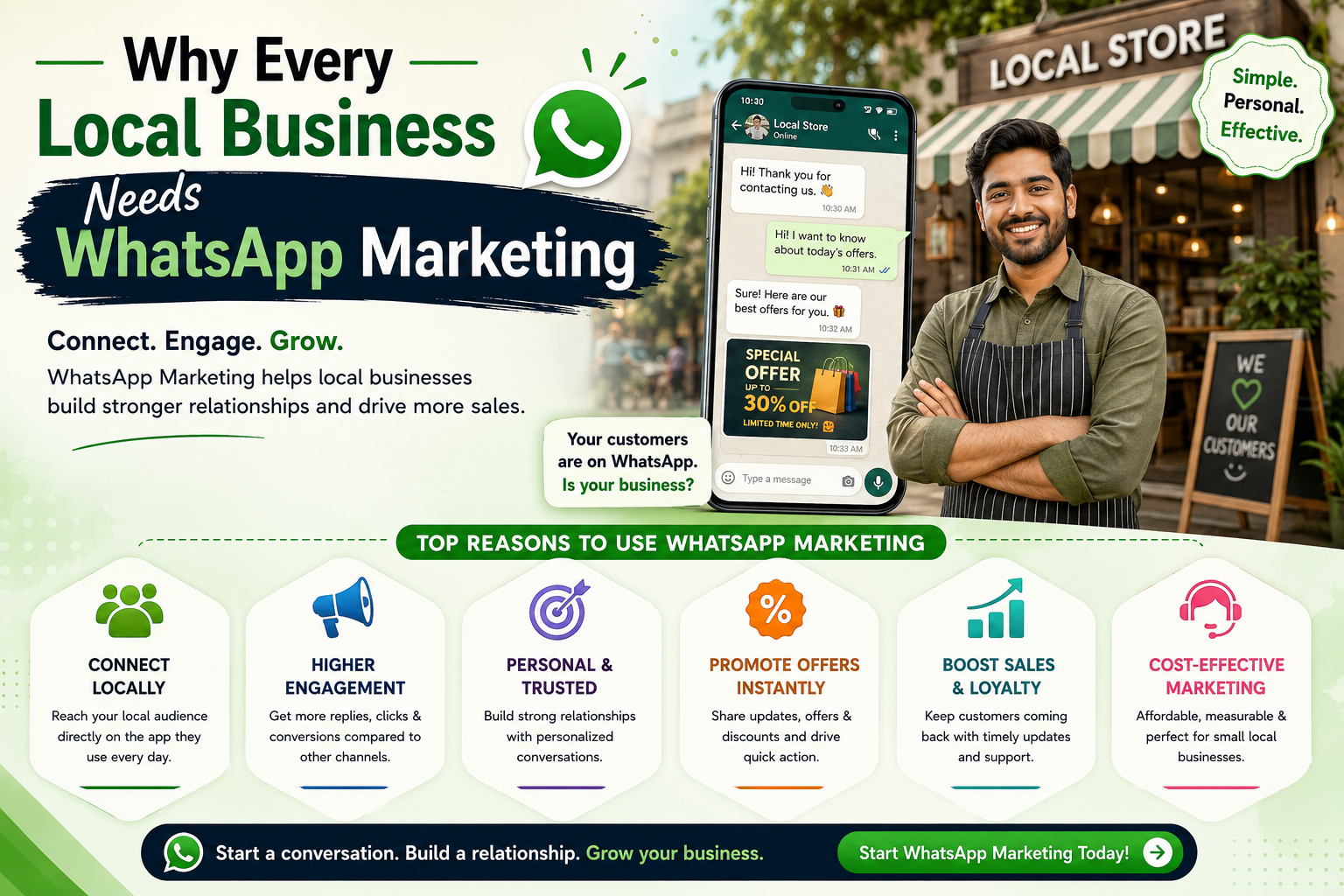
Why Every Local Business Needs WhatsApp Marketing
By a digital marketing consultant with 10+ years of experience helping local businesses across Gujarat and India build WhatsApp marketing systems that generate measurable revenue.
Rekha ben has been selling sarees from the same shop in Vastrapur, Ahmedabad for fourteen years. Silk, cotton, Bandhani, Patola — she knows the fabric, and she knows her customers even better. She remembers whose daughter is getting married this season, which family fasts during which Navratri days, who prefers heavier zari work and who wants something lighter for daily wear.
For most of those fourteen years, her marketing strategy was the oldest one in business: a customer buys a saree, loves it, tells three friends. Those three friends visit, buy something, tell three more. It worked. It was also slow, and entirely dependent on customers remembering to mention her at the right moment.
Three years ago, her daughter — back from college, mildly exasperated that her mother was still running a shop on word of mouth alone in 2023 — set up a WhatsApp Business account and built a broadcast list from 200 of Rekha ben's most loyal customers. On the first morning of Navratri, she sent one message: a few photos of a new chaniya choli collection that had just arrived, the traditional colours her regulars always asked for, the price, and a note that stock was limited.
By noon, forty people had replied. By the time the shop closed that evening, twenty-three of those conversations had turned into confirmed orders.
No advertising spend. No change to the product. Just the right message, reaching the right people, in the place they already check forty times a day.
This article documents exactly why that works — grounded in platform data, published research, and real outcomes from businesses across Gujarat — and gives you a practical, step-by-step path to building the same kind of system for your own business.
The Scale of What We Are Actually Talking About
Before strategy, the numbers that make this channel impossible to dismiss.
WhatsApp is not simply popular in India — it is the country's default channel for digital communication. As of 2024, India has over 500 million WhatsApp users, the largest user base of any country on earth, according to Meta's own published platform statistics. Internal usage data from Meta shows that the average Indian user opens the app 25 to 30 times a day. This is not a platform people check occasionally between other things. It is the place people live digitally for most of their waking hours.
To put that in perspective against channels most small businesses already use: the average email marketing campaign in India achieves an open rate of around 20 to 25%, according to Mailchimp's industry benchmark data. A WhatsApp Business message sent to a customer who has willingly joined your list typically achieves 85 to 95% open rates — a figure confirmed across multiple independent studies including research published by MessageBird and Twilio on global messaging engagement benchmarks.
Channel
Average open rate
Cost per send
Personal feel
20–25%
Low
Low
SMS
35–45%
Medium
Medium
Facebook/Instagram
2–5% organic reach
Low–High
Low
WhatsApp Business
85–95%
Very low
High
What the research confirms: A 2023 study by Sinch (a global communications platform provider) analysing messaging engagement across multiple markets found that WhatsApp consistently outperforms SMS and email on response time as well as open rate — the median response time to a WhatsApp business message is under 90 minutes, compared to several hours for email. For a local business needing quick customer decisions — confirming a delivery slot, finalising an order before stock runs out — this speed difference has direct revenue consequences.
Whether you run a sweet shop in Rajkot, a CA firm in Gandhinagar, or a tiffin service in Surat, your customers are not a hypothetical audience you need to find. They are already on WhatsApp, already opening it dozens of times a day, already comfortable receiving a message there from a business they trust. The only open question is whether your business is one of the ones actually showing up.
Why WhatsApp Changes How Customers Engage With You
Here is the fundamental thing that separates WhatsApp from every other marketing channel available to a small business: it is the same app your customer uses to talk to the people they actually care about.
When a message lands in someone's WhatsApp, their brain does not process it the way it processes a marketing email or an Instagram notification. It arrives in the same space as messages from their mother, their best friend, their child's school WhatsApp group. That context alone creates a level of attention that no other channel can manufacture through clever copywriting or design.
Expert insight: Robert Cialdini's research on persuasion and influence — widely cited across consumer psychology — identifies "liking" and "social context" as among the most powerful drivers of trust in any communication. A message that arrives in a context already associated with trusted personal relationships inherits some of that trust before the recipient has even read the content. This is a structural advantage that WhatsApp has over advertising-based channels, where the platform context itself signals "this is paid promotion" before any message is read.
The personal touch that turns buyers into regulars
Rekha ben's sarees sell well not only because the fabric is good — they sell because every customer feels remembered, not marketed to.
After that first Navratri broadcast, one reply came back almost immediately: "Rekha ben, I have been looking for exactly this colour. Can you hold one for me?" That exchange — instant, personal, happening in the exact app the customer already had open — required no form, no email thread, no waiting. Just a message and a reply, the same way she would talk to a neighbour.
This pattern of interaction is what builds genuine loyalty rather than one-time purchases. HubSpot's State of Marketing Report found that businesses engaging customers through personalised channels retain an average of 89% of those customers, compared with just 33% for businesses relying on impersonal, bulk communication — a gap of more than 50 percentage points that compounds significantly over a customer's lifetime value.
For local businesses across Gujarat that have always operated on relationship — where the shopkeeper genuinely knows the customer's name, their preferences, the dates that matter to their family — WhatsApp is not introducing a new way of doing business. It is simply giving the relationship that already existed a digital extension that scales without losing its warmth.
Practical implementation: When messaging customers, use their name and reference something specific to their history with your business where possible — a previous purchase, a preference they mentioned, an occasion you know is coming up. This is the single easiest way to make a broadcast message feel like a personal one, even when it is sent to 200 people simultaneously.
A conversation, not a broadcast — even when it technically is one
Every other marketing channel available to a small business is fundamentally one-directional. An Instagram post earns likes and the occasional comment. An email might, rarely, get a reply. A roadside banner is seen, not responded to.
WhatsApp is genuinely two-way. A customer who receives your message can reply immediately, ask about availability, request a customisation, confirm a delivery slot, or forward the message to someone else who might want it. That two-way structure produces real, measurable advantages:
- Faster purchase decisions — a customer with a quick question gets a quick answer instead of dropping off the page and never returning
- Higher conversion — businesses that reply promptly on WhatsApp report conversion rates 3 to 5 times higher than those relying solely on email or social media, according to data published by Facebook for Business on small business messaging outcomes
- Natural upselling — a customer asking about one saree often opens the door to a conversation about matching blouse pieces or jewellery, the kind of suggestion that feels helpful rather than pushy because it is happening inside a real conversation
- Early warning on problems — an unhappy customer almost always says so on WhatsApp first, which gives you the chance to fix it quietly before it becomes a public review
Practical implementation tip: Set a personal response-time target of under one hour during business hours. Meta's research on small business messaging consistently shows that response speed is one of the strongest predictors of whether a WhatsApp enquiry converts into a sale — customers who wait more than a few hours for a reply frequently move on to a competitor who responded faster, even if your product or price was better.
Building Broadcast Campaigns That Actually Convert
A broadcast list inside WhatsApp Business holds up to 256 contacts, and here is the structural detail that makes the whole thing work: every recipient receives your message as an individual, private message — not as a group chat. They cannot see who else is on the list. They cannot see anyone else's replies. As far as each customer is concerned, you sent the message to them, specifically.
That is exactly how Rekha ben's 200 customers experienced her Navratri message. No group header. No other names visible. A message from Rekha, to them.
Quality beats size every time
The single biggest mistake business owners make with broadcast lists is chasing size over relevance. A tightly built list of 100 people who genuinely care about your business will consistently outperform a sprawling list of 500 names half of whom barely remember giving you their number.
Trust-building note on consent: WhatsApp's Business Policy requires that contacts have opted in to receive messages from your business — either by messaging you first, providing their number directly for this purpose, or through an explicit opt-in mechanism. Sending unsolicited broadcasts to numbers you have not received clear permission to message violates WhatsApp's terms of service and risks your business account being restricted or banned entirely. Building your list correctly from day one is not just good practice — it protects your access to the channel itself.
Building a list worth having comes down to a few habits:
Ask at the point of purchase, while the experience is still positive. "Can I add you to our WhatsApp updates? We send new stock and offers occasionally — not too often, just when something is genuinely relevant." Customers who have just had a good experience say yes far more often than not.
Mine your existing contacts — with care. Most shop owners already have hundreds of customer numbers saved on their phone from years of orders and deliveries. Going through that list deliberately and building a broadcast group from people who have actually transacted with you (and would reasonably expect to hear from you again) is appropriate. Numbers collected for unrelated reasons should not be added without asking first.
Add an opt-in to your website or Instagram bio. A simple "Join our WhatsApp list" with a click-to-chat link turns passive visitors into an ongoing source of new additions.
Capture sign-ups at events. A printed QR code at a trade exhibition, a wedding exhibition stall, or a local fair lets people join your list on the spot, while they are standing in front of your product.
Practical implementation: Generate your WhatsApp click-to-chat link using wa.me/[your number] with an optional pre-filled message parameter (?text=Hi, I'd like to join your updates list). This is free, requires no technical setup, and can be added to any platform — your Instagram bio, your website footer, a printed flyer — in under five minutes.
Sending the right thing at the right pace
The businesses that get WhatsApp marketing wrong tend to make one of two mistakes: they message too often, turning a trusted channel into noise, or every message reads like an advertisement rather than something worth reading.
A sensible sending rhythm looks like: two to four messages a month for most retail and product businesses, only when genuinely relevant for service businesses tied to specific moments (before Diwali, before a new academic term, ahead of GST filing deadlines), and weekly — but kept short — for subscription or regular delivery businesses where customers expect frequent contact.
Expert insight: Marketing researcher Seth Godin's concept of "permission marketing" — the idea that the most effective marketing earns explicit, ongoing permission to communicate rather than interrupting people who have not asked for contact — applies directly to WhatsApp broadcast strategy. Godin's core argument, developed over two decades of marketing research, is that permission is an asset that must be protected through restraint: every irrelevant or excessive message spends down the trust that makes the channel valuable in the first place. For a small business, this means the discipline to send fewer, better messages consistently outperforms the temptation to message often simply because the channel is free.
What actually earns a reply:
New arrivals, photographed well and described briefly — "New Bandhani collection just arrived, twelve designs, limited pieces" with three to five photos attached and minimal text around them.
Time-bound offers — "20% off all cotton sarees this weekend only, Saturday and Sunday." Specificity and urgency together outperform either alone.
Genuinely useful reminders — for a CA firm, something like "Reminder: last date for GST annual return filing is December 31" does more for long-term trust than any promotional message, because it positions the business as helpful first.
Festival greetings with a natural product tie-in — "Wishing all our customers a joyful Diwali! Gift sets available from ₹500 to ₹2,000, delivery in 2 days, message us to order." The warmth comes first. The offer follows naturally rather than feeling forced.
Milestone recognition — "Thank you for being with us for five years, Varshaben. As a small token of appreciation, we've reserved something special for your next visit." This costs nothing and is remembered for a long time.
What ₹0 in marketing spend bought a Surat textile retailer in 48 hours
A textile retailer in Surat I worked with was preparing for the Diwali season with a broadcast list of 380 customers, all of whom had shopped with them in the previous eighteen months.
Ten days before Diwali, they sent a single message: photos of five new festive fabric designs, the price per metre, and a note offering 15% off for the first 48 hours only.
Within those two days, 67 people had replied with order enquiries. 51 of those conversations converted into confirmed orders. Total revenue for the weekend: ₹80,000. Total marketing spend: ₹0.
That is the kind of result that makes business owners stop questioning whether WhatsApp marketing is "real" marketing.
Practical implementation: Replicate this approach by building urgency around a real constraint, not a manufactured one. The Surat retailer's offer worked because the discount window (48 hours) and the product availability (new festive designs) were both genuinely limited. Customers can usually tell the difference between authentic scarcity and an artificial "sale ending soon" that repeats every week — and the former converts dramatically better because it is believable.
Automation: Being Available Without Being Awake
One of the most genuinely useful features in WhatsApp Business — and one of the most consistently underused — is its automation. Most business owners I talk to know it exists. Very few have actually set it up.
Greeting messages fire automatically the first time someone messages your business. Instead of a new customer waiting hours for a reply, they receive something immediate: "Namaste! Welcome to Rekha Sarees. Thank you for reaching out — we're open Monday to Saturday, 10 AM to 8 PM. Let us know what you're looking for and we'll respond shortly." That gap between a customer's first message and any acknowledgment is exactly where impatient customers move on to a competitor.
Away messages cover the hours your shop is closed. "Thank you for your message! We're currently closed but will reply as soon as we open at 10 AM tomorrow. For urgent enquiries, call [number]." A customer messaging at midnight or on a Sunday morning still gets something professional in response rather than silence that makes them wonder if the business even exists anymore.
Quick replies are saved responses triggered by a single keystroke shortcut. Type /hours and your full business hours text fills in instantly. Type /price and your standard price list appears. Type /location and your address with a maps link is ready to send. For a business fielding the same ten questions every single day, this turns a five-minute typing task into a two-second tap.
Practical implementation: Set up your greeting and away messages first — they take under ten minutes combined and immediately close the gap where most customer drop-off happens. Then build quick replies incrementally: every time you notice yourself typing the same answer twice in a week, save it as a quick reply that evening.
When growth calls for the WhatsApp Business API
Businesses with larger contact lists or more complex needs eventually outgrow the free app and move to the WhatsApp Business API, accessed through an authorised business solution provider. This unlocks automated order confirmations sent the moment a purchase is made, delivery status updates triggered directly by a logistics system, payment reminders sent ahead of due dates, post-purchase feedback requests timed 48 hours after delivery, and abandoned cart recovery for e-commerce operations.
A diagnostic centre in Ahmedabad I worked with implemented exactly this kind of automation for appointment reminders. Before automation, their no-show rate for booked appointments sat at 22% — nearly one in four patients simply not turning up. After setting up two automated WhatsApp reminders, one 24 hours before the appointment and one 2 hours before, that figure dropped to 7%. Across their patient volume, the recovered revenue from that single change — with zero additional staff time required — was substantial.
Expert insight: Healthcare operations research consistently identifies appointment reminder timing as a critical variable — a single reminder reduces no-shows modestly, but two reminders at different intervals (one giving advance notice, one as a final prompt) perform significantly better because they address two different failure modes: forgetting entirely, and forgetting on the day despite remembering earlier. This is why the diagnostic centre's two-reminder structure outperformed a single-reminder approach that many businesses default to.
A Realistic Starting Sequence
None of this requires a large budget or technical expertise to begin. Here is the sequence I recommend to almost every local business client.
Week one — build the foundation. Download WhatsApp Business (not the personal app) and complete every field of your business profile: name, description, address, website, hours, a professional display photo. Set up your greeting message, your away message, and five to ten quick replies covering your most common questions. Build your product or service catalogue inside the app.
Week two — build your list. Create broadcast lists from existing customer contacts already saved on your phone — only those who have genuinely transacted with you or expressed interest. Add a click-to-chat link to your website, your Instagram bio, and your email signature. Print a QR code for the billing counter that lets walk-in customers join your updates list on the spot. Start asking new customers directly, every time, at the point of purchase.
Week three onward — start communicating, properly. Send your first broadcast — something genuinely useful, not a generic sales pitch. Pay attention to who replies and have real conversations with them rather than copy-paste responses. Build the discipline of sending one well-crafted message every week or fortnight rather than whatever comes to mind whenever you remember. Track which messages generate the most replies and orders, and do more of exactly that.
Ongoing — measure and refine. Keep a simple log: date sent, message type, number of replies, number of orders. After eight to ten broadcasts, patterns become obvious — which content type, which day of the week, and which time of day consistently perform best for your specific audience. Use that data, not guesswork, to shape your ongoing calendar.
Conclusion: Your Customers Are Already There
Rekha ben's saree shop now generates 30 to 40% of its monthly revenue through WhatsApp — orders placed directly through conversation, customers who saw a broadcast and called within the hour, referrals from people who simply forwarded her message to a friend who needed exactly that saree for exactly that occasion.
She has not changed how she runs her business. She has not hired a marketing team. She sends two or three well-timed messages a month, and she answers every single enquiry herself, the way she always has.
That is the genuine promise of WhatsApp marketing for a local business in India. It is not a complicated strategy requiring new skills or significant investment. It is the natural digital extension of the relationships you have already spent years building, delivered through the one channel your customers are already checking dozens of times a day, at a cost that rounds to zero.
Your customers — along with the other 500 million Indians on WhatsApp — are already there, already checking the app, already willing to hear from a business they trust. The only thing missing is your business actually showing up where they will see it.
5 — FAQ section (schema-ready)
Why is WhatsApp marketing effective for local businesses in India?
WhatsApp marketing is effective because India has over 500 million WhatsApp users who open the app 25 to 30 times a day on average. WhatsApp Business messages achieve open rates of 85 to 95%, compared to 20 to 25% for email. For local businesses, this means reaching customers in a channel they already trust and check constantly, at a cost that is close to zero.
How do I start WhatsApp marketing for my business?
Start by downloading WhatsApp Business (not the personal app) and completing your business profile with your name, hours, address, and a professional photo. Set up a greeting message and an away message. Then build a broadcast list from your existing customers who have given permission to be contacted, and send your first message — something genuinely useful like a new arrival or a relevant offer rather than a generic promotion.
What is a WhatsApp broadcast list and how does it work?
A WhatsApp broadcast list lets you send one message to up to 256 contacts at once, with each person receiving it as a private, individual message rather than a group message. Recipients cannot see who else received the message or any other replies. This makes broadcasts feel personal even when sent to a large list, which is a key reason WhatsApp marketing achieves such high engagement compared to other channels.
How often should I send WhatsApp marketing messages to customers?
For most retail and product businesses, two to four messages per month is a sensible rhythm. Service businesses should send messages only when genuinely relevant, such as before a festival or a filing deadline. Subscription or regular delivery businesses can message weekly if kept short. Sending too often is the most common mistake — it turns a trusted personal channel into noise and risks customers leaving your list.
Is WhatsApp marketing free for small businesses?
The WhatsApp Business app is free to download and use, including broadcast lists, automated greeting and away messages, quick replies, and a product catalogue. There is no cost to send messages through the free app within WhatsApp's usage policies. Larger businesses with advanced automation needs may eventually use the WhatsApp Business API through a paid solution provider, but most local businesses can run an effective WhatsApp marketing strategy entirely on the free app.
Can I message any customer on WhatsApp for marketing purposes?
No. WhatsApp's Business Policy requires that contacts have opted in to receive messages from your business, either by messaging you first or by giving explicit permission to be added to your list. Sending unsolicited marketing messages to numbers without consent violates WhatsApp's terms of service and can result in your business account being restricted or banned. Always build your broadcast list from customers who have clearly agreed to hear from you.
Ready to Build a WhatsApp Marketing System That Works?
Setting up WhatsApp Business and sending the occasional message is something any business owner can do alone over a weekend. Building a genuinely systematic approach — a properly segmented broadcast list, a content calendar that does not run dry after the first month, automation workflows configured correctly, and a real process for turning replies into confirmed orders — is where Help Me Buddy IT Pvt Ltd makes the difference.
We have helped local businesses across Gujarat — saree shops, tiffin services, CA firms, textile traders, home-based food businesses — build WhatsApp marketing systems that generate consistent, measurable revenue rather than the occasional lucky message.
📱 Book a free WhatsApp marketing consultation. We will review what you currently have in place, identify the fastest opportunities specific to your business, and give you a clear plan — no commitment required.
Visit helpmebuddy.in or send us a message on WhatsApp.
Because your customers are already waiting to hear from you. You just have to send the message.
Comments
Share your thoughts about this post.