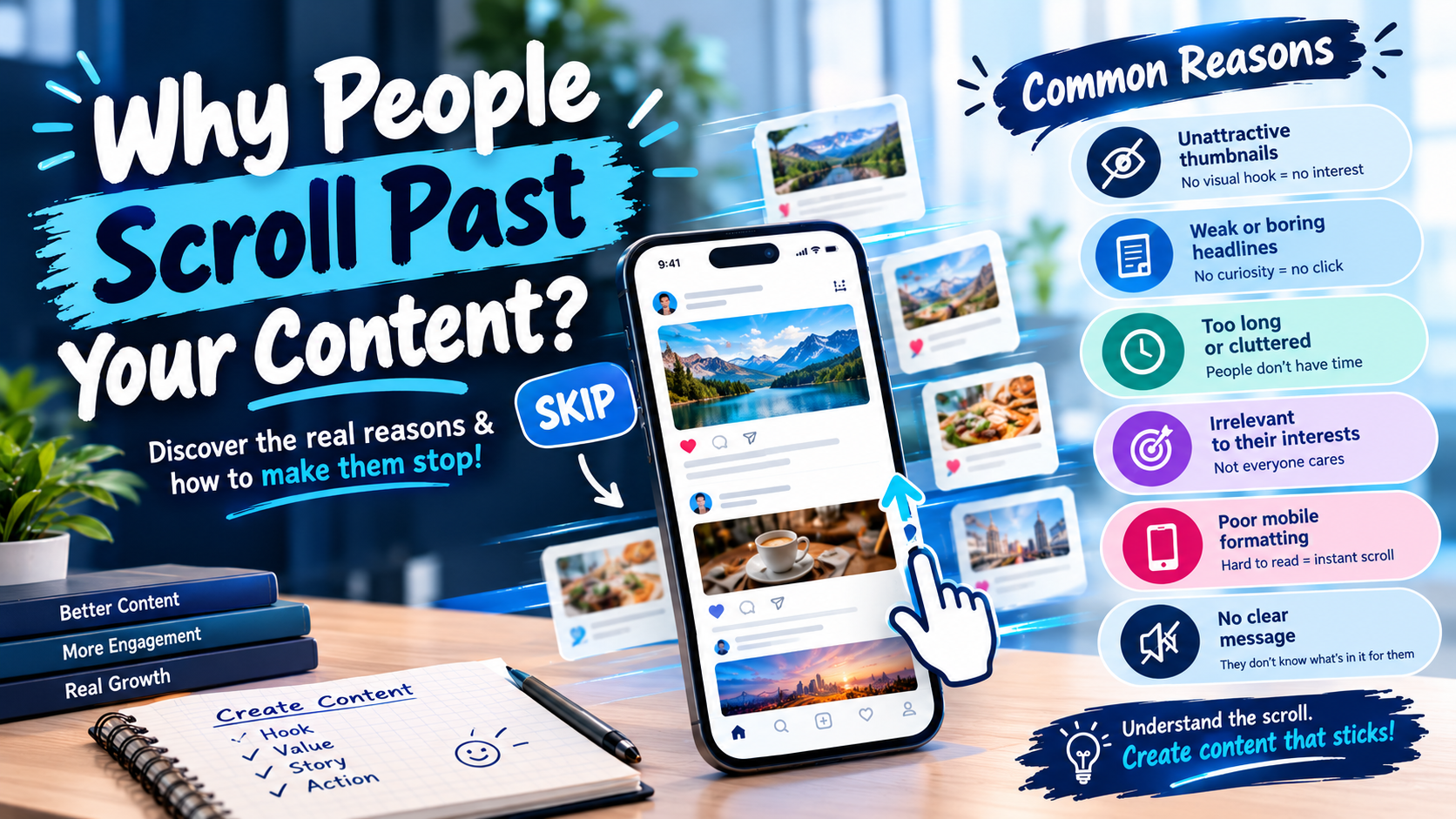
Why People Scroll Past Your Content (And How to Stop It)
By a social media strategy consultant with 10+ years of experience helping small and medium businesses across Gujarat and India build audiences that convert.
The Thumb That Never Stopped
Nisha Parmar had posted on Instagram every single day for eight months. Her small shop in Adajan, Surat, sold hand-embroidered kurtis, the kind that take a karigar three days to finish. Her photos were taken at night under the shop tube-light, and each caption began the same way: “Namaste friends, we are pleased to announce our new collection of beautiful and comfortable kurtis, available in all sizes, at reasonable prices, with free alterations…” and then ran for another twelve lines.
The result? 1,900 followers, about 40 likes per post, and two enquiries a month, both from cousins.
The turning point came at a family dinner. Her 19-year-old niece, Riya, was scrolling on the sofa, and Nisha leaned over to show her the latest post. She watched Riya’s thumb flick past it in under a second. “That was my post,” Nisha said. Riya looked up, genuinely sorry. “Masi, I didn’t even see it.”
That sentence stung, and it also taught her something. Her content wasn’t bad. It was invisible. Nisha wasn’t losing the argument for her kurtis; she was losing the first second.
The next week she filmed eight seconds of a karigar’s hands stitching a mirror-work border, and opened the caption with one line: “This border took 3 days. Your garba night deserves it.” That reel reached over 30,000 people and brought 27 WhatsApp enquiries in a week. Same shop, same kurtis, same tube-light. Different first second.
Note: Names and business examples in this article are illustrative composites drawn from common patterns, not endorsements or case studies of specific companies.
The Shift That Is Already Underway
Nisha’s problem isn’t personal. It’s structural. Every one of us now lives in a feed designed to be scrolled, not read, and our behaviour has adapted.
• Attention is shrinking on screen. Gloria Mark, a professor of informatics at the University of California, Irvine, has tracked attention on screens for over two decades. Her research found that the average time people spend on a single screen before switching fell from about 2.5 minutes in 2004 to roughly 75 seconds, and in recent years to around 47 seconds.
• The feed is crowded. According to DataReportal’s Digital 2024 report, India has over 460 million social media user identities. Your post isn’t competing with your local rival; it is competing with cricket clips, wedding reels, memes and every brand in the country.
• Trust and authenticity decide who wins. Edelman’s Trust Barometer special report on brands found that 81% of consumers say they must be able to trust a brand before buying from it. Sprout Social’s consumer research similarly reports that roughly 70% of people feel more connected to brands whose leaders are visible on social media. People want to see real humans, not brochures.
You may also have heard the popular claim that the human attention span is now “8 seconds, shorter than a goldfish.” That figure comes from a widely circulated 2015 Microsoft Canada report and has been challenged by researchers, so treat it as a memorable illustration rather than settled science. The real lesson is simpler: people decide within moments whether something deserves their attention, and most content fails that test.
Let’s diagnose where you’re losing them, starting with the most common culprit.
Friction Point 1: The Weak Hook
A hook is the first line of your caption, the first frame of your video, or the headline text on your image. It has one job: to earn the next three seconds. Most business posts open with greetings (“Hello friends”), announcements (“We are proud to launch…”) or the business name. None of these give a stranger a reason to stay.
What the expert says
Gary Vaynerchuk, the entrepreneur and chairman of VaynerX, has built his entire content philosophy on one idea: attention is the most valuable currency in modern marketing, and you must earn it on the terms of each platform rather than interrupt people the way old advertising did. In his framework, content that ignores how people actually consume a platform is simply wasted effort.
Why this matters
On Instagram, YouTube Shorts and Facebook, the algorithm watches what viewers do in the opening seconds. If they swipe away, the platform reads it as a signal that your content isn’t interesting and shows it to fewer people. A weak hook therefore costs you twice: you lose the viewer, and you lose the reach you would have gotten next.
A Gujarat example
Rushabh Mehta, an interior designer in Satellite, Ahmedabad, used to open every post with “Welcome to our latest project.” Engagement was flat. He rewrote the opener for a Bopal flat to: “This 2BHK looks 40% bigger. Same carpet area. Here’s the trick.” The post attracted saves and shares from people planning their own renovations, and he began receiving enquiries from homeowners he had never met.
Practical Implementation
• Write five hook options for every post and pick the one that creates the strongest curiosity or promises the clearest benefit.
• Lead with a result, a question or a surprising detail, not with a greeting or your brand name.
• Keep the hook under 12 words so it is fully visible before the “…more” cut-off.
• In videos, show the most interesting visual in the first frame, then explain. Never begin with a logo animation.
• Track which hooks earn the highest 3-second view rate or reach and reuse those patterns.
Friction Point 2: Too Much Information and Visual Fatigue
The second reason people scroll past is the opposite of the first. You hooked them, but the post asks too much. Twelve product specs, four offers, three phone numbers and a paragraph of terms. Or every post looks so identical, in the same template and the same colours, that the eye stops registering it at all. This is visual fatigue: when everything looks the same, nothing stands out.
What the expert says
Donald Miller, author of Building a StoryBrand, sums up the risk in a line his readers know well: “If you confuse, you’ll lose.” His core argument is that customers will not work to decode your message. If they must think hard to understand what you offer, they will simply move on.
Why this matters
Every extra element on a post adds cognitive load, the mental effort needed to process it. On a phone screen, viewed for a second or two, that budget is tiny. A post with one idea, one image and one action is understood instantly. A post with ten ideas is understood by nobody. Visual sameness works the same way: familiarity breeds blindness, and your audience’s eyes learn to skip your template.
A Gujarat example
A tile exporter in Morbi was sharing 12-slide carousels packed with technical specifications, all on the same grey template. Saves were low and slide 5 was where most viewers dropped off. The team switched to a five-slide format: one bold slide showing the finished bathroom floor, one on the problem it solves, one on price range, one customer photo, and one WhatsApp call to action, with specs moved to a downloadable catalogue. Enquiries from architects and dealers rose noticeably within two months.
Practical Implementation
• One post, one idea, one action. If you need to say three things, make three posts.
• Limit text on an image to roughly 7 to 10 words, in a font large enough to read without zooming on a phone.
• Keep your brand colours and logo consistent, but vary layouts, crops, photo styles and formats (reel, carousel, single image, story).
• Use real photos and short videos from your shop, factory or site rather than stock imagery or heavily filtered graphics.
• Move detailed information to a WhatsApp catalogue, website or Google Drive link and use the post only to spark interest.
Friction Point 3: Content That Isn’t Relatable (and How to Create Scroll-Stopping Posts)
Even a sharp hook and clean design fail if the viewer feels the post is not about them. Generic slogans like “Quality you can trust” could belong to any business, and so they belong to none.
What the expert says
Seth Godin, marketing author and former dot-com executive, returns again and again to a simple idea: “People like us do things like this.” People buy and follow based on identity and belonging. When your content reflects their lives, festivals, worries and humour, they see themselves in it and pause.
Why this matters
Relatability is the fastest route to trust, and trust is what converts. Gujarat offers a rich vocabulary of shared moments: Uttarayan rooftops, Navratri prep, the Sunday farsan run, the wedding-season chaos, the eternal “thodu adjust kari lo.” Businesses that speak this language don’t look like advertisers. They look like neighbours.
A Gujarat example
Sneha Joshi, a home baker in Vadodara, stopped posting studio-perfect cake photos with captions like “Order now.” Instead she posted a short video of a half-decorated Uttarayan-themed cake with her mother arguing about the kite colours in the background, captioned: “Every Gujarati house has one person who thinks the manja is more important than the cake.” The post was shared widely among local groups, and her orders for the season sold out early.
A simple scroll-stopping formula
Combine the three fixes into one repeatable structure: Hook (a result, question or surprise), Value (one useful or entertaining idea), Proof (a real face, product or customer), and Ask (one clear next step, such as “WhatsApp us ‘KURTI’”).
Practical Implementation
• List ten moments your customers live through, such as festivals, seasons, budget worries and family habits, and build posts around them.
• Show faces: yours, your team’s, your karigars’ and your customers’. People stop for people.
• Write in the language your customers actually speak. Mixing Gujarati, Hindi and English is fine if it sounds natural.
• Use real customer questions from WhatsApp and DMs as post topics.
• End every post with exactly one call to action, not four.
The Psychology of Being Seen Again and Again
Here is the uncomfortable truth: even a great post rarely converts on the first view. The reason lies in the mere exposure effect, identified by psychologist Robert Zajonc in 1968. His research showed that people tend to develop a preference for things simply because they have seen them repeatedly. Familiarity feels like safety, and safety feels like trust.
For your business, this means consistency beats brilliance. A follower who sees your karigar’s hands, your Sunday bake or your project reveal a dozen times over three months will feel they “know” you long before they message you. Marketers often quote a “rule of seven” (the idea that people need about seven exposures before buying); it is more folklore than science, but the principle behind it is sound.
A realistic plan for a small business is three to four quality posts a week for at least 90 days, using a consistent look, a consistent voice and a small set of recurring themes. Avoid the classic trap of posting daily for two weeks, going silent for a month, and concluding that “social media doesn’t work for us.”
The Business Case: Attention Is Only the Beginning
Scroll-stopping content isn’t about vanity metrics. It is the cheapest way to start relationships, and relationships are where profit lives. Research by Frederick Reichheld of Bain & Company, published in Harvard Business Review, found that increasing customer retention by just 5% can increase profits by 25% to 95%. Separately, Harvard Business Review has reported that acquiring a new customer can cost anywhere from five to 25 times more than retaining an existing one.
Consider a Surat boutique with 500 repeat customers. If better, more relatable content keeps just 25 more of them buying each season, that is a 5% retention improvement, without spending a rupee on new advertising. Content that people actually stop for reminds past customers you exist, gives happy buyers something to share, and builds the trust that makes referrals, the lifeblood of Gujarat’s business culture, come naturally.
FAQ Section (schema-ready)
Q1. Why do people scroll past my social media posts?
Most posts fail in the first second because of a weak hook, too much information, repetitive visuals, or content that doesn’t feel relevant to the viewer. Gloria Mark’s research at UC Irvine shows the average time spent on one screen has dropped to around 47 seconds. In a feed that fast, a post that isn’t instantly clear or interesting is skipped.
Q2. What is a hook in social media content?
A hook is the first line of a caption, the opening frame of a video, or the headline text on an image. Its purpose is to earn the next few seconds of attention. Strong hooks lead with a result, a question or a surprise. Weak ones open with greetings or announcements, which give strangers no reason to stay.
Q3. How much text should I put on a social media image?
Aim for roughly 7 to 10 words on a single image, in a font readable on a phone without zooming. India has over 460 million social media user identities (DataReportal, 2024), and most view content on small screens. Move detailed specs or terms to a catalogue, website or WhatsApp link.
Q4. How often should a small business post to see results?
Three to four quality posts per week for at least 90 days is a realistic starting plan. The mere exposure effect, described by psychologist Robert Zajonc in 1968, shows that people grow to prefer what they see repeatedly. Consistency builds familiarity, and familiarity builds the trust that converts into enquiries.
Q5. Does relatable content really improve business results?
Yes. Edelman’s brand trust research found that 81% of consumers must trust a brand before buying, and relatable, human content builds that trust faster than generic promotion. Sprout Social’s research also indicates that around 70% of consumers feel more connected to brands whose leaders are visible on social media.
Q6. Is social media worth it for retention and profit, not just followers?
Yes. Bain & Company’s Frederick Reichheld found that a 5% increase in customer retention can lift profits by 25% to 95%. Engaging content keeps past customers reminded and loyal, and it costs far less than acquiring new customers, which Harvard Business Review reports can cost five to 25 times more.
Back to Nisha’s Sofa
Months after that dinner, Riya scrolled past Nisha’s profile again. This time her thumb stopped. She watched the whole reel, sent it to two friends, and asked, “Masi, can you make me one for Navratri?”
Nothing about Nisha’s kurtis had changed. What changed was that she stopped treating the feed like a notice board and started treating it like a conversation with a stranger who had one second to give her. She fixed her hook, cut the clutter, varied her visuals, showed the real people behind the work, and kept showing up.
Your audience isn’t ignoring you because they don’t care. They are ignoring you because you haven’t yet given them a reason not to. Pick one post this week, rewrite its first line, and see what happens to the thumb.
Ready to stop the scroll and start the conversations?
Help Me Buddy IT Pvt Ltd helps small and medium businesses across Gujarat and India build content strategies that get noticed and convert.
Contact: helpmebuddy.in
Comments
Share your thoughts about this post.