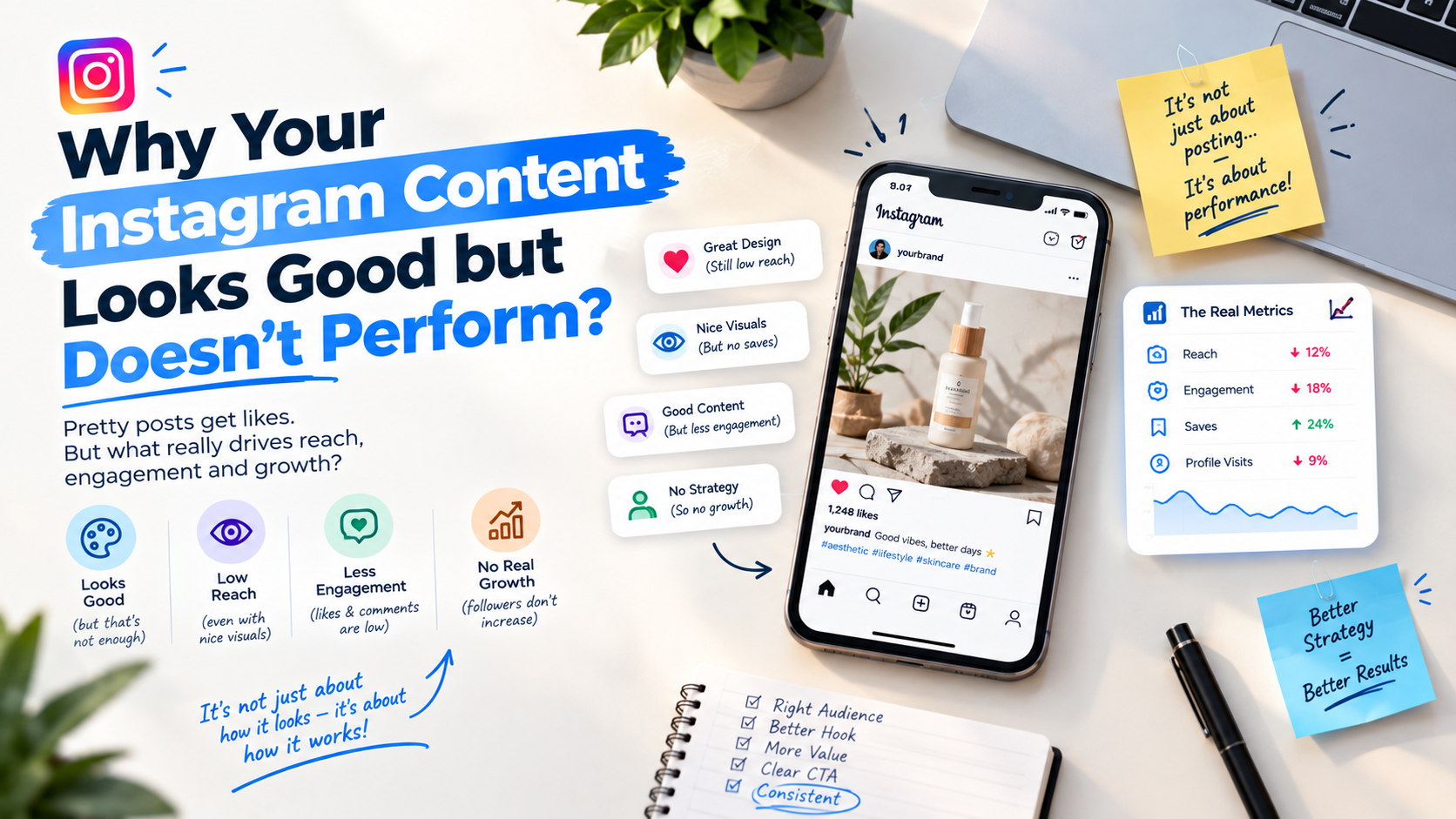
Why Your Instagram Content Looks Good but Doesn’t Perform
By a social media strategy consultant with 10+ years of experience helping small and medium businesses across Gujarat and India build audiences that convert.
The Feed That Looked Perfect but Stayed Quiet
Meera Shah ran a boutique home-décor studio out of a converted garage in Rajkot. Her Instagram grid looked like it belonged to a lifestyle magazine — muted pastel walls, perfectly styled cushions, soft morning light. She hired a photographer, spent hours in Lightroom, and posted three times a week without fail. Her follower count crept up. Her likes looked healthy. And yet, month after month, her DMs stayed empty and her showroom footfall didn't move. She once told me, half-joking and half-defeated, “My feed looks like a Pinterest board nobody can actually buy from.”
The turning point came not from a new camera or a better filter, but from a single afternoon spent rewriting her captions and rebuilding three reels around one question per post: what does the viewer do next? Within six weeks, Meera wasn't posting prettier pictures — she was posting the same beautiful pictures with a spine of strategy underneath them. Enquiries on WhatsApp tripled. That shift — from decoration to direction — is what this article is about.
The Shift That Is Already Underway
Meera's story isn't unusual. It reflects a broader change in how content actually earns attention and trust online, one that most small business owners in India haven't caught up to yet.
Sprout Social's research on social media trends has repeatedly found that a majority of consumers say they buy from brands they feel “connected” to, and that connection is built through content that feels relevant and useful — not simply attractive. Beautiful visuals get a scroll-stopping half-second; relevant, well-messaged content earns the next ten seconds, and it's those ten seconds where trust and intent are built.
The Edelman Trust Barometer has tracked, year over year, that trust in a brand is driven as much by what a brand says and how consistently it says it as by what it sells. Edelman's research consistently shows trust is earned through competence and ethical behaviour communicated clearly — vague, purely decorative content does little to build either.
Meta's own business research has pointed businesses toward “value-first” content — creative that leads with a clear benefit or story rather than a product shot — as a stronger driver of the actions that matter to a business: saves, shares, messages, and site visits, not just likes. And Bain & Company's work on customer loyalty has long argued that businesses which communicate consistently and specifically about the value they provide see meaningfully stronger repeat-purchase behaviour than those relying on general brand awareness alone.
Put together, these sources are converging on the same idea: aesthetics might get you noticed, but strategy is what gets you chosen. In a feed as crowded as Instagram's has become in India — where even a mid-sized city like Rajkot, Surat, or Vadodara now has dozens of visually competent local businesses — visual polish is no longer a differentiator. It's table stakes.
Design vs. Strategy: Two Different Jobs
Expert insight: Marketing professor and branding thinker Mark Ritson has argued for years that most businesses confuse “marketing” with “the bit you can see” — the logo, the colours, the photography — while neglecting the actual strategic questions: who exactly are we targeting, what do we want them to believe, and what do we want them to do. Ritson's core point is that execution without strategy is just expensive decoration.
Why this matters: A design-first approach optimises for how a single post looks in isolation. A strategy-first approach optimises for what a stranger believes about your business after seeing five to seven of your posts over a few weeks. These are different goals, and they require different decisions — about who you're talking to, what problem you solve, and what you want them to feel before they ever see your product.
Indian business example: A wedding-catering business in Vadodara had a genuinely striking Instagram feed — dramatic plating shots, gold-toned reels, professional videography. But every caption was some version of “Best caterers in Vadodara! Book now!” There was no sense of who the food was for, or why a bride's mother should trust them with her daughter's big day. Once they rebuilt their messaging around real client stories — a Gujarati-Marwari fusion menu for an inter-community wedding, a note about handling last-minute guest-count changes — enquiries moved from “what's your rate” to “we saw your Gujarati thali story, can we do something similar.”
Content Relevance and Weak Messaging: Saying Something People Actually Care About
Expert insight: Marketing strategist and author Ann Handley's central idea in content marketing is that “quality content” isn't about production value — it's about being useful, clear, and human enough that the reader feels it was made specifically for them. Her phrase “write for one person” captures it: content built for “everyone” tends to genuinely connect with no one.
Why this matters: Weak messaging usually isn't a writing problem — it's a targeting problem. When a caption tries to appeal to every possible customer at once (“For all your needs!”), it ends up meaning nothing to any one of them. Relevance is what turns a passive scroll into an active pause. Without it, even gorgeous visuals get scrolled past because the viewer never feels the post was made with them in mind.
Indian business example: A skincare brand based in Ahmedabad was posting well-shot product flatlays with captions like “Glow from within” and “Skincare that works.” Generic, on-trend, and interchangeable with a hundred other skincare accounts. When they shifted to addressing specific, local concerns — hard water damage common in Ahmedabad's water supply, make-up routines suited to Gujarat's heat and humidity, skin concerns from daily two-wheeler commutes — their saves and shares increased sharply, because the content finally sounded like it was written by someone who understood the actual reader.
Wrong Format and Missing CTA: The Two Most Common Silent Killers
Expert insight: Social media platform research, including Sprout Social's platform reports, consistently shows short-form video — Reels, in Instagram's case — is prioritised by the algorithm's distribution system in a way static posts are not, and that posts without a clear next step convert at a fraction of the rate of posts that explicitly tell the viewer what to do. As marketing consultant and author Neil Patel puts it in his conversion-focused work: “A confused customer never buys, and a customer who wasn't asked never acts.”
Why this matters: Two very common, very fixable failures sit right next to great visuals. First, format mismatch: a business posts a static carousel when the story genuinely needed motion and sound (a process, a transformation, a “how we make it” moment), or buries a simple, powerful before/after in a slow, over-produced reel when a single strong photo would have travelled further. Second, and even more common: gorgeous content that simply never asks for anything. No “DM us,” no “link in bio,” no “tag someone who needs this.” The viewer is entertained, impressed, and then left to figure out what to do next entirely on their own — and most people, quite reasonably, do nothing.
Indian business example: A handmade jewellery seller in Surat had beautifully lit product photography for a new silver jewellery line but posted it exclusively as single static images, no reels, no process content. Engagement was flat despite genuinely strong craftsmanship. Switching just 30% of their content to short reels — showing the actual hand-finishing process — and adding a simple, consistent CTA (“WhatsApp us your pin code for same-day Surat delivery”) produced a visible jump in both reach and direct enquiries within a month, without changing the products or the photography style at all.
Strategy Before Aesthetics: Why Consistency Beats a Single Great Post
There's a well-documented psychological principle at work here called the mere-exposure effect — first studied extensively by psychologist Robert Zajonc — which shows that people develop a preference for things simply through repeated, familiar exposure to them, independent of any single instance being exceptional. This is precisely why one stunning viral post rarely builds a business, while a steady, strategically consistent presence does.
Every time Meera in Rajkot, the skincare brand in Ahmedabad, or the jewellery seller in Surat showed up with the same clear message, the same visual identity, and the same specific CTA, they weren't just being “consistent” for its own sake — they were compounding familiarity into trust. A potential customer who sees a relevant, well-messaged post once might scroll past. The same customer seeing a similar quality of message five or six times over a month starts to feel like they already know the brand before they've ever spoken to it. That familiarity is what makes the eventual DM, call, or store visit feel low-risk rather than like a cold approach.
This is also why chasing single “viral” moments is often a strategic dead end for small businesses. Virality brings a spike of unqualified attention; consistency brings a slow build of qualified trust. For a business that needs actual customers walking into a Vadodara showroom or messaging a Surat WhatsApp number, trust compounding beats attention spiking almost every time.
The Business Case: What Strategic Content Actually Returns
This isn't just a branding nicety — it shows up directly in retention and revenue. Bain & Company's widely cited research on customer loyalty found that increasing customer retention rates by just 5% can increase profits by 25% to 95%, depending on the industry, because retained customers cost less to serve, buy more often, and refer others. Content strategy plays directly into this: a business whose Instagram consistently communicates real value and a clear next step is, in effect, running a low-cost retention and referral engine every single day, not just an awareness campaign.
For a small or mid-sized business in Gujarat working with a modest monthly marketing budget, this matters enormously. Good design might buy attention, but strategic, relevant, consistent messaging is what turns that attention into the kind of repeat customer and referral behaviour that actually protects margins — without requiring a bigger ad spend every month to keep the pipeline full.
Back to Meera
Six months after that one afternoon of rewriting captions, Meera's Rajkot studio looks almost the same on the surface — same soft light, same pastel walls, same careful styling. What changed is invisible in any single screenshot but obvious in her business results: every post now has a person in mind, a specific point to make, and a clear next step. Her feed didn't get less beautiful. It got a spine. That's the shift every business owner reading this needs to make — not abandoning good design, but finally putting strategy underneath it.
FAQ Section (Schema-Ready)
Q1: Why does my Instagram get likes but no sales?
Likes measure visual appeal, not purchase intent. Sprout Social's research shows consumers act on content that feels relevant and trustworthy, not just attractive. Without clear messaging and a call-to-action, even high-engagement posts rarely convert into enquiries or sales.
Q2: What's the difference between design and strategy on Instagram?
Design is how a single post looks — colours, photography, layout. Strategy is what you want a viewer to believe and do after seeing several posts over time. Businesses that only invest in design often see flat enquiries despite a polished feed.
Q3: How often should a small business post to see real results?
Consistency matters more than frequency. The mere-exposure effect shows repeated, familiar exposure builds trust over time. Most businesses see momentum after 4-6 weeks of consistent, relevant posting rather than sporadic bursts of activity.
Q4: Should I use Reels or static posts for my business?
Match format to your message: Reels suit process, transformation, and story content, while carousels work well for education and static images work for a single strong statement. Sprout Social and Meta's business research both point to Reels typically getting prioritised in distribution.
Q5: Why is a call-to-action so important on Instagram posts?
Without a specific next step, most viewers simply move on. Posts with a clear, low-friction CTA — like “WhatsApp us” or “DM for details” — consistently convert enquiries at a noticeably higher rate than posts that only showcase a product or service.
Q6: How does better content strategy affect business profit?
Bain & Company's research found that a 5% increase in customer retention can increase profits by 25-95%. Strategic, consistent content builds the kind of trust and familiarity that drives repeat customers and referrals, directly supporting retention.
Ready to Fix Your Instagram Strategy, Not Just Your Feed?
If your content already looks good but isn't turning into enquiries, sales, or walk-ins, the fix usually isn't a better camera — it's a strategy layer most businesses skip. Help Me Buddy IT Pvt Ltd works with small and medium businesses across Gujarat and India to build Instagram content that's designed to convert, not just impress.
Get in touch: helpmebuddy.in
Comments
Share your thoughts about this post.